Twin-Tube Shock Absorbers: How to Choose the Right Variant and Diagnose Failure

Twin-tube shocks are not a downgrade from monotube. They are a deliberately engineered design, and for most passenger cars and light trucks they are the correct choice. The real decision is not twin-tube vs monotube — it is which twin-tube variant: gas-charged or non-gas-charged, and with what valving profile for the vehicle and use case. Getting that decision right requires understanding how the two concentric tubes, the base valve, and the gas charge actually work together.
Inside a Twin-Tube Shock: The Components That Determine Performance
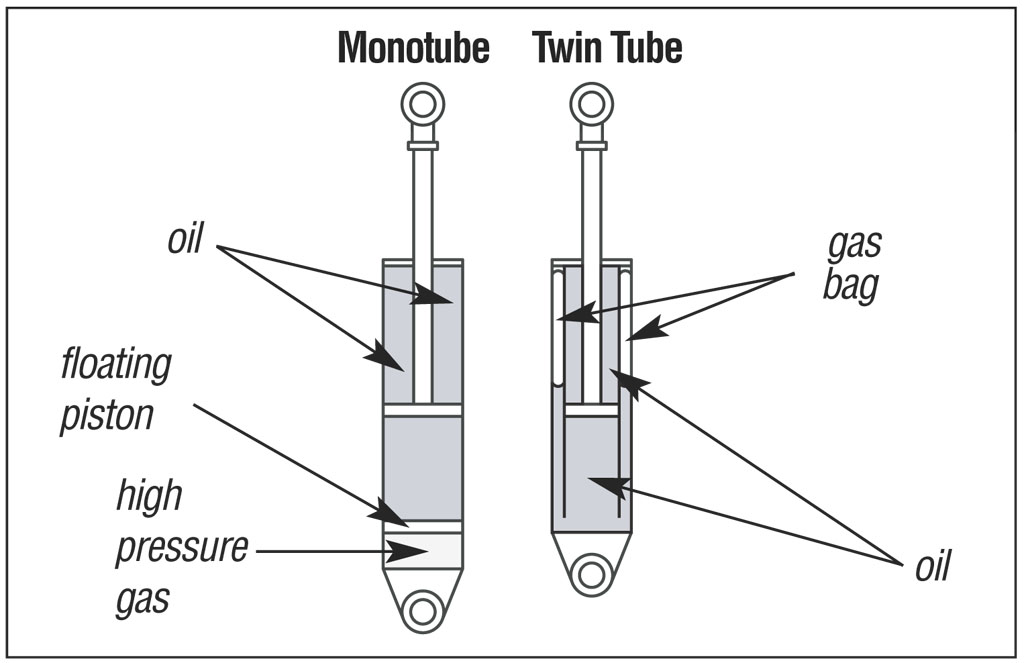
A twin-tube shock uses two concentric steel tubes to separate the damping piston from the fluid reservoir. The inner working tube (pressure tube) houses the piston and hydraulic fluid. The outer reserve tube stores fluid displaced by the piston rod and, in gas-charged units, holds a low-pressure nitrogen charge.
Cutaway callouts — what each component does:
- Inner working tube (pressure tube): Contains the piston and hydraulic fluid. This is the primary damping chamber.
- Outer reserve tube: Stores fluid displaced by the piston rod and, in gas-charged units, the gas charge. It also acts as the outer heat-exchange surface.
- Piston (with rebound valving on the upper face, compression valving on the lower face): Controls fluid flow through the piston during both strokes. The valving stack on each face sets the damping curve.
- Compression valving (piston lower face): Meters fluid during compression, contributing to low-speed and high-speed compression force.
- Rebound valving (piston upper face): Meters fluid during extension, controlling how quickly the suspension returns to ride height.
- Base valve (foot valve, at the bottom of the working tube): Regulates fluid exchange between the working tube and the reserve tube. It handles the bulk of displaced volume during compression and refills the working tube during rebound.
- Rod seal and guide (top of the working tube): Keep fluid in and contaminants out. Seal quality directly affects weepage behavior and service life.
- Gas charge (gas-charged units only): Occupies the space above the fluid in the reserve tube, separated from the working chamber by the base valve and fluid column. It pressurizes the fluid to suppress foaming and aeration.
Decision takeaway: When evaluating a twin-tube, the base valve, rod seal, and gas charge consistency are the quality differentiators. A cheaply built unit with loose tolerances will fade sooner and weep sooner than a well-built one, regardless of which vehicle it is bolted to.
Compression and Rebound: How Fluid Moves Through a Twin-Tube Shock
During compression, the piston moves down, forcing fluid through the piston's compression valving and through the base valve into the reserve tube. The base valve acts as a one-way restriction, generating damping force as fluid passes through it. Some fluid also flows through the piston's compression bleed, but the base valve handles the bulk of the displaced volume. This two-path flow gives twin-tube shocks their characteristic damping curve.
During rebound, the piston moves up, and fluid flows back through the piston's rebound valving. Simultaneously, the base valve allows fluid to return from the reserve tube to the working tube, refilling the space vacated by the rising piston. The rebound valving controls the rate of fluid flow, which determines how quickly the suspension extends.
In gas-charged twin-tubes, the nitrogen charge pressurizes the fluid, raising its boiling point and reducing foaming and aeration that cause fade under repeated cycling. Non-gas-charged twin-tubes rely on atmospheric pressure and are more prone to aeration under severe use — prolonged rough-road driving or heavy towing. The gas charge does not change the fundamental flow paths; it stabilizes the fluid so damping force stays consistent as temperatures rise.
Decision takeaway: If the vehicle sees sustained hard use (towing, washboard roads, repeated cycling), the gas charge is what keeps the damping curve from collapsing. If it sees gentle daily driving, the non-gas-charged flow path is sufficient.
Twin-Tube vs Monotube: What Actually Differs, and When It Matters
Twin-tube shocks are generally less expensive to manufacture than monotube shocks, which is why they dominate OEM and budget replacement applications. The two-tube design uses simpler tooling and lower-cost materials, which translates to lower prices at the parts counter. For daily-driven passenger cars and light trucks, this cost advantage is significant without a meaningful performance penalty in normal use.
Heat dissipation is where monotube shocks typically excel. Their single-wall design exposes more surface area to airflow, and there is no reserve tube insulating the working chamber — so heat generated in the working chamber reaches the atmosphere more directly. Twin-tube shocks can dissipate heat adequately for many passenger and light-truck uses, but they may fade sooner under sustained high-demand conditions. For extreme off-road or track use, monotube shocks are often preferred for this reason.
Packaging favors twin-tube shocks in space-constrained suspensions. Their concentric tubes are often more compact radially, which can be an advantage when mounting space is tight. Monotube shocks require a separate gas reservoir or a floating piston, which can increase length and limit mounting options. Ride comfort is another twin-tube strength: their valving characteristics and lower gas pressures in non-gas-charged versions can provide a softer, more compliant ride.
Off-road durability depends on the specific design. Monotube shocks are often preferred for extreme off-road due to better heat management and resistance to fading, but well-valved twin-tube shocks can perform well in moderate off-road conditions.
Decision takeaway: Choose monotube when sustained high-heat conditions dominate (track, extreme off-road, heavy continuous load). Choose twin-tube when packaging, cost, and ride comfort dominate — which is the majority of passenger and light-truck applications.
Gas-Charged vs Non-Gas-Charged Twin-Tubes: How Charge Pressure Changes Ride and Handling
Gas-charged twin-tubes use nitrogen, often at low pressure, to pressurize the fluid, reducing aeration and fade and improving consistency during hard use. The gas charge occupies the space above the fluid in the reserve tube, maintaining positive pressure on the fluid column. This pressure suppresses foaming, which is the primary cause of fade in non-gas-charged units. For towing, hauling, or spirited driving, the improved consistency of a gas-charged twin-tube is a tangible benefit.
Non-gas-charged twin-tubes rely on atmospheric pressure and are more susceptible to foaming under repeated cycling, but can provide a softer ride. Without a gas charge, the fluid is free to aerate when the shock works hard, leading to a loss of damping force. For gentle daily driving, the softer ride and lower cost of a non-gas-charged twin-tube can be the right trade-off.
Higher gas charge pressures can increase firmness and responsiveness but may reduce ride comfort; lower pressures favor comfort. A low-pressure gas charge (typically 20–50 psi) is a common compromise, offering some anti-foaming benefit without a harsh ride. High-pressure charges are less common in twin-tube designs because the tubes are not designed for extreme internal pressure, but they can be found in some performance-oriented units.
Practical note on charge pressure: On most sealed twin-tubes, charge pressure is not user-serviceable. You cannot verify it with a gauge the way you would check tire pressure. Loss of charge is inferred from behavior — fade after hard use, softness, or a shock that no longer controls the suspension — not measured directly. If those symptoms appear without visible oil loss, the gas charge is the likely cause, and replacement is the fix.
Decision takeaway: Passenger cars often benefit from non-gas or low-pressure gas for comfort. Towing and performance applications favor gas-charged for fade resistance. Match the charge to the duty cycle, not to a spec-sheet number.
Weepage or Leak? A Decision Rule for Twin-Tube Shock Diagnosis
Normal weepage appears as a light film or misting of oil around the rod seal, often attracting dust, but does not drip. This is a normal condition caused by the rod seal allowing a microscopic amount of fluid to pass to lubricate the rod. It is not a failure and does not require replacement. A true leak shows as dripping oil, visible streaks running down the shock body, or oil accumulation on the ground.
Decision rule:
- Film or misting that does not form a drip after a few hundred miles of driving = monitor. Clean the shock body, drive, and re-inspect. If the film remains light and dry, it is weepage. No replacement needed.
- Any drip, wet streak running down the body, or oil accumulation on the ground = replace. This is a true leak and a safety concern.
This threshold is general industry practice, not a validated mileage spec — the pass/fail criterion is the presence or absence of a drip, not a specific odometer reading.
Check for other symptoms: excessive bouncing, poor handling, uneven tire wear, or noise over bumps. A shock that is weeping but still controls the suspension may have many miles left. A shock that is leaking and causing handling degradation is a safety concern. Replacement is typically warranted if the shock is leaking significantly, has lost gas charge (if applicable), or if the vehicle exhibits handling degradation. Mileage is a factor: many shocks are due for replacement after 50,000 miles, but this varies by driving conditions and shock quality.
Decision takeaway: Diagnose by behavior, not by appearance alone. A weeping shock that still controls the vehicle is a monitor item. A leaking shock that degrades handling is a replace item.
Valving and Tuning: Matching Twin-Tube Shocks to Passenger, Towing, and Off-Road Use
Valving is the single biggest differentiator between two twin-tube shocks that look identical on the outside. The balance between compression and rebound valving is tuned for specific vehicle dynamics, and the wrong valving will underperform regardless of construction quality.
Passenger vehicles typically use softer valving for ride comfort, with moderate compression and rebound damping. The goal is to absorb bumps without transmitting harshness to the cabin. Valving is tuned to the vehicle's weight and spring rates, with a bias toward low-speed comfort and adequate high-speed control. For a daily driver, a twin-tube shock with comfort-oriented valving is often the best choice.
Towing and hauling require firmer compression valving to control load and reduce sag, while maintaining adequate rebound control. When a vehicle is loaded, the rear suspension compresses more, so the shock must generate more force to control the extra weight. Firmer compression valving helps prevent bottoming out, while rebound valving controls the return to ride height. A gas-charged twin-tube is often preferred for towing because it resists fade under the sustained load.
Off-road use may benefit from digressive valving for better control over rough terrain, but twin-tube shocks can be tuned for moderate off-road. Digressive valving provides high force at low speeds for control and lower force at high speeds for compliance over bumps. This is a common tuning for off-road shocks. Valving is application-specific and should be matched to vehicle weight, spring rates, and intended use; generic shocks may not be optimal. When selecting a twin-tube shock, ask for the valving profile and compare it to your vehicle's needs.
Decision takeaway: Ask for the valving profile before you buy. A shock with the wrong valving will not perform well, regardless of its construction.
Selection Matrix: Matching Twin-Tube Attributes to the Application
Use this matrix to narrow the choice. The attributes that change across applications are gas charge pressure range, compression/rebound valving bias, and expected service interval.
| Application | Gas charge | Compression/rebound valving bias | Expected service interval |
|---|---|---|---|
| Daily commuter (passenger car, light truck) | Non-gas or low-pressure gas (typically 20–50 psi) | Comfort-biased: softer low-speed compression, moderate rebound | Long; replace on handling degradation or visible leak, not on a fixed mileage |
| Half-ton towing / hauling | Gas-charged (low-pressure range) | Firmer compression to control load and reduce sag; adequate rebound to control return | Shorter under sustained load; inspect for fade and weepage more frequently |
| Lifted 4x4 / moderate off-road | Gas-charged | Digressive bias: high low-speed force for control, lower high-speed force for compliance | Shorter; heat cycling and terrain accelerate wear |
| Extreme off-road / track | Consider monotube | — | — |
Decision takeaway: The matrix is a starting filter, not a final answer. Confirm the valving profile and gas charge against the specific vehicle weight and spring rates before committing.
Making the Call: When a Twin-Tube Shock Is the Right Choice
Twin-tube shocks are often the right choice for daily-driven passenger cars and light trucks where comfort and cost are priorities. They offer a comfortable ride, adequate damping for normal use, and a lower price point than monotube alternatives. For these applications, the benefits of a monotube — better heat dissipation and fade resistance — are rarely needed. A well-valved twin-tube will deliver reliable performance for the life of the vehicle.
Gas-charged twin-tubes offer improved fade resistance for towing or spirited driving, while non-gas-charged can suffice for gentle use. If you regularly haul heavy loads or drive in hilly terrain, the gas charge helps maintain damping consistency. For a commuter car, a non-gas-charged twin-tube may provide a softer ride at a lower cost. For extreme off-road or high-performance applications, monotube shocks may be more appropriate, but well-valved twin-tubes can perform well in moderate conditions.
Always match the shock to the vehicle's intended use and consider valving and gas charge as key differentiators. A shock with the wrong valving will not perform well, regardless of its construction. When buying, look for a supplier that offers application-specific valving and can provide technical details. For suspension components beyond shocks, such as control arms and bushings, ensure they are compatible with your chosen shock setup. A complete suspension refresh, including automotive suspension components like control arms and bushings, can restore ride and handling.
Decision takeaway: Start with the application, then choose the gas charge, then confirm the valving. That order prevents the most common buying mistake — picking a shock on price or brand alone.
FAQ
Are twin-tube shocks worse than monotube?
No. They are a different design with different trade-offs. Twin-tubes generally win on cost, packaging, and ride comfort; monotubes typically win on heat dissipation and fade resistance under sustained high demand. For most passenger and light-truck applications, a well-valved twin-tube is the correct choice.
How do I know if my twin-tube shock is gas-charged?
Check the part specification from the supplier. Gas-charged units use a nitrogen charge in the reserve tube; non-gas-charged units rely on atmospheric pressure. The external appearance is often similar, so the spec sheet is the reliable source.
Can I recharge a gas-charged twin-tube shock?
On most sealed twin-tubes, no. Charge pressure is not user-serviceable. Loss of charge is inferred from fade or softness, not measured. If those symptoms appear without visible oil loss, replacement is the fix.
Is a weeping shock a failed shock?
Not necessarily. A light film or misting that does not form a drip is normal weepage and does not require replacement. Any drip, wet streak, or oil accumulation on the ground indicates a true leak and warrants replacement.
What valving should I choose for towing?
Firmer compression valving to control load and reduce sag, with adequate rebound control. A gas-charged twin-tube is often preferred for towing because it resists fade under sustained load. Confirm the valving profile against your vehicle's weight and spring rates.
---
Related