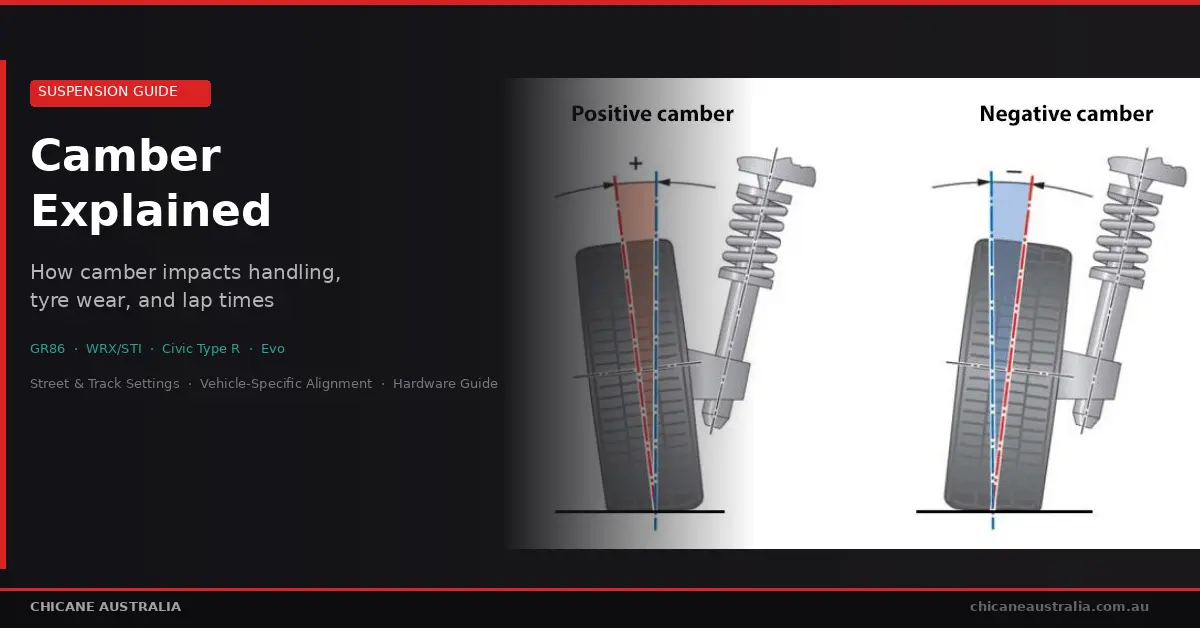
Camber Gain Tuning: How to Measure and Adjust for Maximum Grip

Camber gain is the rate at which camber angle changes per unit of vertical suspension travel. It determines how well your tire maintains full contact with the road during cornering, braking, and over bumps. Getting it right is essential for grip, tire wear, and predictable handling.
Why Camber Gain Matters More Than Static Camber
Static camber is the angle set at rest, but it’s the dynamic change—camber gain—that keeps the tire flat as the chassis rolls and the suspension compresses. If gain is too low, the outside tire rolls onto its outer edge, losing grip. If too high, the inside edge digs in, causing premature wear and unstable cornering. A well-tuned camber gain curve ensures the tire stays flat at the limit, improving both peak grip and consistency.
How Suspension Type Affects Camber Gain
MacPherson Strut
MacPherson struts typically produce negative camber gain (more negative in bump) because the strut’s top mount is fixed and the lower arm pivots. This can aid cornering but often leads to excessive inner edge wear on street cars. Adjustability is limited without aftermarket camber plates or adjustable lower arms.
Double Wishbone
Double wishbone suspensions offer greater control over camber gain. By relocating the upper and lower pickup points, engineers can design a curve that maintains near-constant camber through travel or even positive gain if needed. This is why most high-performance cars use double wishbones.
Multi-Link
Multi-link systems are similar to double wishbones but with more links, allowing finer tuning of the camber curve. However, added complexity means more potential for deflection under load, so bushing selection is critical.
How to Measure Camber Gain: Tools and Techniques
To measure camber gain, you need a digital camber gauge (accuracy ±0.1°) and a way to compress the suspension safely. Start by setting the car at static ride height on level ground, then measure camber. Next, use a suspension lift or ramp to compress the suspension in 1-inch increments, measuring camber at each step. Record the values and plot them against suspension travel to visualize the curve.
For more precise results, use a string or laser alignment system to measure camber at the wheel rim relative to the chassis, eliminating errors from tire sidewall flex. Measure both sides and repeat for droop (extension) by jacking the chassis.
A typical street car might show -0.5° camber at static, increasing to -2.0° at 2 inches of bump. A track car might start at -2.5° and gain to -4.0°. Plotting these points reveals the gain rate.
Adjusting Camber Gain: Methods and Components
Adjustable control arms are the most common way to alter camber gain. By lengthening or shortening the arm, you change the arc of the wheel’s travel, effectively modifying the camber curve. For MacPherson struts, adjustable camber plates at the top mount shift the strut’s pivot point, altering gain.
Roll center adjusters—such as taller ball joints or subframe spacers—change the roll center height, which indirectly affects camber gain by altering the lateral force transfer path. This can reduce body roll and the need for extreme camber gain.
For advanced users, relocating pickup points via custom brackets or fabricated mounts offers the ultimate control. However, any change to camber gain will also affect caster and toe, so a full alignment is mandatory after adjustments.
Camber Gain vs. Static Camber vs. Caster Gain: Understanding the Interplay
Static camber is the angle set at rest; camber gain is the change during suspension movement. Caster gain is the change in caster angle as the suspension compresses, which also influences camber in turns due to steering geometry. All three must be balanced.
For example, high static camber can compensate for low camber gain, but it hurts straight-line braking and tire wear. Conversely, high caster gain can add negative camber to the outside wheel during cornering, reducing the need for static camber. A holistic approach is essential: adjust static camber for straight-line stability, caster for steering feel, and camber gain for cornering grip.
Practical Tuning Tips: Setting Camber Gain for Street, Track, and Off-Road
Street
Prioritize tire wear and stability. Aim for a moderate camber gain of -0.5° to -1.0° per inch of bump. Avoid excessive negative gain that causes inner edge wear. Use compliance in bushings to absorb impacts.
Track
Maximize grip. Target -1.5° to -2.5° per inch, depending on tire compound and cornering loads. The goal is to keep the tire flat at peak lateral acceleration. Use stiffer bushings to minimize deflection and maintain geometry.
Off-Road
Minimal camber gain is desired to maintain tire contact over rough terrain. Aim for less than -0.5° per inch. Soft bushings allow articulation without inducing camber changes.
Camber Gain and Tire Wear: What You Need to Know
Excessive negative camber gain causes the inside edge of the tire to wear rapidly during cornering, especially on street tires. Insufficient gain leads to outside edge wear and reduced grip. By analyzing wear patterns, you can diagnose camber gain issues.
For example, if the outside shoulder is worn on the front tires, the camber gain is too low—the tire is rolling over. If the inside shoulder is worn, gain is too high. Regular tire inspections are essential for tuning.
Frequently Asked Questions
What is the ideal camber gain for a track car?
For track use, aim for -1.5° to -2.5° per inch of bump, but this varies with tire type and suspension design. Start with a baseline and adjust based on tire temperature and wear.
Can I adjust camber gain without replacing suspension parts?
Minor changes can be made via camber plates or eccentric bushings, but significant changes require adjustable arms or relocation brackets.
Does camber gain affect straight-line stability?
Yes, excessive camber gain can cause the car to pull under braking or over bumps. Balance is key.
Conclusion
Camber gain is a critical yet often overlooked aspect of suspension tuning. By understanding how it works, measuring it accurately, and adjusting it for your application, you can unlock more grip, better handling, and longer tire life. Whether you're a weekend warrior or a professional mechanic, mastering camber gain is a game-changer.