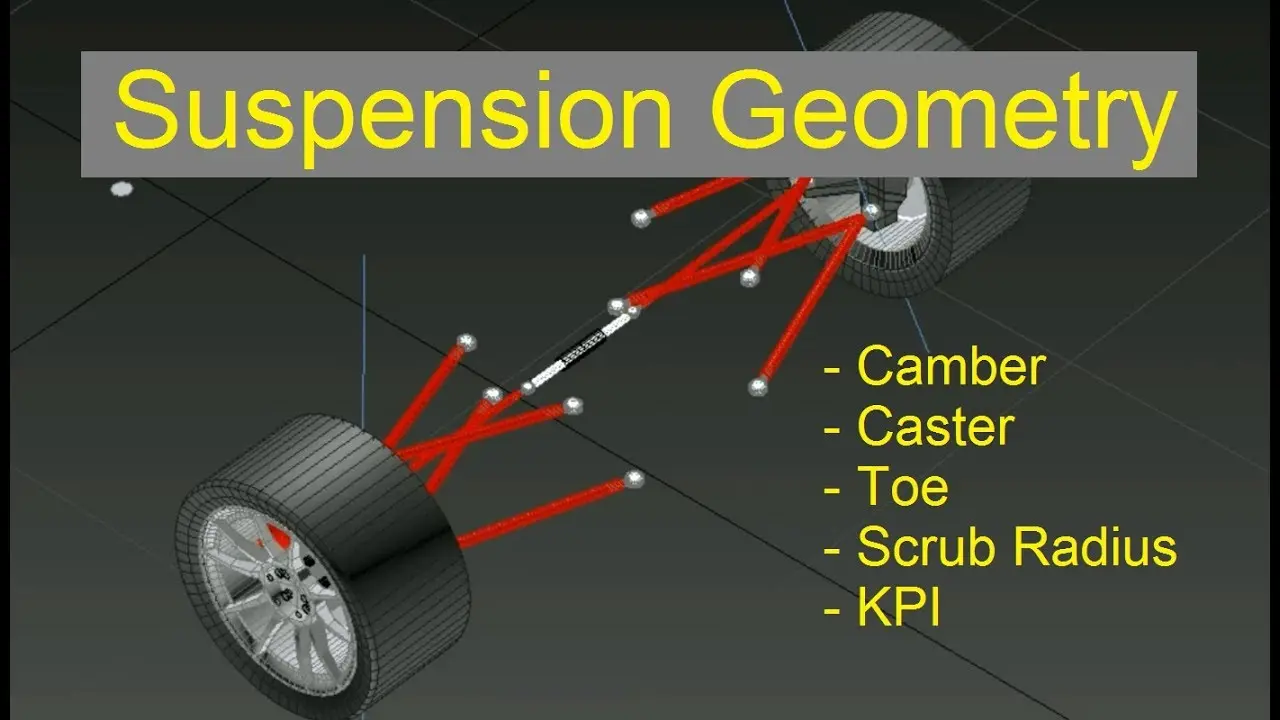
Suspension System Geometry and Handling: A Buyer's Guide to Smarter Upgrades

Suspension geometry determines how your tires contact the road under acceleration, braking, and cornering. Incorrect geometry causes premature tire wear, vague steering, and reduced grip. Understanding these principles lets you select components that match your driving style and avoid costly mistakes.
Camber, Caster, and Toe: The Three Angles That Define Handling
Camber: The Angle That Maximizes Grip
Camber is the vertical tilt of the wheel relative to the road. Negative camber (top of the tire leans inward) increases cornering grip by keeping the contact patch flat during body roll. However, excessive negative camber causes inner edge wear on straight roads. For street cars, a slight negative camber (-0.5° to -1.0°) balances grip and tire life. For track use, more negative camber (-2.0° to -3.0°) is common, but expect faster tire wear.
Caster: The Angle That Shapes Steering Feel
Caster is the angle of the steering axis when viewed from the side. Positive caster (steering axis tilts toward the driver) provides self-centering and straight-line stability. More caster increases steering effort but improves feedback. Most modern cars have 3° to 5° of positive caster. If you feel the steering is too light or lacks return, adding caster via adjustable arms can improve feel.
Toe: The Angle That Affects Stability and Tire Wear
Toe is the difference in distance between the front and rear of the tires. Toe-in (front of tires closer) improves straight-line stability but can cause feather-edge wear if excessive. Toe-out (front of tires farther apart) improves turn-in response but can make the car feel darty. Incorrect toe is the leading cause of rapid tire wear. Even 1/16 inch of total toe misalignment can scrub tires noticeably.
These angles interact. For example, adding negative camber may require slight toe adjustment to maintain straight-line stability. When selecting components like camber plates or adjustable arms, consider how they affect all three angles.
Roll Center and Body Roll: Why Your Car Leans and How Geometry Can Fix It
Roll center is the imaginary point around which the car's body rolls during cornering. It is determined by the suspension link geometry. The distance between the roll center and the center of gravity (CG) creates a lever arm that causes body roll. A higher roll center reduces body roll for a given lateral force, but it also increases jacking forces that can lift the inside wheel.
Anti-roll bars and springs work alongside roll center. Stiffer anti-roll bars resist body roll but can unload the inside tire. Lowering a car often lowers the roll center more than the CG, increasing the roll moment. This is why some lowered cars need roll center adjusters to restore proper geometry.
MacPherson Strut vs. Double Wishbone: Geometry Differences That Affect Your Choice
MacPherson Strut: Simple, Compact, Limited Camber Control
MacPherson struts are common on front axles of economy cars. They combine the shock absorber and spring into a single unit that acts as the upper suspension link. This design is compact and cheap, but it has limited camber control because the upper mount is fixed to the body. During body roll, the camber curve is less favorable, leading to reduced grip and uneven tire wear under hard cornering.
Double Wishbone: More Design Freedom, Better Camber Control
Double wishbone suspensions use two control arms (upper and lower) to locate the wheel. This allows engineers to design a camber curve that keeps the tire flat through suspension travel. As a result, double wishbone cars often have better grip and more consistent tire wear. The trade-off is higher cost and more complex packaging.
If you have a MacPherson strut car, you can improve camber control with camber plates or adjustable ball joints. If you have double wishbone, you have more options for adjusting geometry, such as adjustable control arms.
Anti-Squat and Anti-Dive: How Geometry Controls Pitch Under Acceleration and Braking
Anti-Squat: Resists Rear Squat During Acceleration
Anti-squat is a geometric effect that resists the rear of the car squatting under acceleration. It is determined by the angle of the rear suspension links. A higher anti-squat percentage reduces squat, which can improve traction by keeping the rear tires loaded. However, too much anti-squat can cause wheel hop or harshness. For street cars, a moderate anti-squat (50-80%) is typical. Lowering a car often changes anti-squat, sometimes increasing it, which can affect ride quality.
Anti-Dive: Resists Front Dive During Braking
Anti-dive works similarly for the front suspension during braking. It is determined by the angle of the front lower control arms. More anti-dive reduces front-end dive, which can improve stability under hard braking. However, too much anti-dive can cause a harsh ride and reduce braking grip. Most street cars have modest anti-dive to balance comfort and performance.
When modifying your suspension, be aware that changing ride height or link lengths alters these properties. For example, lowering springs may increase anti-squat, which can help launch but may make the ride uncomfortable.
How to Measure Suspension Geometry at Home: A Practical Guide
Measuring camber, caster, and toe at home is possible with basic tools. You'll need a camber gauge (or smartphone app), toe plates or string, and a level surface. Turn plates are optional but make the job easier.
Camber: Place the gauge against the wheel hub or rim. Ensure the car is on level ground. Read the angle. Compare to factory specs (usually found in the owner's manual or online).
Caster: Turn the wheels 20 degrees to the left and right, measuring camber at each position. The difference in camber readings, combined with the steering angle, gives caster. Some camber gauges have a caster mode.
Toe: Use toe plates or string stretched along the side of the car. Measure the distance between the front and rear of the front tires. The difference is the toe. Adjust tie rods to set toe to spec.
If your measurements are off, you can adjust camber and toe with aftermarket parts, but caster is often non-adjustable without special arms. For precise alignment, a professional shop with a laser alignment machine is recommended.
Choosing the Right Components: How Geometry Guides Your Suspension Upgrades
Before buying suspension parts, define your goals: street comfort, performance driving, or track use. Your choice of components should match the geometry changes you want.
- Camber plates: Allow you to adjust camber at the top of the strut. Useful for track days to add negative camber.
- Adjustable control arms: Let you fine-tune camber and caster. Essential for lowered cars to correct geometry.
- Roll center adjusters: Raise the roll center on lowered cars to reduce body roll and improve grip.
- Bushings: Stiffer bushings reduce compliance and maintain geometry under load. For example, our Large suspension bushing and Large suspension bushing are designed for Hyundai/KIA applications to keep alignment precise.
Consider trade-offs: stiffer bushings increase noise and vibration, while adjustable arms may require more maintenance. Always check compatibility with your vehicle.
Checklist for evaluating components:
- Does it allow the adjustment range you need?
- Will it affect other angles (e.g., camber vs. toe)?
- Is it made from durable materials?
- Does it require additional modifications?
By understanding geometry, you can make informed decisions that improve handling and tire life without guesswork.
FAQ
How does suspension geometry affect tire wear?
Incorrect geometry—especially toe and camber—causes uneven tire wear. Toe misalignment scrubs tires, while excessive negative camber wears inner edges. Proper geometry ensures even contact patch, maximizing tire life.
Can I adjust suspension geometry on my car?
Many cars allow camber and toe adjustment via factory or aftermarket parts. Caster is often fixed but can be adjusted with special arms. Always consult your vehicle's specifications and consider professional alignment.
What is the best suspension geometry for street driving?
For street use, aim for slight negative camber (-0.5° to -1.0°), moderate positive caster (3°-5°), and a slight toe-in (1/16" total) for stability. This balances grip, tire wear, and comfort.
How does lowering affect suspension geometry?
Lowering typically increases negative camber and may alter roll center and anti-squat/anti-dive. It can improve cornering but may cause uneven tire wear and harsh ride if not corrected with adjustable components.
Should I upgrade to adjustable control arms?
If you lower your car or need precise alignment, adjustable control arms allow you to correct camber and caster. They are essential for track use but may be overkill for street-only drivers.
What is the difference between camber plates and adjustable ball joints?
Camber plates are installed at the top of the strut to adjust camber, while adjustable ball joints replace the lower joint to alter camber. Both increase adjustment range, but compatibility varies by vehicle.
How often should I check my suspension geometry?
Check alignment annually or after any suspension modification, impact, or uneven tire wear. Regular checks prevent premature tire wear and maintain handling.
Can I measure caster without special tools?
Yes, you can estimate caster using a camber gauge and a protractor to measure steering angle. However, for accuracy, professional alignment is recommended.
What is roll center and why does it matter?
Roll center is the point around which the body rolls. It affects body roll and grip. Lowering can lower roll center, increasing roll; roll center adjusters can restore geometry.
How do I choose between MacPherson strut and double wishbone?
Double wishbone offers better camber control and grip but costs more. MacPherson strut is simpler and cheaper. For performance, double wishbone is preferred; for economy, MacPherson is fine.