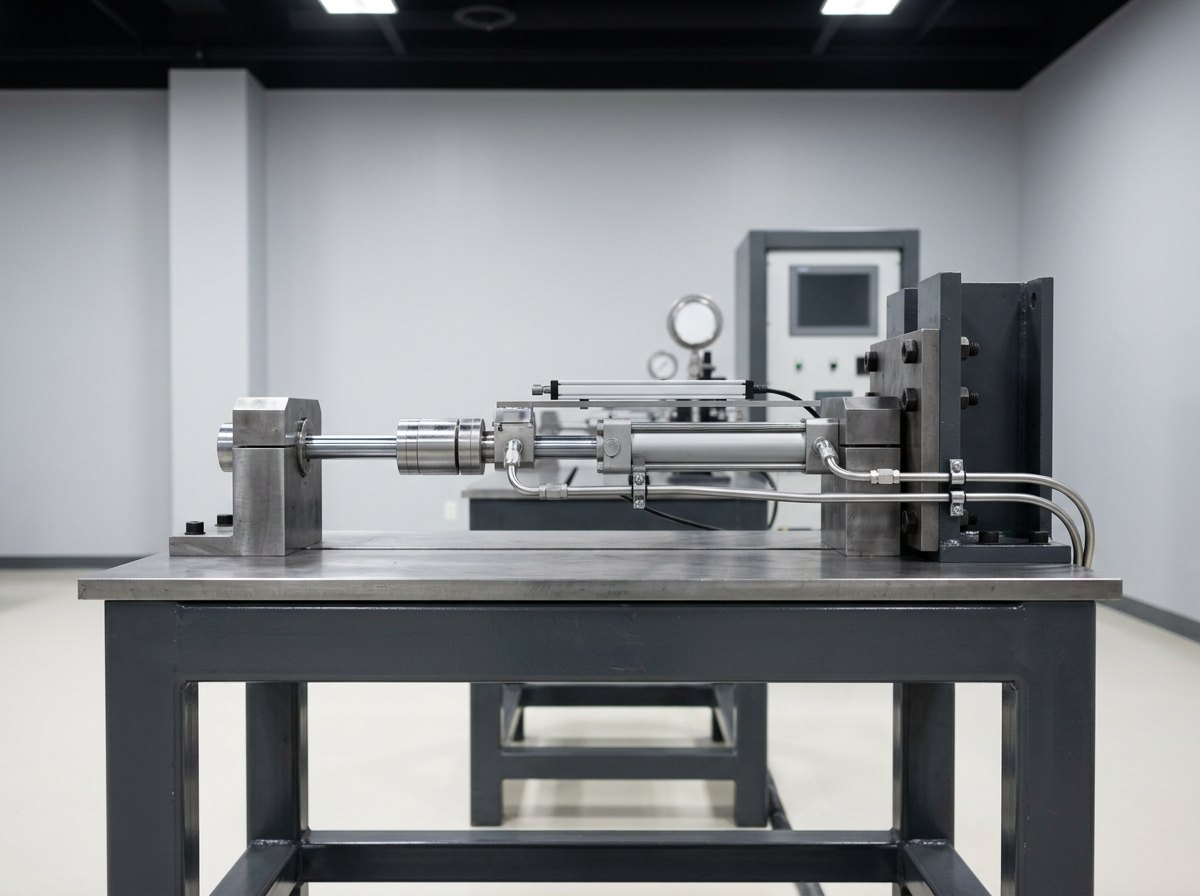
Suspension Testing vs. Validation: How to Read a Supplier's Claim Before You Buy

A supplier claiming a part is "tested" has told you almost nothing. Testing measures behavior under defined conditions; validation confirms a design meets a defined requirement. A part can be tested without being validated against anything relevant to your vehicle, your load profile, or your terrain.
The two words get used interchangeably in marketing. A supplier can truthfully say "tested" after a single bench measurement of a bushing's static stiffness. That measurement tells you how the rubber deflects under one load at one temperature. It does not tell you how the bushing survives 100,000 km of potholes, whether it fits the control arm without preload, or whether it holds alignment under braking. Those are validation questions, and they require a defined requirement — a target, a standard, or a customer specification — to answer.
The buyer's first question should never be "did you test it?" It should be "tested or validated, and against what requirement?" A supplier who can answer that has a validation story. A supplier who cannot is offering a slogan.
The Parameters That Matter: What Suspension Tests Actually Measure
Suspension test programs measure a handful of parameters, and each maps to a different real-world behavior. Load and force measurements show how a component behaves under static and dynamic stress — directly relevant to heavy loads, towing, and EV battery weight. Fatigue and cycle testing speaks to durability over time, not peak performance; a part can pass a peak-load test and still fail in service after repeated cycles. Displacement, travel, and rate measurements describe how the part moves, which affects ride quality, alignment retention, and tire wear.
No single parameter is a proxy for overall quality. A bushing with excellent fatigue life may have poor dynamic stiffness for a performance application. A control arm that passes a peak-load test may have a ball joint that wears out in 30,000 km.
Identify the one or two parameters that match your dominant use case and ask for those specifically:
- Daily-driver replacement: fatigue life and fitment consistency.
- Heavy-load or towing: load capacity and dynamic stiffness under sustained load.
- EV: added mass and different weight distribution shift what the test needs to demonstrate. A test program designed around a 1,500 kg ICE vehicle may not represent a 2,100 kg EV with a low-mounted battery pack.
Match the Test to the Use Case: Daily, Heavy Load, EV, Off-Road
A test that passes under daily-driver conditions says little about behavior under constant heavy load or repeated off-road articulation. The same test evidence must be read differently depending on the operating conditions that matter to you.
Daily road use
The dominant loads are moderate and repetitive — braking, cornering, potholes. Fatigue life and noise/vibration/harshness (NVH) characteristics are the key parameters. A bushing that passes a 100,000-cycle fatigue test at typical road loads is a reasonable candidate.
Heavy load and towing
The load profile changes. Sustained vertical and longitudinal loads are higher, and heat buildup in rubber components becomes a factor. A test that validates a bushing at 500 kg static load does not validate it at 900 kg. Ask what load the test represented, not just whether a test was run.
EV
EVs change the load profile in two ways: added mass and different weight distribution. A suspension component validated for an ICE vehicle of the same class may not be validated for the EV variant. The added mass increases both static and dynamic loads, and the lower center of gravity changes roll and pitch behavior. Ask whether the test program included an EV-specific load case.
Off-road
Off-road use stresses travel, articulation, and impact resistance in ways a road-focused test program may not cover. A control arm that passes a road-load fatigue test may not survive repeated full-articulation cycles or rock impacts. Look for evidence of travel and impact testing, not just road-load durability.
Simulation vs. Physical Testing: What Each Can and Cannot Prove
Simulation and physical testing are not interchangeable. Simulation can explore many design variants quickly and predict behavior under conditions that are hard to reproduce physically — extreme temperatures, high-speed impacts, or rare load cases. It depends on model assumptions: if the model is wrong about materials, loads, or boundary conditions, the result is wrong with confidence.
Physical testing captures real-world effects simulation may miss — manufacturing variation, material inconsistencies, and interaction effects between components. But it only captures those effects for the specific conditions and samples tested. A physical test of one bushing sample at one temperature does not validate the entire production run.
A credible validation story usually involves both. Simulation narrows the design space and predicts behavior; physical testing confirms the simulation and catches what the model missed. When a supplier presents only simulation results, ask what physical testing confirmed them. When a supplier presents only physical test results, ask what analysis guided the design.
The Three Questions: How to Evaluate a Supplier's Test Claims
You can evaluate any "tested" or "validated" claim with three questions.
1. What was tested — the component, a subassembly, or a full system? Results do not transfer between them. A bushing tested on a bench does not validate the control arm assembly. A control arm tested on a rig does not validate the full suspension system.
2. Under what conditions? Load, cycle count, temperature, terrain, and vehicle configuration all change what a result means. A fatigue test at 50,000 cycles is not the same as one at 500,000 cycles. A test at 20°C is not the same as one at -30°C or 80°C.
3. Against what requirement? A test with no defined pass criterion is a measurement, not a validation. The requirement might be an internal standard, an OEM specification, or a regulatory minimum. Without a requirement, there is nothing to validate against.
Suppliers who can answer all three questions are giving you something to compare. Those who cannot are giving you a slogan. Treat unanswered questions as a data point about the supplier, not necessarily a reason to walk away — but do not treat a partial answer as a full validation.
Where Regulation and Regional Compliance Fit — and Why They Differ
Compliance testing confirms a part meets a jurisdiction's minimum legal requirements. It is not the same as validating performance for a specific use case. A part can be compliant and still fail in service under loads or conditions the regulation does not cover.
Different markets define different requirements. A part compliant in one region may not have been evaluated against another's rules. For example, a suspension component that meets a European standard may not have been tested against the equivalent North American or Asian requirement. Buyers importing or specifying across regions should ask which market's requirements the part was evaluated against.
Compliance is a floor, not a ceiling. Passing it does not mean the part is validated for your load, terrain, or vehicle. A compliant bushing may still be the wrong choice for a heavy towing application or an off-road build. Use compliance as a starting point, not a finish line.
Putting It Together: A Buyer's Checklist for Suspension Test Evidence
Before you specify or purchase suspension components, run this checklist:
- Confirm whether the supplier is describing testing, validation, or compliance — and which one your decision actually needs.
- Identify the one or two test parameters most relevant to your dominant use case and ask for those specifically.
- Ask the three questions — what, under what conditions, against what requirement — and compare answers across suppliers.
- Treat unanswered questions as a data point about the supplier, not an automatic reason to walk away.
For buyers evaluating specific components, this framework applies directly to parts like rear trailing arm bushings (e.g., Large suspension bushing — 54584-2D000, Large suspension bushing — 54584-3S100) and control arms. The same logic applies: ask what was tested, under what conditions, and against what requirement. A supplier who can answer those questions for a specific part number is giving you evidence you can use. One who cannot is giving you marketing.
Use this checklist as a filter, not a guarantee. It will not tell you which part is best, but it will tell you which suppliers are worth a deeper conversation — and which are not.
FAQ
Is a "tested" suspension part automatically validated?
No. Testing measures behavior under defined conditions; validation confirms a design meets a defined requirement. A part can be tested without being validated against anything relevant to your vehicle, load profile, or terrain.
What is the single most useful question to ask a suspension supplier?
"Tested or validated, and against what requirement?" A supplier who can answer that has a validation story. A supplier who cannot is offering a slogan.
Does compliance with a regional standard mean a suspension part is validated for my use case?
No. Compliance is a floor, not a ceiling. A compliant bushing may still be the wrong choice for a heavy towing application or an off-road build. Ask which market's requirements the part was evaluated against.
Can simulation replace physical testing for suspension validation?
No. Simulation depends on model assumptions; if the model is wrong about materials, loads, or boundary conditions, the result is wrong with confidence. A credible validation story usually involves both simulation and physical testing.
How do I choose which test parameters to ask about?
Match the parameter to your dominant use case. Daily-driver replacement: fatigue life and fitment consistency. Heavy-load or towing: load capacity and dynamic stiffness under sustained load. EV: EV-specific load cases. Off-road: travel and impact testing.
---
Related