Shock Absorber Valving Demystified: A Manufacturer's Guide to Compression, Rebound, and Shim Stacks

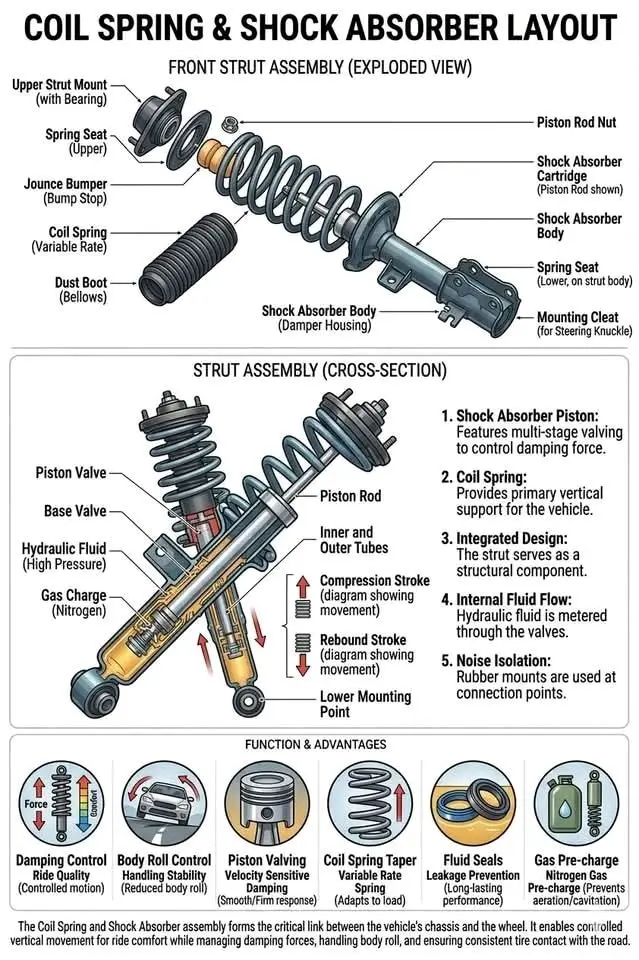
Shock valving controls the flow of hydraulic oil inside a shock absorber, determining the damping forces that manage spring motion and tire contact. In short, valving dictates how your shocks feel and perform—whether they deliver a plush ride or track-ready precision. Springs support the vehicle's weight, but valving controls how that weight transfers during acceleration, braking, and cornering. Without proper valving, even the best springs result in a harsh, bouncy, or unstable ride. Valving is the primary tuning tool for ride quality and handling.
Compression vs. Rebound Damping: What's the Difference and Why You Need Both
Compression damping resists suspension compression (when the wheel moves up, absorbing a bump), while rebound damping resists extension (when the spring pushes the wheel back down). Think of compression as the shock's ability to absorb the punch of a bump, and rebound as its ability to stop the subsequent wobble. Both are essential: compression controls impact harshness and body roll during cornering, while rebound controls oscillation and stability after the bump. If rebound is too soft, the car continues to bounce after hitting a bump; if too stiff, the suspension may pack down and not recover quickly enough for the next bump. Similarly, too much compression makes the ride harsh over small imperfections, while too little allows excessive body roll and bottoming out.
How Shim Stacks Work: The Heart of Valving
Shim stacks are thin metal discs that flex to open and close oil passages inside the shock piston. They are the heart of valving because their thickness, diameter, and arrangement determine the damping curve—how resistance changes with shaft speed. When oil pressure increases, the shims bend, allowing more oil to pass, creating a progressive resistance. By adding or removing shims, or changing their order, tuners can fine-tune damping characteristics to match specific needs. For example, a stack with larger or thicker shims will be stiffer, providing more resistance at a given shaft speed. Understanding shim stacks is crucial for anyone looking to customize shock valving.
Valving Types: Linear, Progressive, Digressive, Regressive – What's Best for You?
Valving types describe how damping force changes with shaft velocity. Linear valving provides constant damping force across all shaft speeds, offering predictable behavior, often used for comfort-oriented street applications. Progressive valving increases damping with shaft speed, providing more resistance at higher speeds, which can be versatile for mixed driving. Digressive valving increases damping at low speeds but decreases at high speeds, a common choice for performance driving because it offers firm low-speed control for body motion while allowing high-speed compliance for sharp impacts. Regressive valving, where damping decreases as speed increases, is rare and used in specific applications like certain off-road setups. For most drivers, digressive valving offers the best balance for spirited driving, while linear or progressive suits daily commuting. [MODEL_ANALYSIS] Note: These are general characterizations; actual performance depends on the specific vehicle and suspension setup.
How to Choose the Right Valving for Your Vehicle and Driving Style
Choosing the right valving starts with understanding your vehicle type and primary use. For a passenger car used for daily commuting, prioritize comfort with softer compression and rebound to absorb road imperfections. For a sports car used on track days, firmer compression and rebound, possibly digressive, will reduce body roll and improve response. For trucks and SUVs used for towing or off-roading, consider progressive or digressive valving with high-speed compression control to handle large impacts and heavy loads. Spring rates must match valving: stiff springs require more damping to control oscillation, while soft springs need less. Adjustable shocks offer flexibility, allowing you to tune for different conditions without revalving. As a general guideline, if you value ride comfort, lean towards softer valving; if you prioritize handling, choose firmer.
Step-by-Step Selection Guide
- Define your primary use: daily commuting, spirited driving, track days, towing, or off-road.
- Assess your spring rates: Determine if your springs are stock or upgraded. Stiffer springs require more damping.
- Match valving type to use: For comfort, choose linear or progressive. For performance, consider digressive. For off-road, look for high-speed compression control.
- Consider adjustability: If you frequently change conditions, adjustable shocks allow fine-tuning.
- Consult manufacturer data: Use valving curves and application guides to match shocks to your vehicle.
- Test and refine: Start with recommended settings and adjust based on feel.
Comparison Table: Valving Types
| Valving Type | Damping Behavior | Best For | Trade-offs |
|--------------|------------------|----------|------------|
| Linear | Constant force across speeds | Daily commuting, comfort | May feel floaty at high speeds |
| Progressive | Increases with speed | Mixed driving, versatility | Can feel harsh on sharp impacts |
| Digressive | Firm at low speed, softer at high speed | Performance, track use | Requires careful tuning |
| Regressive | Decreases with speed | Specialized off-road | Rare, not for general use |
Common Valving Mistakes and How to Avoid Them
One of the most common mistakes is over-damping—setting valving too stiff, which results in a harsh ride and poor traction over rough surfaces. Under-damping, or too soft, causes excessive body motion and bottoming out. Another frequent error is mismatching valving to spring rates: using stiff springs with soft valving leads to uncontrolled oscillations, while soft springs with stiff valving create a jarring ride. Ignoring the effect of tires and bushings on overall compliance is also a mistake; these components contribute to the suspension's effective spring rate and damping. To diagnose issues, pay attention to how the car behaves: if it bounces after a bump, increase rebound; if it dives under braking, increase compression. If the ride is harsh, reduce both. Always consider the entire suspension system, not just the shocks.
Valving and Spring Rates: How They Work Together
Springs store energy, and valving dissipates it. The spring rate determines how much energy is stored, and the valving must be matched to control its release. Stiff springs, with a high spring rate, store more energy and require more damping to prevent oscillation. Soft springs, with a low rate, need less damping. If valving is too soft for stiff springs, the car will continue to bounce after a bump; if too stiff for soft springs, the suspension will not compress enough to absorb impacts, leading to a harsh ride and potential coil bind. For example, a track car with 500 lb/in springs needs significantly more rebound damping than a street car with 200 lb/in springs. Always select valving based on the spring rate and intended use to achieve a balanced setup.
Practical Tuning Tips: Adjusting Valving for Street, Track, and Off-Road
For street driving, prioritize comfort and tire longevity. Use softer compression and rebound settings to absorb road imperfections and reduce driver fatigue. For track use, prioritize handling and response. Increase compression to control body roll and rebound to stabilize the car under braking and acceleration. Digressive valving is often ideal for track use because it provides firm low-speed control without being harsh over curbs. For off-road, focus on absorbing large impacts. Use progressive or digressive valving with emphasis on high-speed compression control to handle rocks and ruts. If your shocks are adjustable, start with the manufacturer's recommended settings and make small changes (e.g., two clicks at a time) to find the best balance. For non-adjustable shocks, choosing the right valving from the start is critical—consider your typical driving conditions and consult with a specialist if needed.
Frequently Asked Questions
What is the difference between compression and rebound damping?
Compression damping resists suspension compression (bump absorption), while rebound damping resists extension (spring back). Both are essential for controlling wheel motion and vehicle stability.
How do I know if my shock valving is too stiff or too soft?
If the ride is harsh and the car skips over bumps, valving is likely too stiff. If the car bounces excessively or bottoms out, valving is too soft. Adjust accordingly or consult a professional.
Can I change the valving on my shocks?
Some shocks are adjustable, allowing you to change damping settings externally. Others require revalving, which involves disassembling the shock and changing shim stacks. This is best done by a professional.
What is a shim stack?
A shim stack is a series of thin metal discs that flex to control oil flow in a shock absorber. The arrangement determines the damping characteristics.
How does spring rate affect valving?
Spring rate determines how much energy is stored. Stiffer springs require more damping to control oscillation, while softer springs need less. Valving must be matched to spring rate for optimal performance.
Conclusion
Shock absorber valving is the key to achieving the right balance between ride comfort and handling performance. By understanding compression and rebound damping, shim stacks, and the different valving types, you can make informed decisions for your vehicle. Whether you're a DIY enthusiast or a professional mechanic, always consider your vehicle type, driving conditions, and spring rates when selecting or adjusting valving. For high-quality suspension components, including bushings and control arms, visit our automotive suspension components page. Our manufacturing facility ensures precision and durability, and our quality control processes guarantee reliability. Learn more about our company to see how we can support your suspension needs.