Suspension System Fundamentals: A Manufacturer's Guide to Components, Geometry, and Maintenance

A vehicle's suspension system absorbs road shock, maintains tire contact, and supports vehicle weight by converting vertical wheel motion into controlled movement. Springs absorb energy, dampers dissipate it as heat, and anti-sway bars resist body roll, all working together to keep tires planted. This guide explains the components, geometry, and maintenance practices you need to know for informed decisions on repairs and purchases.
How Does a Car Suspension Work? The Core Principles
When a wheel hits a bump, the spring compresses, storing energy. The damper then controls the release of that energy, preventing uncontrolled oscillation. Without dampers, a car would bounce continuously after every bump, compromising control. The system must balance ride comfort with handling stability: soft setups absorb bumps well but allow body motion; stiff setups improve cornering but transmit harshness.
Key Suspension Components: Springs, Dampers, and Anti-Sway Bars
Springs: Types and Functions
Springs support vehicle weight and absorb impacts. Common types include:
- Coil springs: Helical steel coils used in most modern cars for progressive rate and compact design.
- Leaf springs: Layered steel strips for trucks and heavy-duty vehicles, offering high load capacity.
- Torsion bars: Twisting metal bars used in some SUVs and trucks for space efficiency.
Each type has specific load ratings and ride characteristics. Coil springs offer smoother rides; leaf springs handle heavier loads.
Dampers (Shocks and Struts): How They Work
Dampers control spring motion by converting kinetic energy into heat via hydraulic fluid through valves. Key difference:
- Shocks: Dampers only, used with separate springs and control arms.
- Struts: Structural components combining a damper with a coil spring and providing an upper mounting point. Struts are load-bearing and often part of the steering system.
Both control spring oscillation, but struts also support vehicle weight and maintain wheel alignment.
Anti-Sway Bars and Other Components
Anti-sway bars (stabilizer bars) connect left and right wheels via a torsion bar. During cornering, body roll twists the bar, resisting roll and transferring load to the inside wheel, reducing body lean. Bushings and links connect these components: bushings (rubber or polyurethane) isolate noise and vibration while allowing controlled movement; links are metal rods connecting the anti-sway bar to control arms. Worn bushings cause clunking and vague handling.
Suspension Geometry: Camber, Caster, and Toe Explained
Suspension geometry refers to wheel angles relative to the vehicle and each other, directly affecting tire wear, handling, and stability.
- Camber: Vertical tilt of the wheel from the vehicle's side. Negative camber (top leans inward) improves cornering grip but causes inner edge wear if excessive. Positive camber (top leans outward) reduces grip and causes outer edge wear.
- Caster: Angle of the steering axis from vertical, viewed from the side. Positive caster (steering axis leans toward driver) provides straight-line stability and steering return; negative caster makes steering light but unstable.
- Toe: Horizontal angle of wheels relative to vehicle centerline. Toe-in (front edges closer) improves straight-line stability; toe-out (front edges farther) improves turn-in response. Incorrect toe causes rapid tire wear and pulling.
Improper geometry—from worn parts or misalignment—leads to uneven tire wear, poor handling, and increased fuel consumption. Regular alignment checks are essential.
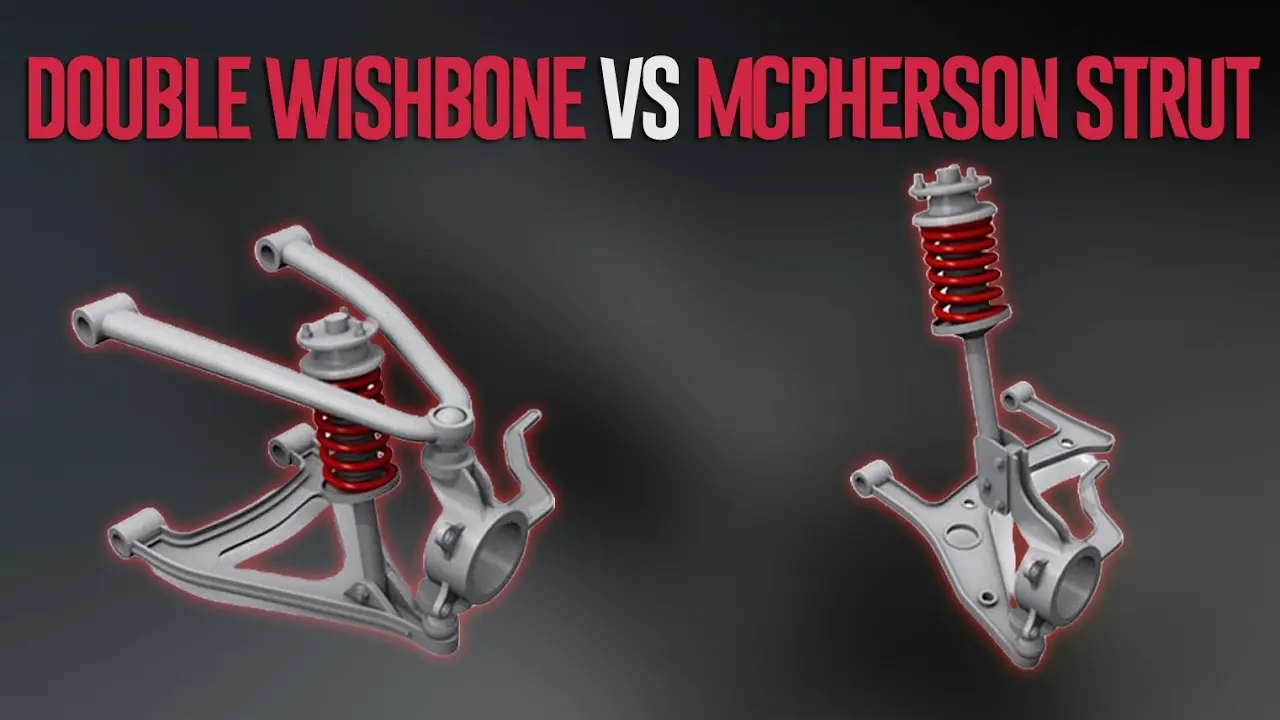
MacPherson Strut vs. Double Wishbone: Pros and Cons
Two common suspension designs dominate:
MacPherson Strut
- Pros: Compact, lightweight, cost-effective, easy to package in front-wheel-drive cars. Fewer moving parts reduce maintenance.
- Cons: Limited adjustability, less precise geometry control under high loads, and can transmit more road noise.
Double Wishbone
- Pros: Superior handling and grip due to precise control of camber and toe. More adjustability for performance tuning. Better ride quality over rough surfaces.
- Cons: More complex, heavier, and expensive. Requires more space, making it less suitable for compact cars.
Other designs include multi-link (compromise between handling and ride) and torsion beam (simple, cost-effective dependent rear suspension for economy cars).
Signs of Bad Suspension: Symptoms and Diagnostic Tips
Common symptoms include:
- Uneven or rapid tire wear
- Excessive bouncing after bumps
- Vehicle pulling to one side
- Nose diving under braking
- Clunking or knocking noises over bumps
- Steering wheel vibration
Diagnostic tips:
- Visual inspection: Look for fluid leaks on shocks/struts (oil residue indicates seal failure). Check bushings for cracks or deterioration.
- Bounce test: Push down on a corner. If it bounces more than once or twice, the damper is weak.
- Check for play: With vehicle on jack stands, grab tire at 3 and 9 o'clock to check tie rods; at 6 and 12 o'clock to check ball joints and wheel bearings.
- Listen: Drive over rough road and note clunks or rattles.
Differentiate between shock/strut wear and alignment issues: If vehicle pulls consistently, likely alignment or brake issue; if it dives under braking, front shocks are worn.
Maintenance and Inspection Procedures for Suspension Components
Regular inspection extends suspension life. Follow these guidelines:
- Inspect every 20,000 miles or during tire rotations, whichever comes first.
- Check shocks/struts for leaks, damage, and worn mounts.
- Inspect bushings for cracks, tears, or excessive play. Use a pry bar to check movement.
- Check ball joints for play by lifting vehicle and moving wheel.
- Verify alignment annually or after any suspension work.
Replace worn components in pairs (e.g., both front shocks) to maintain balance. If one side is worn, the other is likely close to failure.
DIY vs. professional: Basic inspections can be done at home with a jack and stands. However, alignment and complex repairs (like control arm replacement) require specialized tools and expertise. When in doubt, consult a professional.
Why Component Quality Matters: A Manufacturer's Perspective
As a manufacturer of suspension components, we understand that quality directly impacts safety and performance. Here's what separates premium parts from cheap alternatives:
- Material quality: High-grade steel and aluminum offer better strength-to-weight ratios and corrosion resistance. Rubber bushings use durable compounds that resist cracking; polyurethane offers longer life but transmits more noise.
- Manufacturing tolerances: Precision machining ensures proper fit and function. Poorly made parts can cause alignment issues and premature wear.
- OEM specifications: Parts that meet or exceed original equipment specifications guarantee correct geometry and performance. Our components are designed to match OEM dimensions and materials.
- Testing: Quality parts undergo rigorous testing for durability and performance. While we don't publish specific test data, our manufacturing processes include quality control checks at every stage.
Investing in quality parts saves money long-term by reducing replacements and preventing damage to other components. For example, a worn control arm bushing can cause uneven tire wear, leading to premature tire replacement.
How to Choose the Right Suspension Parts for Your Vehicle
Selecting the correct suspension parts requires a systematic approach:
- Identify your vehicle: Year, make, model, and trim level. This determines exact part numbers and specifications.
- Determine your driving needs: Daily commuting, off-road, or performance driving. This influences whether you need OEM, OEM-equivalent, or aftermarket performance parts.
- Choose part type: OEM parts match factory specifications; aftermarket parts may offer improved performance or adjustability. Consider ride height, load capacity, and adjustability.
- Check compatibility: Use manufacturer catalogs or consult a professional to ensure exact fitment. For example, our automotive suspension components include control arms and bushings for specific Hyundai and KIA models.
- Consider quality: Look for parts that meet OEM specs and come from reputable manufacturers. Our quality control process ensures reliability.
If unsure, consult a mechanic or contact the manufacturer directly. Many companies, including ours, offer technical support to help you choose the right part.
Conclusion: The Importance of a Well-Maintained Suspension
A well-maintained suspension is crucial for safety, performance, and comfort. Understanding fundamentals—components, geometry, and maintenance—empowers you to make informed decisions, whether you're a DIYer or a professional buyer. Regular inspections and timely replacements of worn parts extend vehicle life and ensure predictable handling and braking. When replacing components, choose quality parts that meet OEM specifications. Visit our product page to explore our range of suspension components, or learn more about our manufacturing facility and about our company.
FAQ
Q: How often should suspension components be inspected?
A: It is recommended to inspect suspension components every 20,000 miles or during tire rotations, whichever comes first. Regular checks can prevent premature wear and ensure safety.
Q: What is the difference between shocks and struts?
A: Shocks are dampers that control spring oscillation, while struts are structural components that combine a damper with a coil spring and provide an upper mounting point. Struts are load-bearing and often part of the steering system.
Q: How do I know if my suspension needs repair?
A: Common signs include uneven tire wear, excessive bouncing, pulling to one side, nose diving under braking, clunking noises, and steering wheel vibration. Perform a visual inspection and bounce test to identify potential issues.
Q: Should I replace suspension parts in pairs?
A: Yes, it is recommended to replace worn components in pairs (e.g., both front shocks) to maintain balance and consistent handling.
Q: What is the benefit of choosing OEM-quality parts?
A: OEM-quality parts ensure correct geometry, fit, and performance, which is critical for safety and longevity. They are designed to meet original equipment specifications, reducing the risk of premature failure.