Suspension Spring Manufacturing: A Guide to Materials, Processes, and Quality

How are suspension springs made, and what separates a high-quality spring from a mediocre one? The answer lies not just in design, but in the precision of manufacturing: material selection, coiling method, heat treatment, and finishing. Each step introduces variables that affect fatigue life, load capacity, and consistency. This guide walks you through the entire process, from raw material to finished spring, so you can evaluate spring quality and make informed purchasing decisions.
Materials Used in Suspension Springs: Composition and Properties
The most common spring steels are SAE 5160, chrome-silicon, and chrome-vanadium alloys. SAE 5160 (a chromium-silicon-manganese steel) offers a good balance of hardenability and cost, making it popular for OEM springs. Chrome-silicon (e.g., SAE 9254) provides higher strength and fatigue resistance, often used in performance springs. Chrome-vanadium (e.g., SAE 6150) adds vanadium for finer grain structure, improving toughness and fatigue life, but at a higher cost.
Yield strength determines the maximum stress the spring can withstand without permanent deformation. Fatigue resistance is critical because suspension springs endure millions of cycles. Hardenability—the ability to harden deeply during heat treatment—ensures consistent properties throughout the wire cross-section. Alloying elements like chromium increase hardenability, silicon improves strength and relaxation resistance, and vanadium refines grain size.
Material selection criteria depend on application: heavy-duty trucks may prioritize toughness, while performance cars demand high fatigue life. Always verify the material grade with a mill certificate, as substitution can drastically alter spring performance.
Cold Coiling vs. Hot Coiling: Which Method Produces Better Springs?
Cold coiling is performed at room temperature on wire up to about 16 mm diameter. It offers superior dimensional precision and surface finish because the wire is not oxidized by heat. Cold-coiled springs typically have better fatigue life due to a smoother surface, which reduces stress concentrations. The process is faster and more energy-efficient, making it ideal for high-volume production of smaller springs.
Hot coiling is used for wire diameters above 16 mm or when forming tight coil pitches that would crack cold wire. The steel is heated to 800–1000°C, making it malleable. This method allows larger spring diameters and thicker wire, but introduces scale that must be removed. Hot-coiled springs often require additional grinding or shot blasting to improve surface quality. The heat-affected zone can alter mechanical properties, but proper heat treatment restores them.
Which produces better springs? For most passenger vehicle springs (wire diameter 10–16 mm), cold coiling yields superior consistency and fatigue life. Hot coiling is reserved for heavy-duty applications where size dictates the method. Cost-wise, cold coiling is cheaper per unit at high volumes, but hot coiling has higher setup costs but is necessary for large springs.
Step-by-Step Manufacturing Process: From Wire to Finished Spring
Step 1: Wire Preparation and Straightening
The raw wire is inspected for surface defects, then straightened and cut to length. Any surface imperfections at this stage can become crack initiation points later.
Step 2: Coiling and End Forming
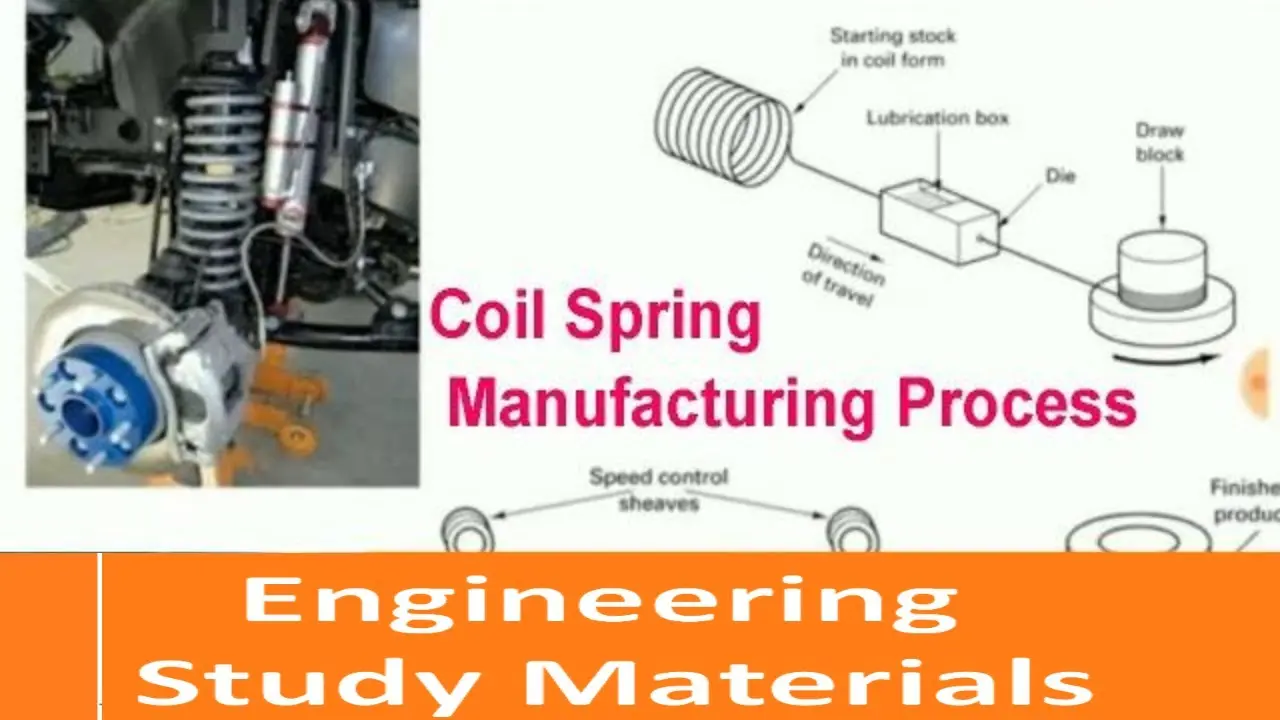
The wire is fed into a coiling machine that wraps it around a mandrel. Cold coiling uses CNC-controlled machines for precise pitch and diameter. Hot coiling involves heating the wire and forming it on a mandrel. End configurations—closed, open, or pigtail—are formed either during coiling or in a separate operation.
Step 3: Heat Treatment
All springs undergo quenching and tempering. Quenching (rapid cooling) hardens the steel, but makes it brittle. Tempering (reheating to 300–500°C) relieves internal stresses and adjusts hardness and ductility. The exact temperatures and times are critical; even small deviations can change spring rate and fatigue life.
Step 4: Shot Peening
Shot peening bombards the spring surface with small steel shots, creating compressive residual stresses. This dramatically improves fatigue life by preventing crack propagation. Springs that skip shot peening may fail prematurely.
Step 5: Finishing
Springs are ground flat on the ends to ensure proper seating. They may be coated with paint, powder coating, or zinc plating for corrosion resistance. Finally, each spring is inspected for dimensions and surface defects.
Quality Control and Testing: How Manufacturers Ensure Spring Reliability
Dimensional inspection verifies free height, coil diameter, wire diameter, and end alignment. These measurements must meet tight tolerances—often within ±1% of nominal. Mechanical testing includes load rate testing (measuring force at specified heights), fatigue testing (cycling the spring to failure), and stress relaxation tests (checking for sag over time).
Non-destructive testing methods like magnetic particle inspection and ultrasonic testing detect surface and internal cracks without damaging the spring. Reputable manufacturers hold certifications such as ISO 9001 or IATF 16949, which require documented quality systems and traceability. When evaluating a manufacturer, ask for material certifications and test reports—these provide evidence that quality is built into the process.
Design Considerations: How Spring Geometry and Manufacturing Interact
Spring rate (stiffness) depends on wire diameter, coil diameter, and number of active coils. Increasing wire diameter raises the rate, while increasing coil diameter or active coils lowers it. Stress analysis ensures the spring does not exceed material yield strength at full compression, avoiding coil bind (when coils touch) and fatigue failure.
Manufacturing constraints include minimum coil pitch (to allow proper heat treatment and shot peening) and end configurations that must be grindable. Tolerances on wire diameter and coil diameter directly affect spring rate—a 0.1 mm variation can change rate by several percent. When designing a custom spring, consult with the manufacturer early to ensure your geometry is manufacturable within standard tolerances.
Choosing a Suspension Spring Manufacturer: What to Look For
Assess the manufacturer's capabilities: do they perform cold and hot coiling, heat treatment, and shot peening in-house? In-house control ensures consistent quality. Review their quality certifications and testing procedures—ask for examples of their SPC data. Request material certifications and traceability to confirm the steel grade. Evaluate their engineering support: can they help with design optimization or failure analysis? A manufacturer with experienced engineers can prevent costly mistakes. Finally, consider their production volume and lead times to ensure they can meet your demand.
By understanding the manufacturing process, you can make informed decisions that balance performance, durability, and cost. Whether you are a buyer, mechanic, or DIY enthusiast, knowing what goes into a quality spring helps you choose the right product for your application.
FAQ
What is the best material for suspension springs?
The best material depends on the application. Chrome-silicon (SAE 9254) offers high strength and fatigue resistance for performance springs, while SAE 5160 is a cost-effective choice for OEM springs. Chrome-vanadium (SAE 6150) provides superior toughness and fatigue life but at a higher cost.
How can I tell if a spring is cold-coiled or hot-coiled?
Cold-coiled springs typically have a smoother surface finish and tighter dimensional tolerances. Hot-coiled springs may show scale or surface roughness and are usually larger in diameter. When in doubt, ask the manufacturer for process details.
Why is shot peening important for suspension springs?
Shot peening induces compressive residual stresses on the spring surface, which significantly improves fatigue life by preventing crack initiation and propagation. Springs without shot peening are more prone to premature failure.
What certifications should a quality spring manufacturer have?
Look for ISO 9001 or IATF 16949 certifications, which require documented quality management systems and traceability. Additionally, request material certifications and test reports to verify quality.
Can I specify a custom spring for my vehicle?
Yes, many manufacturers offer custom springs. Work with the manufacturer early to ensure your design is manufacturable within standard tolerances and meets your performance requirements.