Suspension Shock Absorber Technology: A Manufacturer's Guide to Types, Trade-offs, and Selection

Shock absorbers are not one-size-fits-all components. The right choice depends on your vehicle's suspension design, driving conditions, and performance requirements. This guide explains the technology, trade-offs, and selection criteria to help you make informed purchasing and recommendation decisions.
How Shock Absorbers Work: The Physics of Damping
Shock absorbers convert the kinetic energy of suspension movement into heat through hydraulic fluid displacement. When a wheel hits a bump, the suspension spring compresses and stores energy; without damping, that energy would release as uncontrolled oscillation. The shock absorber's job is to dissipate that energy by forcing hydraulic fluid through precision orifices and valves, creating resistance that slows spring motion.
The damping force is controlled by the size of these orifices and the stiffness of the valve stacks. On compression (jounce), fluid flows through the piston's compression valves; on extension (rebound), it flows through rebound valves. By tuning valve stiffness and orifice size, engineers determine how much resistance the damper provides at different shaft speeds. This is why two shocks can look identical externally yet feel completely different—the internal valving dictates the damping curve.
Damping is essential for three reasons: it controls spring oscillations, maintains tire contact with the road, and ensures vehicle stability. Without proper damping, a car would continue bouncing after every bump, tires would lose grip, and braking and cornering would become unpredictable. In short, shock absorbers are what make a vehicle's ride both comfortable and safe.
Twin-Tube vs. Monotube: Design Trade-offs and Applications
Twin-Tube Shocks
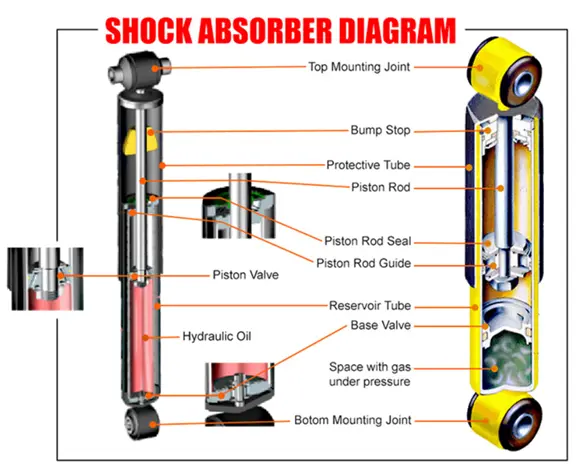
Twin-tube shocks have an inner and outer tube, are more cost-effective, offer a softer ride, and are common in OEM applications. The inner tube (working cylinder) houses the piston, while the outer tube acts as a fluid reservoir. During operation, oil flows between the two tubes through a base valve, which also separates the oil from a low-pressure gas charge (typically nitrogen) that compensates for fluid volume changes as the rod enters and exits.
Advantages:
- Lower manufacturing cost
- More compliant ride due to low-pressure gas and outer tube cushioning
- Can be mounted at any angle because gas and oil are separated by the base valve
Disadvantages:
- More prone to heat fade under sustained heavy use because oil churns in the outer tube
- Smaller piston limits maximum damping force
Monotube Shocks
Monotube shocks feature a single tube with a separate gas chamber, providing better heat dissipation, more consistent damping, and are often used in performance and off-road vehicles. In a monotube design, the piston moves inside a single cylinder, with a free-floating dividing piston separating the oil from a high-pressure gas charge (around 300 psi). This design allows for a larger piston area and more oil volume, which improves heat dissipation and reduces fade during intense use.
Advantages:
- Better heat dissipation and consistent damping over long periods
- Larger piston area allows higher damping forces
- More suitable for performance and heavy-duty applications
Disadvantages:
- More expensive to manufacture
- Transmits more road harshness due to high-pressure gas
- Must be mounted within 45 degrees of horizontal to prevent gas bypass
Selection Guidance
When choosing between twin-tube and monotube shocks, consider the vehicle's weight, usage intensity, and performance requirements. For a passenger car used primarily for commuting, twin-tube shocks offer a good balance of comfort and cost. For a sports car, a heavy-duty truck, or an off-road vehicle that experiences high temperatures and demanding conditions, monotube shocks are the better choice. Many OEMs use twin-tube shocks for cost reasons, but aftermarket performance upgrades often switch to monotube designs.
Advanced Shock Absorber Technologies: Adaptive, Magnetorheological, and Electronic Systems
Adaptive Shocks
Adaptive shocks use electronic valves to adjust damping based on driving conditions, offering a balance between comfort and handling. These systems typically use a solenoid-operated valve that varies the oil flow path, allowing the damper to switch between soft and firm settings in milliseconds. The vehicle's control module monitors sensors for steering angle, throttle position, brake pressure, and body acceleration to determine the optimal damping level. For example, a luxury sedan might default to a soft setting for highway cruising but firm up during aggressive cornering or braking.
Magnetorheological (MR) Shocks
Magnetorheological (MR) shocks use fluid containing magnetic particles that change viscosity in response to a magnetic field, enabling rapid and precise damping control. The MR fluid consists of micron-sized iron particles suspended in oil. When an electromagnetic coil in the piston generates a magnetic field, the particles align into chains, increasing the fluid's resistance to flow. By varying the current, the controller can adjust damping in less than 5 milliseconds—much faster than conventional valves. This technology, first introduced by Delphi (now part of BWI Group) as MagneRide, is used in high-performance vehicles like the Chevrolet Corvette and Ferrari models.
Considerations for Buyers
These systems require sensors, control modules, and specialized fluids, increasing cost and complexity but providing significant performance and safety benefits. The main advantages are improved ride comfort without sacrificing handling, reduced body roll, and shorter stopping distances. However, they are more expensive to manufacture and repair, and they require sophisticated electronics that can fail. For buyers, the decision to choose adaptive or MR shocks depends on the vehicle's intended use and budget. If you're sourcing for a mainstream vehicle, standard twin-tube or monotube shocks are often sufficient. For premium or performance vehicles, advanced systems can be a selling point, but they also demand higher replacement costs and specialized diagnostic equipment.
Materials and Manufacturing: What Goes into a Quality Shock Absorber
High-quality shocks use precision-machined pistons, hardened steel rods, and durable seals to ensure longevity and consistent performance. The piston is typically CNC-machined from aluminum or steel to achieve tight tolerances—often within 0.01 mm—to ensure consistent fluid flow and minimal leakage. The rod is made from induction-hardened chrome-plated steel to resist wear and corrosion; the chrome plating also provides a smooth surface for the seal to ride on. Seals are usually made from PTFE or polyurethane, which offer low friction and high durability.
Manufacturing processes like CNC machining, robotic welding, and automated assembly contribute to consistency and quality control. In our manufacturing facility, we use automated assembly lines that precisely fill each shock with the correct amount of oil and charge it with nitrogen gas. Robotic welding ensures consistent, leak-proof joints. Every unit undergoes a dynamometer test to verify its damping force curve matches the specification. This level of quality control is critical because even minor variations in valve shims or oil viscosity can dramatically affect ride and handling.
Quality indicators include chrome-plated rods, multi-stage valving, and nitrogen gas charging (for gas-pressurized shocks). A chrome-plated rod resists rust and pitting, which can damage seals. Multi-stage valving provides progressive damping—soft at low shaft speeds for comfort, firmer at high speeds for control. Nitrogen gas charging prevents oil aeration and cavitation, which can cause inconsistent damping. When inspecting a shock, look for smooth rod finish, clean welds, and proper gas pressure. If you're sourcing from a supplier, ask about their quality control processes and whether they test each unit.
Signs of Wear and When to Replace Shock Absorbers
Common symptoms include excessive bouncing, nose diving under braking, uneven tire wear, and fluid leaks on the shock body. If your vehicle continues to bounce after hitting a bump, or if the front end dips noticeably when you brake, the shocks are likely worn. Uneven tire wear—especially cupping or scalloping—can also indicate poor damping, as the tire loses contact with the road. A visual inspection may reveal oil streaks on the shock body, which indicates seal failure and loss of hydraulic fluid.
A simple bounce test can indicate worn shocks, but a professional inspection is recommended for accurate diagnosis. To perform the bounce test, press down firmly on a corner of the vehicle and release. If the vehicle bounces more than one and a half times before settling, the shock is suspect. However, this test is not definitive, as other suspension components (like bushings or springs) can affect the result. A professional technician can measure damping force with a shock dyno or perform a comprehensive suspension inspection.
Replacement intervals vary, but shocks should be checked regularly and replaced if performance is compromised. Many manufacturers recommend replacing shocks every 50,000 miles, but this depends on driving conditions. Frequent driving on rough roads, towing, or carrying heavy loads can accelerate wear. If you notice any of the symptoms above, or if the vehicle has high mileage, it's wise to have the shocks inspected. Replacing worn shocks not only improves ride comfort but also restores braking performance and tire life.
Selecting the Right Shock Absorber: Vehicle Type, Driving Conditions, and Performance Needs
Consider vehicle type (passenger car, SUV, truck) and suspension design (MacPherson strut, double wishbone) when selecting shock type. MacPherson struts combine the shock and spring into a single unit and are common on front suspensions of many cars; they require a strut-type shock with a specific mounting configuration. Double wishbone suspensions use separate shocks and springs, offering more flexibility in shock choice. Trucks and SUVs often have leaf springs or multi-link setups that require shocks with specific travel and mounting dimensions.
Driving conditions (highway, off-road, towing) dictate the need for specific damping characteristics and durability. For highway driving, a shock with a softer low-speed valving provides a smooth ride. For off-road use, you need a monotube shock with high gas pressure to resist fade and a larger oil reservoir to handle heat. If you tow or carry heavy loads, consider shocks with a stiffer damping curve or even adjustable shocks that can be set to match the load.
Performance needs (comfort vs. handling) guide the choice between standard, performance, and adjustable shocks. Standard shocks are designed for comfort and predictable handling. Performance shocks have firmer valving and often monotube construction to reduce body roll and improve steering response. Adjustable shocks allow the driver to change damping settings to suit different conditions—for example, a softer setting for daily driving and a firmer setting for track days. When selecting, always match the shock to the vehicle's original specifications or choose an upgrade that is compatible with the suspension geometry.
Maintenance and Signs of Wear
Regular inspection of shock absorbers should be part of any vehicle maintenance routine. Look for signs of oil leakage, physical damage to the body, or worn bushings at the mounting points. If you notice any of these, it's time to replace the shock. Also, check the shock's rubber bushings—if they are cracked or deteriorated, they can cause noise and affect alignment.
When replacing shocks, it's recommended to replace them in pairs (both front or both rear) to maintain balanced handling. Always use quality parts that meet or exceed OEM specifications. If you're sourcing shocks for a fleet or resale, consider working with a supplier that offers a range of options and can provide technical support.
Future Trends in Shock Absorber Technology
The future of shock absorbers lies in further integration with vehicle electronics and the development of energy-harvesting dampers. Regenerative shock absorbers, which capture energy from suspension motion and convert it into electricity, are being researched for hybrid and electric vehicles. Additionally, the rise of autonomous vehicles will require shocks that can adapt to road conditions without driver input, relying on sensors and predictive algorithms. As technology advances, we can expect more vehicles to feature adaptive or MR dampers, making these systems more affordable and widespread.
Conclusion
Understanding shock absorber technology is essential for making informed decisions, whether you're a parts buyer, mechanic, or vehicle owner. From the basic physics of damping to the trade-offs between twin-tube and monotube designs, and the latest in adaptive and magnetorheological systems, each type serves a specific purpose. By recognizing signs of wear and knowing how to select the right shock for your vehicle and driving needs, you can ensure safety, performance, and comfort. As a manufacturer, we are committed to producing high-quality suspension components that meet the demands of modern vehicles. For more information about our range of automotive suspension components, including control arms and bushings, visit our about our company page.
FAQ
What is the difference between twin-tube and monotube shock absorbers?
Twin-tube shocks have two tubes and are generally cheaper and softer, while monotube shocks have a single tube and offer better heat dissipation and performance, but at a higher cost.
How often should shock absorbers be replaced?
Typically every 50,000 miles, but this varies based on driving conditions and vehicle usage. Regular inspections are recommended.
What are the signs of worn shock absorbers?
Excessive bouncing, nose diving under braking, uneven tire wear, and fluid leaks on the shock body are common indicators.
Can I replace shock absorbers myself?
If you have mechanical experience and the proper tools, yes. However, professional installation is recommended to ensure safety and proper alignment.
What is a magnetorheological shock absorber?
It uses a fluid containing magnetic particles that change viscosity in response to a magnetic field, allowing rapid and precise damping control, often used in high-performance vehicles.
How do I choose the right shock absorber for my vehicle?
Consider your vehicle type, suspension design, driving conditions, and performance needs. Always match the shock to the vehicle's specifications or choose a compatible upgrade.
Are performance shocks worth the extra cost?
If you prioritize handling and performance, yes. They offer firmer damping and better heat dissipation, which can improve cornering and stability.
What is the difference between a shock absorber and a strut?
A strut is a structural component that combines the shock absorber and spring into one unit, while a shock absorber is a separate component. Struts are common on front suspensions of many cars.
Can worn shocks affect tire wear?
Yes, worn shocks can cause uneven tire wear, especially cupping or scalloping, because the tire loses contact with the road.
What is the bounce test?
Press down firmly on a corner of the vehicle and release. If the vehicle bounces more than one and a half times before settling, the shock may be worn.
What is the difference between adaptive and magnetorheological shocks?
Adaptive shocks use electronic valves to adjust damping, while MR shocks use magnetic particles in the fluid. MR shocks can react faster and offer more precise control.
Are monotube shocks always better than twin-tube?
Not necessarily. Twin-tube shocks are often more comfortable and cost-effective for everyday driving, while monotube shocks are better for performance and heavy-duty use.
How do I know if my shocks need replacement?
Look for symptoms like excessive bouncing, fluid leaks, or uneven tire wear. A professional inspection can provide a definitive diagnosis.
Can I mix shock absorber brands or types?
It's not recommended to mix different types or brands on the same axle, as it can lead to unbalanced handling. Always replace in pairs.
What is the role of gas in a shock absorber?
Gas pressure helps prevent oil aeration and cavitation, ensuring consistent damping performance.
Are there shock absorbers for off-road vehicles?
Yes, monotube shocks with high gas pressure and larger oil reservoirs are often used for off-road applications to resist fade and handle heat.
What is the difference between a shock absorber and a spring?
A spring stores energy from bumps, while a shock absorber dissipates that energy to control oscillation.
How do I know if a shock absorber is gas-charged?
Look for a gas charging valve or check the product specifications. Many gas-charged shocks have a visible nitrogen gas chamber.
Can I upgrade my vehicle's shocks for better performance?
Yes, upgrading to performance or adjustable shocks can improve handling and ride quality, but ensure compatibility with your vehicle's suspension.
What is the best shock absorber brand?
There are many reputable brands, but the best choice depends on your vehicle and needs. Consult a professional or refer to manufacturer specifications.
How do I maintain my shock absorbers?
Regularly inspect for leaks, damage, and worn bushings. Keep them clean and replace them when they show signs of wear.
What is the difference between a shock absorber and a damper?
They are the same thing; "damper" is a more technical term often used in engineering.
Can shock absorbers be repaired?
In most cases, it's more cost-effective to replace them rather than repair, as internal components are not easily serviceable.
What is the warranty on shock absorbers?
Warranty varies by manufacturer and product. Check with your supplier for specific warranty information.
How do I know if my shocks are leaking?
Look for oil streaks or wetness on the shock body. A leaking shock will eventually lose damping capability.
What is the difference between a shock absorber for a car and a truck?
Truck shocks are typically more heavy-duty, with larger bodies and higher gas pressure to handle heavier loads and rougher conditions.
Can I use a shock absorber from a different vehicle?
No, shocks are vehicle-specific. Using the wrong one can lead to poor handling and safety issues.
What is the difference between a shock absorber and a coilover?
A coilover is a shock absorber with a coil spring wrapped around it, often used in performance applications for adjustability.
How do I know if my shocks are affecting my braking?
Worn shocks can cause nose diving under braking, which increases stopping distances and reduces stability.
What is the difference between a shock absorber and a leaf spring?
A leaf spring is a type of suspension spring, while a shock absorber controls its motion.
Can I drive with a leaking shock absorber?
It's not recommended, as it can lead to poor handling, increased tire wear, and potential safety issues.
What is the difference between a shock absorber and a strut mount?
A strut mount is the top mounting point for a strut, while the shock absorber is the damping component.
How do I know if my shocks are too stiff?
If the ride is excessively harsh and you feel every bump, the shocks may be too stiff for your preferences.
What is the difference between a shock absorber and a sway bar?
A sway bar reduces body roll during cornering, while a shock absorber controls spring oscillation.
Can I adjust the damping on my shocks?
Some shocks are adjustable, allowing you to change the damping force to suit different conditions.
What is the difference between a shock absorber and a MacPherson strut?
A MacPherson strut is a type of suspension that incorporates the shock absorber and spring into a single unit.
How do I know if my shocks are worn out?
If you experience excessive bouncing, poor handling, or uneven tire wear, it's likely time for replacement.
What is the difference between a shock absorber and a coil spring?
A coil spring supports the vehicle's weight and absorbs bumps, while a shock absorber controls the spring's motion.
Can I use a shock absorber from a different brand?
Yes, as long as it meets the vehicle's specifications and is compatible with the suspension design.
What is the difference between a shock absorber and a torsion bar?
A torsion bar is a type of spring, while a shock absorber controls its motion.
How do I know if my shocks are properly installed?
If the vehicle sits level and handles well, they are likely installed correctly. A professional alignment and inspection can confirm.
What is the difference between a shock absorber and a damper?
They are the same thing; "damper" is a more technical term often used in engineering.
Can I use a shock absorber from a different vehicle?
No, shocks are vehicle-specific. Using the wrong one can lead to poor handling and safety issues.
What is the difference between a shock absorber and a strut?
A strut is a structural component that combines the shock absorber and spring into one unit, while a shock absorber is a separate component.
How do I know if my shocks are affecting my tire wear?
Worn shocks can cause uneven tire wear, especially cupping or scalloping, because the tire loses contact with the road.
What is the difference between a shock absorber and a coilover?
A coilover is a shock absorber with a coil spring wrapped around it, often used in performance applications for adjustability.
Can I drive with a leaking shock absorber?
It's not recommended, as it can lead to poor handling, increased tire wear, and potential safety issues.
What is the difference between a shock absorber and a leaf spring?
A leaf spring is a type of suspension spring, while a shock absorber controls its motion.
How do I know if my shocks are too stiff?
If the ride is excessively harsh and you feel every bump, the shocks may be too stiff for your preferences.
What is the difference between a shock absorber and a sway bar?
A sway bar reduces body roll during cornering, while a shock absorber controls spring oscillation.
Can I adjust the damping on my shocks?
Some shocks are adjustable, allowing you to change the damping force to suit different conditions.
What is the difference between a shock absorber and a MacPherson strut?
A MacPherson strut is a type of suspension that incorporates the shock absorber and spring into a single unit.
How do I know if my shocks are worn out?
If you experience excessive bouncing, poor handling, or uneven tire wear, it's likely time for replacement.
What is the difference between a shock absorber and a coil spring?
A coil spring supports the vehicle's weight and absorbs bumps, while a shock absorber controls the spring's motion.
Can I use a shock absorber from a different brand?
Yes, as long as it meets the vehicle's specifications and is compatible with the suspension design.
What is the difference between a shock absorber and a torsion bar?
A torsion bar is a type of spring, while a shock absorber controls its motion.
How do I know if my shocks are properly installed?
If the vehicle sits level and handles well, they are likely installed correctly. A professional alignment and inspection can confirm.