Suspension Roll Stiffness: From Formula to Function

Roll stiffness is the resistance of a vehicle's suspension to body roll, quantified as the roll moment required to produce one degree of roll, typically expressed in Nm/deg or lb-ft/deg. When a vehicle corners, lateral acceleration shifts weight to the outside wheels, creating a moment that rolls the body. Roll stiffness opposes that moment, determining how much the body leans for a given lateral force.
This parameter is fundamental to vehicle dynamics because it directly influences grip distribution, responsiveness, and driver confidence. A stiffer roll stiffness reduces body roll, which can improve tire contact patch loading and response, but it also increases the load transfer at that axle, potentially reducing overall grip. Conversely, a softer setting allows more body roll, which can improve mechanical grip but may feel less precise.
Roll stiffness is distinct from roll center height and roll moment distribution. Roll center height is a geometric property that, along with roll stiffness, determines the roll moment arm and the amount of weight transfer. Roll moment distribution refers to how the total roll moment is split between front and rear axles, which is a key tuning lever for handling balance.
How to Calculate Roll Stiffness: Formulas and Step-by-Step Examples
To calculate roll stiffness, you must account for the contributions from the springs and anti-roll bars (ARBs). For a given axle, the total roll stiffness is the sum of the spring contribution and the ARB contribution.
The spring contribution for an independent suspension is:
K_spring = (π/180) (K_wheel t^2) / 2
where K_wheel is the wheel rate (spring rate divided by motion ratio squared), and t is the track width. The wheel rate is K_spring_actual / (MR^2), where MR is the motion ratio (the ratio of spring displacement to wheel displacement).
For a solid axle, the formula is similar but uses the spring rate directly and the track width.
The anti-roll bar contribution is:
K_ARB = (π/180) (K_bar MR_ARB^2 t^2) / (2 L^2)
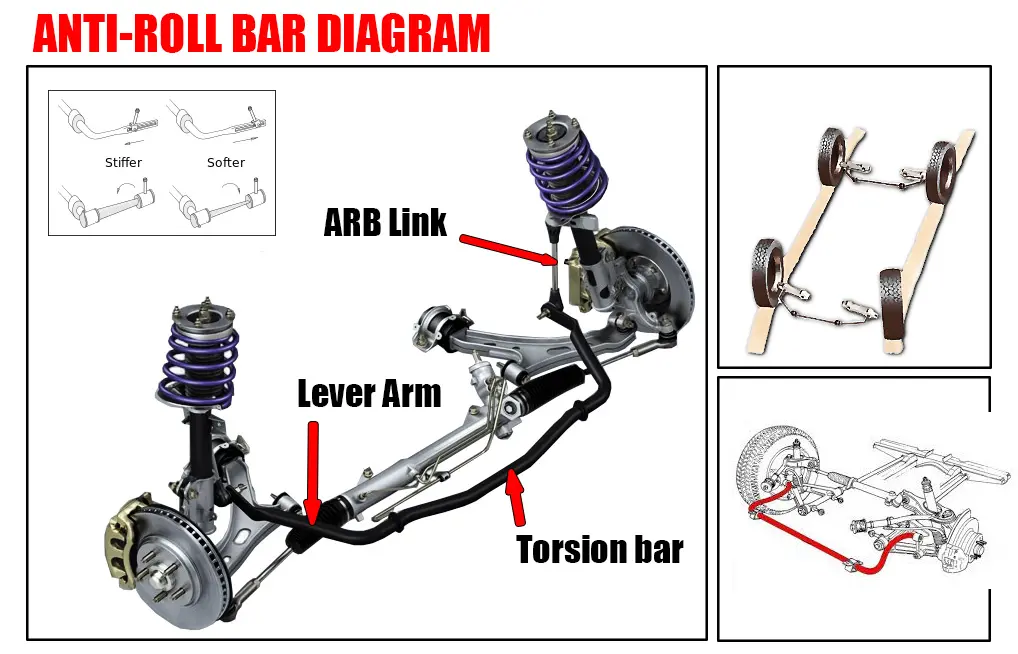
where K_bar is the bar's torsional stiffness (typically given in Nm/deg or lb-in/deg), MR_ARB is the motion ratio of the bar's lever arm, and L is the lever arm length. In practice, many tuners use simplified formulas or manufacturer data for K_bar.
Let's walk through a typical sedan example. Assume a front spring rate of 200 lb/in, a motion ratio of 0.95, and a track width of 60 inches. First, compute the wheel rate: K_wheel = 200 / (0.95^2) = 200 / 0.9025 ≈ 221.6 lb/in. Then, K_spring = (π/180) (221.6 60^2) / 2 = (0.01745) (221.6 3600) / 2 = 0.01745 * 797,760 / 2 ≈ 6,960 lb-in/deg. Divide by 12 to get lb-ft/deg: 580 lb-ft/deg.
Now, add an anti-roll bar with a stiffness of 500 lb-in/deg and a motion ratio of 0.8. K_ARB_wheel = K_bar MR_ARB^2 = 500 0.64 = 320 lb-in/deg. Then K_ARB = (π/180) (320 3600) / 2 = 0.01745 * 1,152,000 / 2 = 10,050 lb-in/deg ≈ 838 lb-ft/deg.
Total front roll stiffness = 580 + 838 = 1,418 lb-ft/deg.
Repeat for the rear axle to get the total roll stiffness distribution.
Roll Stiffness Distribution: Balancing Understeer and Oversteer
The front-to-rear distribution of roll stiffness dictates the vehicle's handling balance. Understeer occurs when the front tires lose grip before the rear, causing the car to push wide. Oversteer is the opposite: the rear loses grip first, causing the car to rotate.
Increasing roll stiffness at an axle increases the lateral weight transfer at that axle, which reduces the grip available at that end. Thus, stiffening the front anti-roll bar increases front weight transfer, reducing front grip, and promoting understeer. Stiffening the rear promotes oversteer.
The roll moment distribution is the ratio of front roll stiffness to total roll stiffness. A typical street car might have 60% front roll stiffness, yielding mild understeer. To reduce understeer, you can soften the front or stiffen the rear, shifting the distribution rearward.
Practical example: On a front-wheel-drive hot hatch, increasing rear roll stiffness by fitting a thicker rear anti-roll bar reduces understeer and improves cornering rotation. This is a common modification because it balances the car's natural tendency to understeer.
Suspension Type Comparison: MacPherson Strut vs. Double Wishbone in Roll Stiffness
Suspension architecture significantly influences roll stiffness and its tunability. MacPherson strut designs have a higher roll center and often rely more on the spring/strut assembly for roll stiffness. The motion ratio is typically close to 1, but the strut's mounting points limit the effectiveness of anti-roll bars due to packaging constraints. As a result, achieving high roll stiffness often requires very stiff springs, which can compromise ride quality.
Double wishbone designs offer more flexibility in roll center placement and motion ratios. Engineers can position the anti-roll bar to achieve a more favorable motion ratio, allowing for precise tuning of roll stiffness without excessively stiff springs. This is why many sports cars use double wishbones: they provide a wider range of adjustment and better control over roll stiffness.
For example, a typical MacPherson strut sedan might have a maximum practical roll stiffness of 1,500 lb-ft/deg before ride quality suffers, while a double wishbone sports car can achieve 2,000 lb-ft/deg with better ride comfort. The choice of suspension type thus sets the boundaries for roll stiffness tuning.
How to Measure Roll Stiffness on a Vehicle: Practical Methods
Measuring roll stiffness on a vehicle is essential for verifying calculations and baselining. The static method involves using a corner balance scale and a roll bar to induce a known roll angle. Place the car on scales, secure it, and apply a lateral force at the center of gravity using a hydraulic ram or winch. Measure the resulting roll angle with an inclinometer. The roll stiffness is the applied moment (force times height of CG) divided by the roll angle.
Alternatively, you can measure the resistance at each corner. Use spring scales or load cells under each wheel, then lift one side of the car to induce roll. Measure the change in load and the roll angle to compute the roll stiffness.
The dynamic method uses a data logger with a lateral accelerometer and suspension position sensors. During cornering, record lateral acceleration and body roll angle. Plotting roll angle vs. lateral acceleration gives the roll rate, which is the roll stiffness per unit lateral acceleration.
Important: Measure at the tire contact patch and account for tire deflection. Tire deflection contributes to body roll, so the measured roll angle includes tire compliance. To isolate suspension roll stiffness, you must subtract the tire deflection component, which requires knowing tire stiffness.
Adjusting Roll Stiffness: Anti-Roll Bars, Springs, and Coilovers
Anti-roll bars are the primary adjuster for roll stiffness. Changing bar diameter, lever arm length, or using adjustable end links alters roll stiffness. A thicker bar increases stiffness, while a longer lever arm reduces it. Adjustable end links allow fine-tuning by changing the preload and effective lever arm.
Spring rate changes also affect roll stiffness. Stiffer springs increase roll stiffness but also degrade ride quality. Coilovers offer easy spring changes and adjustable perches, allowing quick roll stiffness adjustments. However, changing springs affects ride frequency and may require re-tuning dampers.
Adjustable dampers complement roll stiffness changes. When you increase roll stiffness, you may need to adjust damping to control the faster weight transfer. For example, increasing front roll stiffness might require higher front rebound damping to manage the increased load transfer.
When selecting components, consider the desired handling characteristics and budget. For a track car, adjustable anti-roll bars and coilovers are essential. For a street car, a thicker anti-roll bar might be sufficient. Always match roll stiffness to tire grip and weight distribution.
Real-World Tuning Scenarios: Case Studies and Manufacturer Insights
Case Study 1: Front-Wheel-Drive Hot Hatch. A common issue is understeer. By increasing rear roll stiffness (e.g., fitting a thicker rear anti-roll bar), the rear axle's weight transfer increases, reducing rear grip and promoting oversteer, which balances the car. This improves cornering speed and driver confidence.
Case Study 2: Luxury SUV. These vehicles prioritize ride comfort. Manufacturers use adaptive anti-roll bars that can vary stiffness electronically. In comfort mode, the bars are soft to absorb bumps; in sport mode, they stiffen to reduce body roll during cornering. This allows a compromise between comfort and stability.
Manufacturer insights: Suspension engineers balance roll stiffness with ride comfort and packaging constraints. For example, a double wishbone suspension allows more room for anti-roll bars, but it is more expensive to produce. Engineers also consider the vehicle's weight distribution and tire grip. A high-performance car with sticky tires can handle higher roll stiffness, while a family sedan needs a softer setup.
When tuning, always match roll stiffness to the tires' grip. If you increase roll stiffness without upgrading tires, you may exceed the tire's optimal load range, reducing overall grip. Also, consider the vehicle's roll center height; changing roll stiffness without adjusting roll center can lead to unexpected handling changes.
Frequently Asked Questions
What is the difference between roll stiffness and roll center height?
Roll stiffness is the resistance to body roll, while roll center height is a geometric point that affects the roll moment arm. Both influence weight transfer, but they are independent parameters.
How does roll stiffness affect ride comfort?
Higher roll stiffness typically reduces ride comfort because it increases the suspension's resistance to body movement, transmitting more road irregularities to the chassis.
Can I increase roll stiffness without changing springs?
Yes, by installing a thicker anti-roll bar or adjusting its lever arm. This is often the easiest way to alter roll stiffness without affecting ride frequency.
Why does my car understeer after stiffening the front anti-roll bar?
Stiffening the front increases front weight transfer, reducing front grip, which causes understeer. To reduce understeer, soften the front or stiffen the rear.
How do I measure roll stiffness at home?
You can use the static method with scales and an inclinometer, or the dynamic method with a data logger. Both require careful measurement of forces and angles.
What is a good roll stiffness value for a street car?
Typical street cars have roll stiffness around 1,000-1,500 lb-ft/deg per axle. Performance cars may have higher values, but it depends on weight and tire grip.
For more information on suspension components, see our automotive suspension components and learn about our quality control processes.