Suspension Parts Manufacturing: A Cost-Performance-Quality Guide

Choosing the right suspension parts manufacturing method isn't about finding the 'best' process—it's about aligning cost, precision, volume, and quality with your specific application and supplier capabilities. This guide provides a decision framework from a manufacturer's perspective.
Manufacturing Methods Compared: Casting, Forging, CNC Machining, and More
Each method offers distinct trade-offs in cost, precision, volume, and material properties. Understanding these helps you select the most suitable process for your part.
Casting: Cost-Effective for Complex Shapes
Casting pours molten metal into a mold, ideal for complex geometries at high volume with low per-unit cost. However, cast parts generally have lower strength and fatigue resistance than forged or machined parts. Common methods:
- Sand Casting: Low tooling cost, suitable for low to medium volumes, but lower dimensional accuracy.
- Investment Casting: Higher precision and better surface finish, but higher cost per part.
- Die Casting: High volume, excellent dimensional consistency, but high initial tooling cost and limited to non-ferrous metals like aluminum and zinc.
Casting is often used for steering knuckles, control arms (in some designs), and brackets where weight reduction and complex shapes are priorities.
Forging: Superior Strength and Fatigue Resistance
Forging shapes metal through compressive forces, aligning grain structure to improve strength and toughness. Forged parts exhibit superior fatigue resistance, making them ideal for critical safety components such as control arms, knuckles, and tie rods. The trade-off is higher cost due to expensive tooling and additional machining. Forging suits high-volume production where mechanical properties are paramount.
CNC Machining: Precision and Flexibility
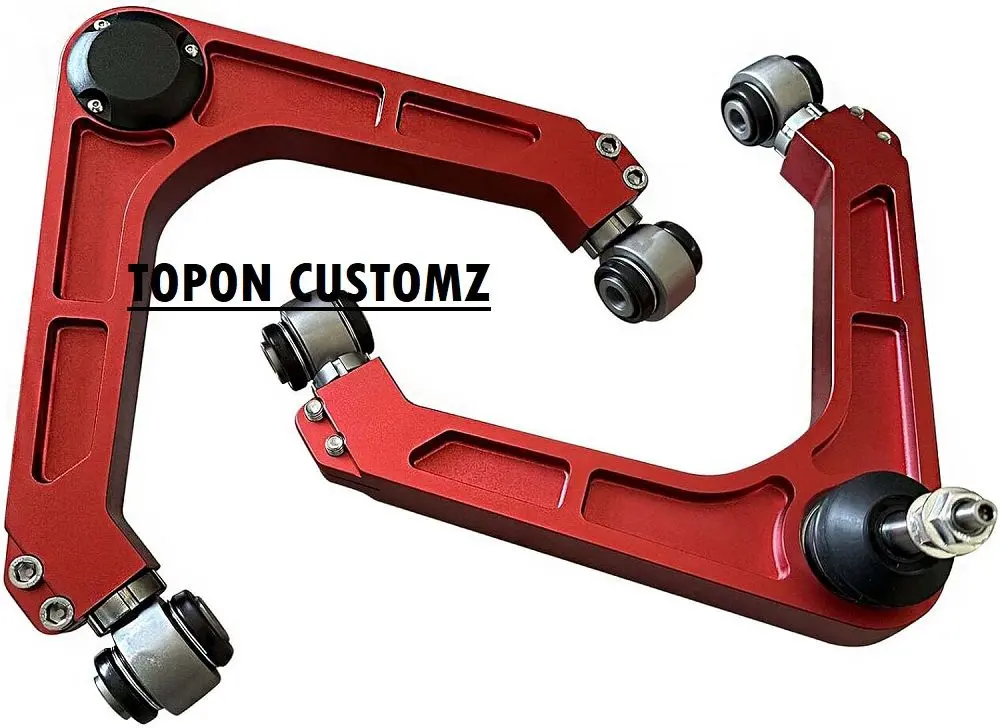
CNC machining removes material from a solid billet to achieve tight tolerances and complex geometries. It offers unmatched precision and flexibility, perfect for prototypes, low-volume production, and high-performance parts where exact specifications are critical. The downside is higher per-unit cost and material waste. CNC machining is common for custom suspension links, mounts, and performance components.
Stamping and Welding: Cost-Effective for Simple Structures
Stamping uses dies to cut and form sheet metal, while welding joins components. These processes are cost-effective for simple brackets, mounting plates, and structural parts at high volumes. However, they are limited in complexity and may not achieve the strength of forged or machined parts. Stamped and welded assemblies are often used in subframes and suspension arms where weight and cost are primary concerns.
Spring Manufacturing: Coiling, Heat Treatment, and Finishing
Springs require specialized processes: wire coiling, heat treatment to set properties, and finishing like shot peening to improve fatigue life. Wire material and manufacturing precision directly affect spring rate and durability. Coil springs typically use high-carbon steel alloys, and manufacturing must adhere to strict tolerances for consistent performance.
Material Selection: Steel Grades, Aluminum Alloys, and Performance Impact
Material choice is as critical as the manufacturing method. It influences strength, weight, corrosion resistance, and cost.
Steel Grades: Strength and Toughness
Steel remains the most common material for suspension parts due to its high strength and relatively low cost. Common grades:
- Carbon Steels: Good strength and formability, used for brackets and less critical components.
- Alloy Steels (e.g., 4140, 4340): Higher strength and toughness, used for control arms, knuckles, and other load-bearing parts. These alloys can be heat-treated to enhance mechanical properties.
Aluminum Alloys: Lightweight and Corrosion Resistant
Aluminum offers significant weight savings, improving fuel efficiency and handling. Common alloys:
- 6061: Good corrosion resistance and weldability, used for subframes and brackets.
- 7075: Higher strength, often used in high-performance applications, but more expensive and less weldable.
Aluminum parts are typically cast or forged, and may require surface treatments to prevent galvanic corrosion when in contact with steel.
Material Selection Criteria
When selecting a material, consider:
- Load-Bearing Requirements: Determine maximum forces the part will experience.
- Weight Reduction Goals: Aluminum can reduce weight by up to 50% compared to steel.
- Environmental Exposure: Corrosion resistance is critical in regions with road salt.
- Cost: Material cost and manufacturability (castability, forgeability, machinability) affect overall part price.
Quality Control and Testing: What to Look For in a Manufacturer
Quality assurance is non-negotiable for suspension parts, as failures can lead to accidents. Reputable manufacturers adhere to international standards and implement rigorous testing.
Relevant Standards
- ISO 9001: General quality management system.
- IATF 16949: Automotive-specific standard that includes additional requirements for defect prevention and continuous improvement.
Testing Procedures
Manufacturers should conduct:
- Material Verification: Spectrochemical analysis to confirm alloy composition.
- Mechanical Testing: Tensile, hardness, and impact tests to validate strength.
- Fatigue Testing: Simulates real-world loading cycles to ensure durability.
- Dimensional Inspection: CMM (coordinate measuring machine) checks to verify tolerances.
What to Ask a Manufacturer
- How do you inspect incoming raw materials?
- What in-process checks are performed?
- What final testing is done on finished parts?
- Can you provide traceability documentation for each batch?
Red Flags
- Lack of IATF 16949 or ISO 9001 certification.
- Vague answers about testing procedures.
- No traceability system for materials or processes.
At our facility, we adhere to these standards and maintain full traceability for every part we produce. Learn more about our quality control processes.
Supply Chain Considerations: Lead Times, MOQs, and Supplier Reliability
Production scheduling and cost management depend on understanding lead times and minimum order quantities (MOQs).
Lead Times by Manufacturing Method
- CNC Machining: Shortest lead time (days to weeks) as no tooling is required.
- Casting and Forging: Longer lead times (weeks to months) due to tooling creation and setup.
- Stamping: Moderate lead times, depending on die complexity.
Minimum Order Quantities (MOQs)
- CNC Machining: Low MOQs (even one-off prototypes) are feasible.
- Casting and Forging: High MOQs (thousands) are typical to amortize tooling costs.
- Stamping: Moderate to high MOQs.
Supplier Reliability
Assess potential suppliers on:
- Communication: Responsiveness and clarity in technical discussions.
- Track Record: Years in business and references from similar projects.
- Financial Stability: Ability to invest in equipment and weather market fluctuations.
- Capacity: Can they handle your volume without compromising quality?
Risk Mitigation Strategies
- Dual Sourcing: Use two suppliers for critical parts to avoid disruptions.
- Safety Stock: Maintain inventory to buffer against lead time variability.
- Clear Contracts: Define delivery schedules, penalties, and quality expectations.
Sustainability and Environmental Impact of Manufacturing Processes
Environmental considerations are increasingly important in procurement decisions. Different processes have varying footprints.
Energy Consumption and Emissions
- Casting and Forging: Energy-intensive due to melting and heating, resulting in higher CO2 emissions.
- CNC Machining: Lower energy use per part, but electricity consumption is still significant.
- Stamping and Welding: Moderate energy use.
Material Waste
- CNC Machining: Generates significant scrap (chips), though these are often recyclable.
- Casting and Forging: Near-net-shape processes reduce waste.
- Stamping: Can be efficient with nesting, but offal is produced.
Recyclability
Steel and aluminum are highly recyclable, and many manufacturers use recycled content. Consider the entire life cycle, including end-of-life recycling.
Regulatory Trends
OEMs are increasingly requiring suppliers to report on sustainability metrics. Choosing a manufacturer with a clear environmental policy can future-proof your supply chain.
How to Evaluate a Suspension Parts Manufacturer: Capabilities, Certifications, and Communication
Selecting the right partner involves more than comparing prices. Use this framework to vet potential manufacturers.
Technical Capabilities
- Equipment: Does the manufacturer have in-house machining, forging, or casting capabilities? Outsourcing can introduce quality variability.
- Engineering Support: Can they assist with design for manufacturability (DFM) and provide value engineering?
- Process Control: Do they use statistical process control (SPC) to monitor quality?
Certifications
- IATF 16949: Essential for automotive suppliers.
- ISO 9001: Baseline quality management.
- Customer-Specific Requirements: Some OEMs have additional certifications.
Communication
- Responsiveness: How quickly do they reply to inquiries?
- Transparency: Are they willing to share test data and audit results?
- Technical Depth: Can they discuss material properties and manufacturing trade-offs intelligently?
Practical Steps
- Request Samples: Evaluate material quality and finish.
- Conduct Audits: Visit the facility or request a virtual tour.
- Check References: Talk to existing customers.
At our manufacturing facility, we welcome customer audits and provide full transparency into our processes.
Making the Final Choice: A Decision Matrix for Your Suspension Parts
To synthesize the information, use this decision matrix to guide your selection.
Step-by-Step Decision Process
- Define Part Specifications: Load, environment, weight targets, and required tolerances.
- Shortlist Manufacturing Methods: Based on volume, cost, and performance needs.
- Evaluate Suppliers: Assess capabilities, certifications, and communication.
- Request Quotes and Samples: Compare not just price, but lead time, MOQ, and quality.
- Make Final Selection: Choose the supplier that best aligns with your overall requirements.
Key Factors to Weigh
- Application Requirements: Safety-critical parts demand forging or high-quality casting.
- Volume: High volumes justify tooling costs for casting or forging.
- Budget: Balance per-unit cost with tooling amortization.
- Quality Needs: Higher precision may require CNC machining.
- Sustainability Goals: Consider energy use and recyclability.
Example Decision Matrix
| Factor | Weight (%) | Casting | Forging | CNC Machining |
|--------|------------|---------|---------|---------------|
| Strength | 30 | 3 | 5 | 4 |
| Cost per Unit | 20 | 5 | 3 | 2 |
| Tooling Cost | 10 | 4 | 2 | 5 |
| Lead Time | 10 | 2 | 2 | 5 |
| Precision | 15 | 3 | 4 | 5 |
| Volume Flexibility | 15 | 3 | 3 | 5 |
| Total | 100 | 3.4 | 3.6 | 4.1 |
Scores are subjective and should be tailored to your specific needs.
By following this framework, you can make an informed decision that balances all critical factors. For more information on our capabilities, visit our about our company page or explore our range of automotive suspension components.
Note: The decision matrix is a general guide. Always consult with engineering experts to validate your specific application.