Suspension Kinematics Optimization: A Buyer’s Guide to Geometry, Trade-offs, and Real-World Performance

Suspension kinematics optimization is the process of tuning the geometric relationships of suspension links to achieve desired vehicle handling characteristics. For buyers and mechanics, understanding this process is critical because it directly influences grip, stability, and tire wear. This guide breaks down what you need to know to evaluate components and suppliers with confidence.
What Is Suspension Kinematics and Why Does It Matter for Your Purchase?
Suspension kinematics is the study of wheel motion relative to the chassis, ignoring forces like tire deflection and bushing compliance. It defines how camber, toe, and roll center change as the suspension travels. Optimization means adjusting these geometric parameters to balance understeer/oversteer, maximize tire contact, and ensure predictable behavior.
Why does this matter for your purchase? Because every suspension component—control arms, bushings, subframes—has a kinematic design that affects how your vehicle handles. A part that looks identical may perform differently due to subtle changes in hardpoint locations. When you buy a replacement or upgrade, you’re not just buying a piece of metal; you’re buying a set of kinematic properties.
For example, a control arm designed with optimized pivot points can improve camber gain, keeping the tire flat in corners. This translates to better cornering grip and even tire wear. Conversely, a poorly designed arm can introduce unwanted toe changes, making the car unstable under braking. As a buyer, you need to know what to look for in the specs and what questions to ask.
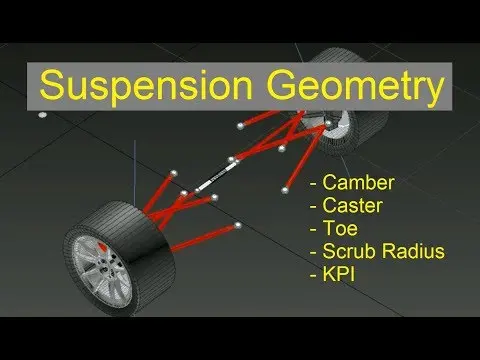
Key Kinematic Parameters: Camber, Caster, Toe, and Roll Center Explained
Camber
Camber is the vertical tilt of the wheel relative to the road. Negative camber (top of tire leans inward) increases cornering grip because it keeps the contact patch flatter during body roll. However, too much negative camber reduces straight-line braking traction and accelerates inner edge tire wear. Static camber is set at rest; dynamic camber changes with suspension travel. Optimization aims to provide enough negative camber gain in corners without sacrificing straight-line performance.
Caster
Caster is the angle of the steering axis when viewed from the side. Positive caster (steering axis tilted toward the driver) provides self-centering and straight-line stability, but too much can make steering heavy. Caster also influences dynamic camber in turns—more caster increases negative camber on the outside wheel. For most street vehicles, a moderate positive caster is ideal.
Toe
Toe is the angle of the wheels relative to the vehicle’s centerline when viewed from above. Toe-in (front of wheels closer together) improves straight-line stability but can reduce turn-in response. Toe-out does the opposite. Toe changes during suspension travel—called bump steer—can cause the car to dart under braking or over bumps. Kinematic optimization aims to minimize unwanted toe changes.
Roll Center
Roll center is the imaginary point about which the body rolls during cornering. Its height relative to the center of gravity determines body roll and jacking forces. A high roll center reduces body roll but can cause the vehicle to jack up (lift) during cornering, reducing grip. A low roll center increases body roll but can improve grip in some conditions. The optimal location depends on the vehicle’s intended use.
Optimization Methods: From Empirical Tuning to Simulation and Algorithms
Empirical Methods
Traditional empirical tuning involves adjusting suspension settings on a test track and measuring lap times or subjective feel. This is time-consuming and limited by driver variability, but it provides real-world validation. For aftermarket parts, manufacturers often use this to fine-tune designs.
Analytical Methods
For simple mechanisms, closed-form equations can predict kinematics. These are useful for quick calculations but become impractical for complex multi-link suspensions.
Simulation-Based Methods
Modern optimization relies on multibody dynamics software like ADAMS or CarSim. Engineers create a virtual model of the suspension, define hardpoints, and simulate various load cases. This allows rapid iteration and objective measurement of parameters like camber gain and roll center height.
Optimization Algorithms
To find the best compromise among conflicting goals, engineers use algorithms:
- Genetic Algorithms: Mimic natural selection to explore a wide design space. They are robust but computationally expensive.
- Neural Networks: Can model complex relationships but require large datasets for training.
- Response Surface Methods: Fit a polynomial to simulation results, allowing faster optimization.
Each has trade-offs in speed and accuracy. For a buyer, the key takeaway is that a manufacturer using simulation and algorithms is more likely to have explored the design space thoroughly than one relying solely on trial and error.
Simulation vs. Reality: Validating Optimization with Physical Testing
Simulation models have limitations: tire models are approximations, bushing compliance is hard to predict, and friction in joints is often ignored. Therefore, physical testing is essential to validate simulation results. A kinematic and compliance (K&C) test rig measures actual suspension behavior under controlled loads, providing ground truth.
Manufacturers that validate their designs with physical testing are more likely to deliver parts that perform as advertised. When evaluating a supplier, ask if they have K&C data for their products. If they only provide simulation results, be cautious—unvalidated designs may not behave as expected on the road.
Trade-offs and Pitfalls: Why Optimizing One Parameter Can Hurt Another
Optimization is about compromise. For example, aggressive negative camber improves cornering but reduces straight-line braking and tire life. A high roll center reduces body roll but can cause jacking. Compliance—the deflection of bushings under load—can be tuned to improve grip (e.g., toe compliance under braking) but can also introduce unpredictability.
A common pitfall is over-optimizing for track performance, which ruins ride comfort. Harsh bushings and aggressive geometry can make the car jittery on rough roads. Another pitfall is ignoring the interaction between kinematics and compliance. A control arm with optimized hardpoints but soft bushings may not deliver the intended geometry under load.
To avoid these issues, define clear objectives before optimization. Are you prioritizing cornering grip, ride comfort, or tire longevity? The best parts are those that balance these factors for your specific use case.
How to Choose Suspension Components Aligned with Your Kinematics Goals
- Define your goals: Street comfort, track performance, or a balance? This determines the kinematic targets.
- Look for adjustability: Components like camber plates or adjustable control arms allow fine-tuning to match your alignment specs.
- Check for kinematic data: Does the manufacturer provide camber gain curves or roll center heights? If not, ask.
- Consider compliance: Polyurethane or spherical bearings change kinematics under load. Choose based on intended use—spherical bearings offer precise control but transmit noise and vibration.
- Consult experts or use simulation tools: If you’re unsure, a professional alignment shop or suspension engineer can help.
The Role of Compliance: Kinematics vs. Compliance in Real-World Performance
Kinematics is geometry without forces; compliance is deflection under load. Both affect wheel alignment dynamically. For instance, a bushing that deflects under braking can cause toe-out, destabilizing the car. Conversely, designed compliance can improve grip by allowing the tire to remain flat under load.
When selecting parts, consider both kinematic design and compliance characteristics. For example, our Large suspension bushing is designed to provide controlled compliance for Hyundai and KIA vehicles, maintaining alignment while absorbing road impacts. Similarly, control arms with optimized hardpoints ensure proper camber and caster curves.
Case Study: Applying Kinematics Optimization to a Front Control Arm Upgrade
Consider a MacPherson strut front suspension on a popular vehicle. The lower control arm’s pivot points determine the roll center height and camber gain. By moving the inner pivot slightly upward, engineers can raise the roll center, reducing body roll. However, this may increase camber loss during compression, hurting cornering grip.
To optimize, a manufacturer would simulate various pivot locations, measuring roll center height, camber gain, and toe change. They would then select a compromise that improves cornering without sacrificing braking stability. Physical testing on a K&C rig would validate the simulation.
For a buyer, this means a control arm with relocated pivot points can offer real performance benefits, but only if the manufacturer has done the engineering. Look for products that come with data or at least explain the design rationale.
Conclusion
Suspension kinematics optimization is not just for race teams—it affects every vehicle’s handling and tire life. By understanding the key parameters and trade-offs, you can make informed decisions when purchasing suspension components. Always consider your driving goals, ask for kinematic data, and choose parts that balance performance and comfort. With the right knowledge, you can transform your vehicle’s dynamics and enjoy a safer, more responsive ride.