Suspension Geometry Comparison: Cars, Motorcycles, Bicycles, and EVs

Suspension geometry determines how a vehicle handles, rides, and wears its tires. Whether you're buying parts for a car, motorcycle, or bicycle, understanding these angles helps you make choices that optimize performance and safety. This guide compares geometry across vehicle types, explains key angles, and shows how modifications affect real-world behavior.
Key Angles and Their Effects
Suspension geometry is defined by several critical angles that influence stability, cornering, and tire contact.
- Camber: The wheel's tilt from vertical. Negative camber (top leans inward) improves cornering grip but can cause inner-edge tire wear if excessive. Positive camber (top leans outward) is rare and usually reduces grip.
- Caster: The steering pivot's angle from vertical, viewed from the side. Positive caster (pivot leans backward) enhances straight-line stability and steering return. More caster increases steering effort but improves high-speed stability.
- Toe: The wheels' angle relative to the vehicle's centerline, viewed from above. Toe-in (front edges closer) aids stability; toe-out improves turn-in response. Incorrect toe causes rapid tire wear: toe-in wears outer edges, toe-out wears inner edges.
- Ackermann: Steering geometry that makes the inner wheel turn more sharply than the outer wheel during a turn, reducing tire scrub. Proper Ackermann ensures smooth cornering and even tire wear.
- Anti-squat: Rear suspension geometry that resists squatting under acceleration. It improves traction but can compromise ride comfort if excessive.
- Anti-dive: Front suspension geometry that resists nose-diving under braking. It maintains stability but can make the ride harsh if over-tuned.
- Roll center: The imaginary point around which the body rolls during cornering. A higher roll center reduces body roll but can increase jacking forces, potentially lifting the inside wheel.
These angles are tuned to balance grip, comfort, and durability. For example, a street car might use -0.5° camber for even tire wear, while a track car might use -3° for maximum cornering force. The trade-off is always between tire contact patch, stability, and component stress.
Car Suspension Geometry: Design, Effects, and Modifications
Car suspension geometry is designed to keep the tire contact patch flat on the road through braking, accelerating, and cornering. Front and rear suspensions have different roles.
Front vs. Rear Suspension
- Front: Typically uses MacPherson struts or double wishbones. Caster and camber are adjustable to balance steering feel and tire wear. Toe is set to minimize rolling resistance and tire scrub.
- Rear: Often a solid axle (on trucks) or independent setup (on cars). Rear camber and toe affect stability during cornering and braking. Solid axles have simpler geometry but can suffer from axle hop under hard acceleration.
Effects on Handling, Tire Wear, and Ride Comfort
- Camber: Too much negative camber wears the inner edge; too little reduces cornering grip.
- Caster: More caster increases steering effort but improves high-speed stability.
- Toe: Incorrect toe causes rapid tire wear—toe-in wears the outer edges, toe-out wears the inner edges.
- Roll center: A higher roll center reduces body roll but can increase jacking forces.
Common Modifications and Their Consequences
- Lowering: Lowers the center of gravity and reduces body roll, but it also changes roll center height, scrub radius, and bump steer. If not done with proper alignment, it can cause premature tire wear and poor ride quality.
- Lifting: Raises the vehicle, increasing ground clearance but raising the roll center, which can make the vehicle feel tippy. It also alters caster and camber, often requiring correction brackets.
- Anti-squat/anti-dive: Modifying these can improve acceleration or braking stability but may compromise ride comfort.
When you change ride height, you're not just changing looks—you're altering the entire geometry. Always get a professional alignment after any suspension modification.
Motorcycle Suspension Geometry: Unique Considerations for Two Wheels
Motorcycles rely on two wheels, so their geometry is fundamentally different from cars. Key parameters are rake (head angle) and trail, which govern steering stability and agility.
Rake and Trail
- Rake: The angle of the steering axis from vertical. A steeper rake (smaller angle) gives quicker steering; a slacker rake (larger angle) adds stability.
- Trail: The horizontal distance from the front tire contact patch to the point where the steering axis intersects the ground. More trail increases stability; less trail makes the bike turn faster.
Geometry Across Motorcycle Types
- Sport bikes: Steep rake (around 24°) and short trail for quick turn-in.
- Touring bikes: Slack rake (around 30°) and long trail for straight-line stability.
- Off-road bikes: Long suspension travel and geometry that balances front-end grip on climbs with stability on descents.
Impact of Geometry Changes
Adjusting ride height (e.g., raising the rear) changes rake and trail, affecting handling. Lowering the front or raising the rear steepens the rake, making the bike turn faster but less stable. These adjustments are common for track days but should be done carefully.
Bicycle Suspension Geometry: Off-Road Performance and Fit
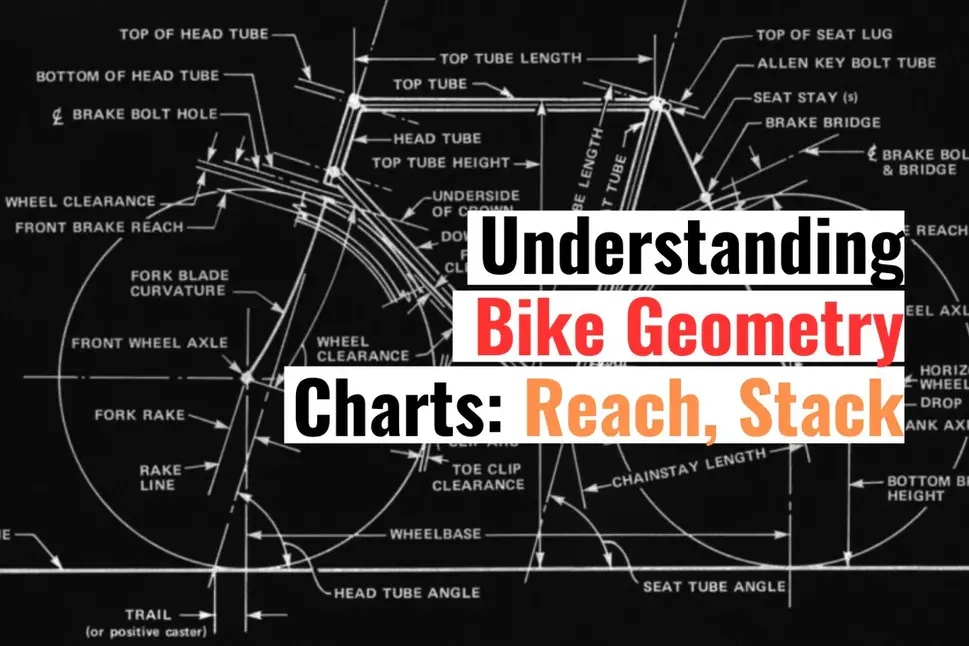
Mountain bikes have their own geometry language, but the principles are similar. Key measurements include head tube angle, wheelbase, chainstay length, and bottom bracket drop.
Key Parameters
- Head tube angle: The angle of the front fork from horizontal. A slacker angle (65° or less) improves downhill stability; a steeper angle (68°+) makes the bike more agile on climbs.
- Wheelbase: The distance between front and rear axles. Longer wheelbases are more stable at speed; shorter ones are more maneuverable.
- Chainstay length: The distance from the bottom bracket to the rear axle. Shorter chainstays make the bike easier to wheelie and accelerate; longer ones add stability.
- Bottom bracket drop: How far the bottom bracket sits below the wheel axles. A lower drop lowers the center of gravity, improving cornering but reducing pedal clearance.
Geometry by Discipline
- Cross-country (XC): Steeper head angle (69-70°), shorter wheelbase, and higher bottom bracket for efficient climbing.
- Trail: Balanced geometry (65-67°) for all-around riding.
- Downhill (DH): Slack head angle (62-64°), long wheelbase, and low bottom bracket for high-speed stability.
These parameters determine how the bike handles on technical terrain. A slacker head angle makes the front wheel less likely to wash out on descents, but it can make the bike feel sluggish on switchbacks.
Direct Comparison: Cars vs. Motorcycles vs. Bicycles
Despite their differences, all three vehicle types follow the same physics: the tire contact patch must be optimized for grip, and weight transfer must be managed.
Similarities
- Camber: Cars and motorcycles use camber to maximize tire contact during cornering. Bicycles don't have adjustable camber, but the frame's geometry affects how the wheels lean.
- Toe: Cars and motorcycles have toe adjustments to stabilize straight-line running. Bicycles don't have toe, but the fork's offset affects steering.
- Weight transfer: All three use anti-squat and anti-dive principles to manage weight transfer during acceleration and braking.
Differences
- Number of wheels: Cars have four wheels, so they can use geometry to distribute loads across all tires. Motorcycles and bicycles lean into corners, so they rely on rake and trail to maintain balance.
- Design priorities: Cars prioritize comfort and tire wear; motorcycles prioritize stability and agility; bicycles prioritize climbing and descending capability.
- Adjustability: Cars have the most adjustable geometry (camber, caster, toe). Motorcycles have limited adjustability (ride height, fork offset). Bicycles are the least adjustable, but frame geometry is tailored to the rider's needs.
Understanding these universal principles helps you make informed decisions when buying or modifying suspension components.
Practical Guide: Measuring and Adjusting Suspension Geometry at Home
You can measure basic suspension geometry at home with the right tools. Here's how to get started.
Tools Needed
- Camber gauge: A digital or bubble gauge that attaches to the wheel hub.
- Toe plates or tape measure: To measure toe across the front and rear of the tires.
- Plumb bob: For measuring caster.
- Smartphone app: For measuring bike head angle (using the built-in gyroscope).
Measuring Car Camber, Caster, and Toe
- Camber: Park on a level surface. Attach the camber gauge to the wheel hub and read the angle. Compare to manufacturer specs.
- Caster: Turn the steering wheel 20° left and right, measuring the camber change. Use a caster gauge or calculate from the camber readings.
- Toe: Use toe plates or a tape measure to compare the distance between the front and rear of the front tires. Adjust tie rods to achieve the specified toe.
Measuring Bike Geometry
- Head tube angle: Use a smartphone app with a protractor. Place the phone against the head tube and read the angle.
- Wheelbase: Measure from the center of the front axle to the center of the rear axle.
- Chainstay length: Measure from the bottom bracket center to the rear axle center.
Limitations
Home measurements are approximate. For precise alignment, especially after modifications, visit a professional shop with laser alignment equipment.
Suspension Geometry and Electric Vehicles: New Challenges and Opportunities
Electric vehicles (EVs) are changing suspension design due to their heavy batteries and instant torque.
Added Weight and Low Center of Gravity
EVs are 20-30% heavier than comparable gas cars, but the battery is mounted low, giving a lower center of gravity. This reduces body roll but increases suspension loads. Engineers must tune geometry to handle the extra mass without compromising ride comfort.
Regenerative Braking and Anti-dive
Regenerative braking can decelerate the car without using the friction brakes, but it still causes nose dive. Anti-dive geometry must be tuned to handle both braking modes. Some EVs use brake-by-wire to blend regenerative and friction braking smoothly.
EV-Specific Suspension Parts
Aftermarket manufacturers are developing control arms and bushings with stiffer materials to handle the added weight. For example, our Large suspension bushing and Large suspension bushing are designed to reduce deflection under load, improving alignment stability. When upgrading an EV, choose parts that are rated for the vehicle's weight and torque.
Frequently Asked Questions
What is the most important suspension geometry angle?
It depends on the vehicle and use. For cars, camber and toe are critical for tire wear; for motorcycles, rake and trail are crucial for stability; for bikes, head tube angle and wheelbase define handling.
Can I adjust suspension geometry myself?
Yes, but you need the right tools and knowledge. For cars, you can adjust camber and toe with basic tools, but caster is harder. For bikes, you can change fork offset or ride height, but frame geometry is fixed.
How does lowering affect suspension geometry?
Lowering lowers the center of gravity and reduces body roll, but it also changes roll center, scrub radius, and bump steer. You may need adjustable control arms to correct alignment.
What are the signs of incorrect suspension geometry?
Uneven tire wear, pulling to one side, poor handling, and a steering wheel that isn't centered are common signs.
Conclusion: Key Takeaways
Suspension geometry is a complex but essential aspect of vehicle design. Whether you're a buyer, mechanic, or DIY enthusiast, understanding how camber, caster, toe, rake, trail, and head angle affect handling and tire wear will help you make better decisions. Always measure before and after modifications, and use quality parts from reputable manufacturers. For more information on suspension components, explore our automotive suspension components or learn about our manufacturing facility.