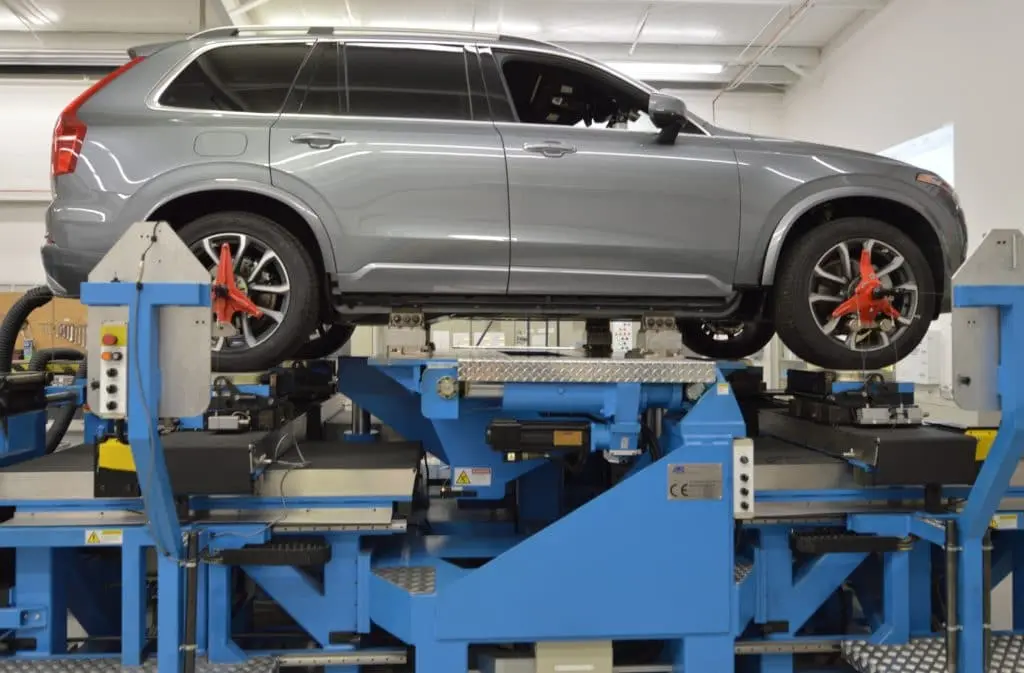
Suspension Dynamic Testing: A Buyer’s and Manufacturer’s Guide to Quality Assurance

Dynamic suspension testing evaluates how components behave under real-world forces, frequencies, and temperatures—conditions that static tests cannot replicate. For buyers and manufacturers, understanding dynamic testing is critical for making informed decisions about component quality, safety, and durability. This guide explains why dynamic testing matters, how it compares to other methods, and how to apply it effectively.
Why Dynamic Testing Matters: Beyond Quasi-Static Analysis
Dynamic testing captures the real-world forces, frequencies, and temperatures that quasi-static tests miss. Quasi-static tests, such as K&C (Kinematics and Compliance) testing, apply loads slowly and measure steady-state responses. They are valuable for characterizing geometric and compliance properties but do not reveal how components respond to rapid inputs like potholes, road irregularities, or engine vibrations.
Dynamic testing applies realistic inputs—road profiles, sinusoidal sweeps, random vibrations—to assess behavior under load and frequency. It reveals issues like resonance, damping fade, and fatigue that static tests cannot. For example, a bushing may perform well under static load but exhibit excessive deflection or heat generation under dynamic cycling, leading to premature failure. Dynamic testing validates components for safety and durability, ensuring they meet performance expectations throughout their service life.
For buyers and manufacturers, dynamic testing provides confidence that components will perform reliably in the field, reducing warranty claims and enhancing brand reputation.
Dynamic Testing vs. K&C Testing vs. Simulation: Choosing the Right Approach
Choosing the right testing approach depends on the stage of development, budget, and specific performance questions. Here’s a breakdown of each method:
- K&C Testing: Measures kinematic and compliance characteristics under controlled, quasi-static conditions. It uses a rig to apply forces and moments to the suspension while measuring wheel positions and angles. K&C is ideal for validating suspension geometry, roll centers, and alignment curves. It is relatively fast and cost-effective but does not capture dynamic effects.
- Dynamic Testing: Applies real-world inputs (road profiles, forces) to assess behavior under load and frequency. This includes rig-based testing (e.g., four-post shakers, servo-hydraulic actuators) and on-road testing with instrumented vehicles. Dynamic testing reveals resonance, damping, and fatigue characteristics. It is more complex and expensive but provides critical data for ride comfort, handling, and durability.
- Simulation: Uses mathematical models to predict behavior. Tools like ADAMS or CarSim simulate suspension dynamics under various inputs. Simulation is useful early in design to explore concepts and optimize parameters. However, it requires validation with physical testing to ensure accuracy. Simulation reduces the number of prototypes and test iterations, saving time and cost.
Decision Framework: Use K&C testing for geometric validation, dynamic testing for performance validation under realistic conditions, and simulation for early design exploration. Combine methods: simulation to narrow down designs, K&C to verify kinematics, and dynamic testing to confirm real-world performance.
Step-by-Step Guide to Conducting a Dynamic Suspension Test
Conducting a dynamic suspension test involves several steps, from defining objectives to reporting results. Follow this guide to ensure accurate and meaningful data.
1. Define Test Objectives and Select Standards
Clearly state what you want to measure: ride comfort, handling, durability, or specific component behavior. Select relevant test standards, such as ISO 8628 (road vehicles — test method for the evaluation of the ride comfort) or SAE J670 (vehicle dynamics terminology). Standards provide a framework for test procedures and acceptance criteria.
2. Prepare the Vehicle or Component
Instrument the vehicle or component with sensors: accelerometers, displacement transducers, strain gauges, and load cells. Ensure proper mounting and calibration. Set up a data acquisition system to record signals at a sufficient sampling rate (typically >1 kHz for dynamic events). For component testing, use a servo-hydraulic test rig capable of applying dynamic loads.
3. Execute the Test
Run various road profiles or load cases. For full-vehicle testing, use a four-post rig to simulate road inputs. For component testing, apply sinusoidal or random loads at specified amplitudes and frequencies. Monitor data in real-time to detect anomalies. Follow the test plan, including any conditioning or pre-loading procedures.
4. Analyze Data
Filter and process the data to remove noise. Compute key metrics such as natural frequency, damping ratio, and transmissibility. Compare results against acceptance criteria. Document findings and identify any failures or performance issues.
Data Analysis and Interpretation: Turning Test Results into Decisions
Data analysis transforms raw test data into actionable insights. Key metrics include:
- Natural Frequency: The frequency at which a system oscillates without external force. For suspension, this affects ride comfort. High natural frequencies can cause harshness, while low ones may lead to poor handling.
- Damping Ratio: Indicates how quickly oscillations decay. Optimal damping balances comfort and control. Under-damping causes excessive bouncing; over-damping can lead to harshness.
- Transmissibility: The ratio of output amplitude to input amplitude across frequencies. It shows how forces are transmitted from the road to the chassis. Peaks indicate resonance points.
- Fatigue Life: Estimated from strain or load data using cumulative damage models (e.g., Palmgren-Miner rule). Dynamic testing can accelerate fatigue by applying repeated loads.
Use data analysis software (e.g., MATLAB, nCode) for signal processing and visualization. Plot time histories, frequency spectra, and transfer functions. Interpret results against specifications: if natural frequency is outside the target range, the component may need redesign. Identify failure modes: cracks, excessive wear, or fluid leaks.
Case Example: A control arm bushing showed excessive deflection under dynamic load, leading to poor wheel alignment. Data analysis revealed a resonance at 30 Hz, causing high transmissibility. Redesigning the bushing durometer shifted the natural frequency, improving performance.
Common Challenges and Solutions in Dynamic Testing
Dynamic testing presents several challenges. Here are common issues and practical solutions:
- Challenge: Sensor Noise and Signal Integrity
- Solution: Use shielded cables, proper grounding, and differential amplifiers. Apply low-pass filters to remove high-frequency noise. Calibrate sensors regularly.
- Challenge: Test Repeatability and Variability
- Solution: Follow standardized procedures and control environmental conditions (temperature, humidity). Use multiple test runs and average results. Ensure consistent mounting and preload.
- Challenge: Correlating Test Results with Real-World Performance
- Solution: Conduct correlation studies by comparing test data with on-road measurements. Adjust test inputs to better match real-world conditions. Use validated simulation models to bridge gaps.
Industry Standards and Regulatory Compliance for Dynamic Testing
Adhering to industry standards ensures consistency and market acceptance. Key standards include:
- ISO 8628: Specifies a method for evaluating ride comfort using sinusoidal or random inputs.
- SAE J670: Defines vehicle dynamics terminology, including suspension terms.
- Other relevant standards: ISO 2631 (human exposure to vibration), ASTM D5992 (fatigue testing of elastomeric materials).
Regulatory requirements vary by region. For example, the UN ECE R51 (noise) and R13 (braking) indirectly affect suspension design. Ensuring your testing meets these standards is crucial for certification and customer requirements. Work with accredited laboratories that follow these standards.
Future Trends in Suspension Testing: AI, Machine Learning, and Beyond
Emerging technologies are reshaping dynamic testing:
- AI and Machine Learning: Used for predictive maintenance and test optimization. ML algorithms can analyze vast datasets to identify patterns and predict failures before they occur.
- Digital Twins: Virtual replicas of physical systems that simulate real-time behavior. Digital twins allow for virtual testing, reducing the need for physical prototypes.
- Real-Time Data Analytics and Cloud-Based Testing: Enable remote monitoring and analysis, accelerating test cycles and collaboration.
These trends will reduce cost, speed up development, and improve accuracy. For example, AI can optimize test schedules based on predicted wear, and digital twins can explore extreme scenarios without risk.
Choosing a Testing Service Provider: Criteria and Questions to Ask
Selecting a reliable testing partner is critical. Consider these criteria:
- Accreditation: Look for ISO 17025 accreditation or equivalent.
- Experience: Choose a provider with expertise in suspension testing for your industry.
- Equipment Capabilities: Ensure they have the necessary rigs, sensors, and data acquisition systems.
- Data Quality: Ask about their data processing and reporting practices.
Questions to Ask:
- What standards do you follow?
- Can you provide references from similar projects?
- How do you handle data confidentiality?
- What is your typical turnaround time?
Cost Considerations: Outsourcing testing can be cost-effective if you lack equipment. In-house testing offers control but requires significant investment. Evaluate ROI based on your testing frequency and needs.
Conclusion: Leveraging Dynamic Testing for Superior Vehicle Performance
Dynamic suspension testing is indispensable for ensuring safety, durability, and performance. By understanding the methods, data interpretation, and industry standards, buyers and manufacturers can make informed decisions. Embrace future trends like AI and digital twins to stay ahead. Whether you are developing new components or sourcing parts, dynamic testing provides the evidence needed to deliver quality.
For high-quality suspension components that meet rigorous testing standards, explore our automotive suspension components and learn about our quality control processes.