Suspension Compliance Testing: How to Read K&C Data for Smarter Parts Buying

Suspension compliance testing—often called Kinematics and Compliance (K&C) testing—measures how suspension components deflect under load, directly affecting tire grip, stability, and ride comfort. For buyers, understanding this data is the difference between choosing parts based on specs that look good on paper versus parts that actually perform on the road.
What Is Suspension Compliance Testing and Why Should You Care?
Suspension compliance testing quantifies how much suspension components deflect when forces are applied at the tire contact patch. It answers a simple question: when you hit a bump, brake hard, or corner aggressively, how much do the bushings and links give? That deflection—compliance—determines whether your tires stay planted, whether the car tracks straight, and whether you feel every imperfection in the road.
Why should a parts buyer care? Because compliance is what separates a comfortable daily driver from a harsh, unpredictable one. A control arm with a bushing that's too stiff might improve steering response but transmit every road shock into the cabin. Conversely, a bushing that's too soft can cause vague handling and premature tire wear. Compliance testing gives you objective data to compare these trade-offs.
When you're shopping for replacement bushings or control arms, basic specs like dimensions and material tell you little about how the part will behave under load. K&C data reveals the actual deflection characteristics, allowing you to match parts to your driving needs—whether that's OEM comfort or track-focused precision.
Kinematics vs. Compliance: The Two Sides of Suspension Behavior
Kinematics and compliance are two distinct aspects of suspension behavior, and K&C testing measures both. Kinematics refers to how the suspension geometry changes as the wheel moves through its travel—camber, toe, and caster angles as a function of vertical displacement. This is purely geometric, assuming rigid components.
Compliance, on the other hand, is the deflection that occurs in flexible elements—bushings, mounts, and even the arms themselves—when forces are applied. Under lateral cornering, longitudinal braking, or vertical loading, these components deform, altering the wheel alignment beyond what kinematics alone predicts.
For example, a control arm bushing might allow the wheel to toe-out slightly under braking, which can stabilize the car or cause it to wander depending on the design. K&C testing captures these effects, giving engineers and buyers a complete picture of how a suspension will behave in real-world conditions.
Buyers often overlook compliance because it's invisible in static specs. But it's the reason two seemingly identical control arms can feel completely different on the road. When you see K&C data, you're looking at the hidden layer of suspension performance.
How K&C Testing Works: Equipment and Procedures
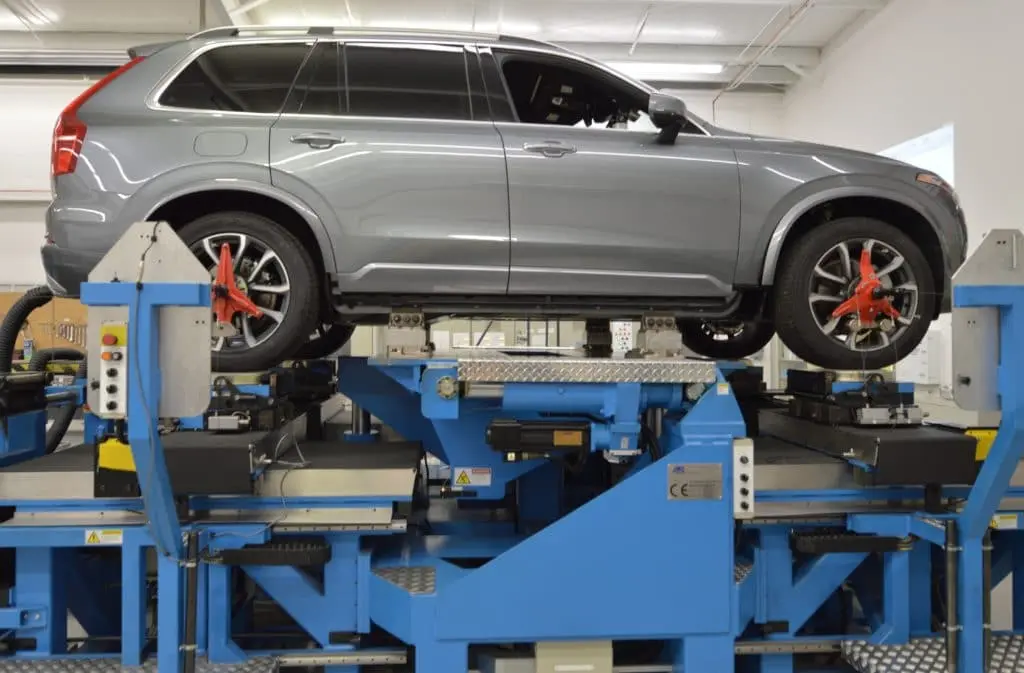
K&C testing is performed on a specialized rig that applies controlled forces to the tires while measuring the suspension's response. The vehicle is typically mounted on platforms that can move independently, allowing engineers to simulate lateral, longitudinal, and vertical loads.
The core equipment includes:
- Platforms that support each wheel and can apply forces or displacements in multiple directions.
- Actuators that generate precise forces (e.g., up to several kilonewtons) or displacements.
- Sensors that measure wheel position, forces, and moments at each corner.
- Data acquisition systems that record everything at high frequency.
Typical tests include:
- Lateral compliance test: A side force is applied to the tire contact patch, and the resulting toe and camber changes are measured. This reveals how the suspension deflects under cornering loads.
- Longitudinal compliance test: A fore-aft force is applied, simulating braking or acceleration, to measure deflection in the trailing arm or control arm bushings.
- Vertical compliance test: The platform moves vertically to simulate road inputs, measuring how the suspension absorbs bumps and how geometry changes with travel.
Industry standards, such as those from ISO and SAE, ensure that these tests are performed consistently across labs. For example, ISO 8854 and SAE J670 define coordinate systems and measurement procedures, so data from different sources can be compared.
Interpreting K&C Test Results: Key Metrics for Ride and Handling
K&C test results are typically presented as graphs showing how alignment angles change with applied forces or wheel travel. Here are the key metrics to look for:
- Lateral force compliance steer: This measures how much toe changes per unit of lateral force. If a car has high lateral force compliance steer, it may feel unstable during cornering because the rear wheels are steering slightly. A lower value generally indicates more predictable handling.
- Longitudinal compliance: This shows how much the wheel moves fore-aft under braking or acceleration. Excessive compliance can cause a vague brake pedal feel or rear-end squat under power.
- Camber gain: This is the change in camber angle per unit of wheel travel. It affects cornering grip—more negative camber gain can improve grip in corners but may reduce straight-line stability.
- Toe compliance: This indicates how toe angle changes under longitudinal forces. For example, a rear suspension that toes-in under braking can enhance stability, while toe-out can cause twitchiness.
When reading a K&C graph, look at the slope of the curve. A steep slope means high compliance (more deflection per unit force), while a flat slope indicates stiffness. For ride comfort, you generally want some compliance to absorb road imperfections, but too much can hurt handling.
For example, a graph of toe vs. lateral force might show a curve that rises steeply at first, then levels off. The initial slope indicates how much the bushing deflects under light loads—important for on-center feel. The plateau suggests the bushing has bottomed out or is limited by its design.
Relate these metrics to your driving experience: if you feel the car wander during hard braking, check the longitudinal compliance data. If it feels unstable in crosswinds, look at lateral force compliance steer.
Why Compliance Testing Matters in Vehicle Development and Benchmarking
OEMs use K&C testing extensively during vehicle development. They set target values for each metric to achieve a desired balance of ride and handling. For example, a luxury sedan might prioritize low longitudinal compliance for a stable, quiet ride, while a sports car might accept higher compliance in exchange for better cornering grip.
Aftermarket manufacturers should also test their parts to ensure they don't degrade these characteristics. A replacement control arm with a bushing that's too stiff might improve steering response but could introduce harshness or even cause premature wear on other components. K&C testing helps aftermarket parts match or improve upon OEM performance.
Benchmarking is another critical use. By measuring a competitor's vehicle or part, engineers can understand how it achieves its performance and set targets for their own designs. For buyers, this means that when a manufacturer provides K&C data, they're showing that their parts have been validated against real-world performance standards—not just designed on a computer.
How to Use Compliance Data When Buying Suspension Parts
When you're evaluating aftermarket suspension parts, here's how to put compliance data to work:
- Ask for K&C test reports or data sheets. Reputable manufacturers should be able to provide data from their parts, either from their own testing or from independent labs. If they can't, that's a red flag.
- Compare to OEM benchmarks. If you have the OEM K&C data for your vehicle, compare the aftermarket part's curves. Look for areas where the aftermarket part deviates significantly—this could indicate a change in ride or handling.
- Look for parts that improve or maintain compliance characteristics. A good aftermarket bushing might offer lower deflection for better precision, but it shouldn't compromise durability. Check that the bushing material and design are appropriate for your use case.
For example, if you're replacing a rear trailing arm bushing on a Hyundai KIA, you can look for parts that match the OEM compliance curve. Our Large suspension bushing and Large suspension bushing are designed to meet or exceed OEM specifications, ensuring that your suspension behaves as intended.
Remember, compliance testing is not just for race cars. Even daily drivers benefit from parts that are properly tuned. By understanding K&C data, you can make an informed choice that balances comfort, handling, and durability.
Buyer's Checklist: Key K&C Metrics and What to Look For
| Metric | What It Measures | Ideal Characteristic | Red Flag |
|--------|------------------|----------------------|----------|
| Lateral force compliance steer | Toe change per unit lateral force | Low value for predictable handling | High value causing instability |
| Longitudinal compliance | Fore-aft wheel movement under braking/accel | Moderate for comfort without vagueness | Excessive causing brake feel issues |
| Camber gain | Camber change per wheel travel | Sufficient negative gain for cornering grip | Excessive positive gain causing understeer |
| Toe compliance | Toe change under longitudinal forces | Toe-in under braking for stability | Toe-out causing twitchiness |
Use this checklist when comparing parts: if a manufacturer provides K&C data, verify these metrics align with your driving priorities. If data is unavailable, ask for it—or consider that a lack of data may indicate insufficient testing.
Conclusion
Suspension compliance testing is a powerful tool that reveals how your suspension will perform under real-world forces. By understanding the difference between kinematics and compliance, how tests are conducted, and how to interpret the results, you can make smarter purchasing decisions. Whether you're replacing a worn bushing or upgrading for performance, always ask for K&C data and compare it to OEM benchmarks. That data is your best guide to parts that deliver the ride and handling you expect.