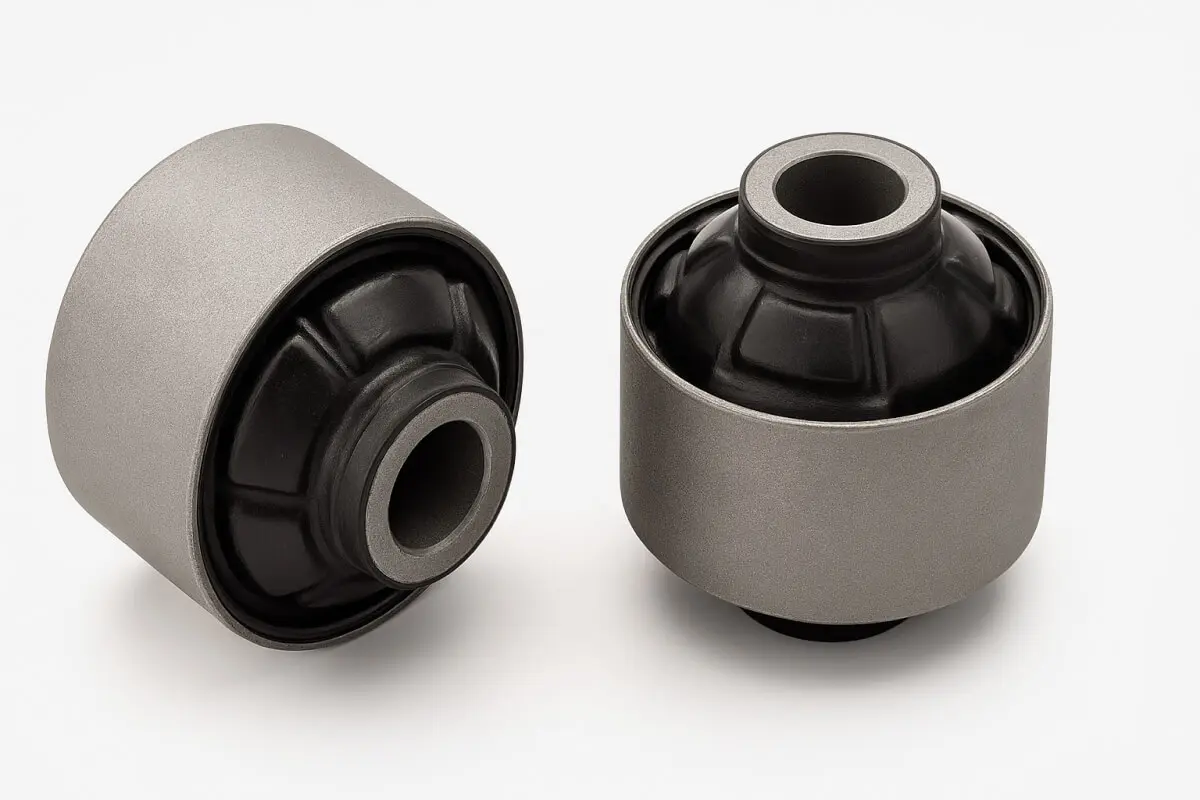
Suspension Bushing Design: Engineering for Durability and Performance

The best suspension bushing for your vehicle depends on the specific demands of your application: rubber offers comfort and noise isolation, polyurethane provides performance and durability, and bronze suits high-load industrial uses. OEM parts are designed for a balance of factors, while aftermarket options may prioritize performance or cost, but quality varies. Understanding how bushings are designed—material selection, load case analysis, and manufacturing constraints—helps you make informed purchasing or replacement decisions.
What Suspension Bushings Do and Why Design Matters
Bushings are the flexible pivots in your suspension system. They connect control arms, trailing arms, and subframes to the chassis, allowing controlled movement while absorbing road shocks and vibrations. Without them, every bump would transmit directly to the cabin, and metal-on-metal contact would cause rapid wear and failure.
Design matters because bushings must withstand multi-axial loads—from braking, cornering, and rough roads—while enduring temperature extremes from -40°C to over 100°C, and exposure to oil, salt, and UV radiation. A poorly designed bushing can lead to premature failure, compromised handling, and uncomfortable rides. Conversely, a well-designed bushing balances stiffness for precise wheel control with compliance for NVH isolation, extending the life of the entire suspension system.
Bushing Material Comparison: Rubber vs. Polyurethane vs. Bronze
Choosing the right material is the first major design decision. Each material offers distinct trade-offs:
Rubber (natural or synthetic) is the OEM standard for most passenger vehicles. It excels at isolating NVH because its viscoelastic properties absorb high-frequency vibrations. Rubber is also compliant, allowing the suspension to articulate freely. However, rubber degrades over time—exposure to oil, ozone, and UV radiation causes cracking and hardening. It also has a shorter fatigue life compared to polyurethane, especially under high loads.
Polyurethane is a popular aftermarket upgrade. It is stiffer than rubber, providing sharper handling response and better durability—it resists oil, ozone, and abrasion. However, this stiffness transmits more NVH to the cabin, and polyurethane bushings often require periodic lubrication to prevent squeaking. They are ideal for performance-oriented drivers who prioritize handling over comfort.
Bronze (or other metal-based bushings) are used in heavy-duty and industrial applications. They offer the highest load capacity and low friction, making them suitable for extreme conditions like off-road racing or commercial vehicles. But they are harsh for road use—no vibration isolation—and require precise lubrication. They are rarely used in passenger vehicles.
When selecting a material, consider the vehicle's intended use. For daily drivers, rubber offers the best balance. For track or off-road use, polyurethane or bronze may be justified. Always weigh the trade-offs: comfort vs. durability, cost vs. performance.
Key Design Considerations: Load, Deflection, and Environment
Designing a bushing requires analyzing the loads it will face and the deflection (movement) it must allow.
Load cases include static loads (vehicle weight), dynamic loads (acceleration, braking, cornering), and impact loads (potholes, curbs). Bushings experience multi-axial forces—radial, axial, and torsional—often simultaneously. Engineers must calculate the maximum expected loads and design the bushing to survive them without excessive stress or fatigue.
Deflection requirements are a trade-off. More compliance (softer bushing) improves NVH isolation but reduces handling precision. Less compliance (stiffer bushing) sharpens response but transmits more road noise. The design must specify the desired stiffness in each direction (radial, axial, torsional) to meet vehicle dynamics targets.
Environmental factors are often overlooked but critical. Temperature extremes affect rubber's elasticity—it becomes brittle in cold and softens in heat. Chemical exposure (oil, fuel, salt) can degrade rubber. UV radiation causes surface cracking. Designers must select materials that withstand the expected environment, and may add protective features like dust boots or coatings.
Manufacturing Processes and Design for Manufacturability (DFM)
How a bushing is manufactured directly impacts its quality and consistency. Two main processes dominate:
Rubber bushings are typically compression molded. The rubber compound is placed in a mold with the inner and outer metal sleeves, then heated and pressed to bond the rubber to the metal. The bond integrity is crucial—if adhesion fails, the bushing will tear apart under load. Design for manufacturability (DFM) ensures uniform wall thickness to avoid voids or weak spots, and proper draft angles for easy demolding.
Polyurethane bushings are often cast or injection molded. Casting allows for complex shapes but requires careful control of curing time and temperature. Post-curing is sometimes needed to achieve final properties. DFM for polyurethane involves designing for uniform thickness to prevent shrinkage cracks and ensuring proper venting to avoid air pockets.
Regardless of material, DFM principles apply: avoid sharp corners that create stress concentrations, design for uniform wall thickness, and ensure the bonding surfaces are clean and properly prepared. A design that is difficult to manufacture will result in inconsistent quality and higher costs.
Testing Standards and Quality Assurance for Bushings
Before a bushing reaches the market, it must pass rigorous testing to validate its performance and durability. Common tests include:
- Static and dynamic stiffness tests measure the bushing's response to applied loads, ensuring it meets specifications.
- Fatigue tests simulate millions of load cycles to assess durability and predict lifespan.
- Temperature cycling exposes the bushing to extreme hot and cold to check for material degradation.
- Salt spray tests evaluate corrosion resistance of metal components.
Industry standards such as ASTM, ISO, or OEM-specific specifications govern these tests. Quality assurance involves batch testing—samples from each production run are tested to ensure consistency. Dimensional checks and material verification (e.g., durometer hardness) are also critical.
When choosing a bushing supplier, ask about their testing procedures and quality certifications. A reputable manufacturer will have documented test results and a quality management system in place.
Common Failure Modes and How Design Prevents Them
Bushings fail in several predictable ways, and good design can mitigate these issues:
- Tearing occurs when the rubber is overstressed, often due to excessive deflection or sharp edges in the metal housing. Design prevents this by using proper radii and stress-relief features.
- Bonding failure happens when the rubber separates from the metal sleeve, often due to poor adhesion or contamination during manufacturing. Design ensures proper surface preparation and bonding agents.
- Compression set is the permanent deformation of rubber under constant load, leading to loss of compliance. Design selects materials with low compression set and optimizes wall thickness.
- Environmental degradation (cracking, hardening) is slowed by using UV stabilizers, antioxidants, and protective coatings.
Recognizing failure signs is crucial: clunking noises over bumps, uneven tire wear, vague steering, or excessive wheel play. If you notice these, inspect the bushings for cracks, tears, or separation. Replacing worn bushings promptly prevents further suspension damage.
OEM vs. Aftermarket Bushings: Engineering Trade-offs
When replacing bushings, you have two main options: OEM (Original Equipment Manufacturer) or aftermarket. Each has its own engineering trade-offs.
OEM bushings are designed by the vehicle manufacturer to balance comfort, durability, and cost. They undergo extensive validation to meet the vehicle's performance targets. They are typically made of rubber and are designed to last a certain mileage under normal driving conditions. OEM parts guarantee fitment and performance but may be more expensive.
Aftermarket bushings vary widely in quality. Some are made to OEM specifications and offer similar performance at a lower cost. Others prioritize performance—like polyurethane bushings—which may be stiffer and more durable but compromise comfort. Quality can be inconsistent, so it's essential to choose a reputable brand. Consider warranty, fitment, and your intended use. If you want a direct replacement, OEM or OEM-equivalent aftermarket is safest. If you're upgrading for performance, polyurethane from a trusted manufacturer may be worth the trade-offs.
For those seeking reliable aftermarket options, our automotive suspension components include bushings and control arms for various Hyundai and Kia models, manufactured with quality control in mind. Visit our manufacturing facility to see our processes, and learn about our quality control measures. For more about our company, see about our company.
Conclusion
Suspension bushing design is a complex engineering discipline that balances material properties, load analysis, and manufacturing constraints. Understanding these factors helps you choose the right bushings for your vehicle, whether you prioritize comfort, performance, or durability. Always consider the material, design quality, and testing behind the part. A well-designed bushing not only improves ride and handling but also extends the life of your suspension system.
When it's time to replace bushings, inspect the old ones for failure signs and choose a replacement that matches your driving needs. OEM parts offer proven performance, while aftermarket options can provide cost savings or performance upgrades—just ensure they come from a reputable source. By making an informed choice, you'll keep your vehicle safe and enjoyable for miles to come.