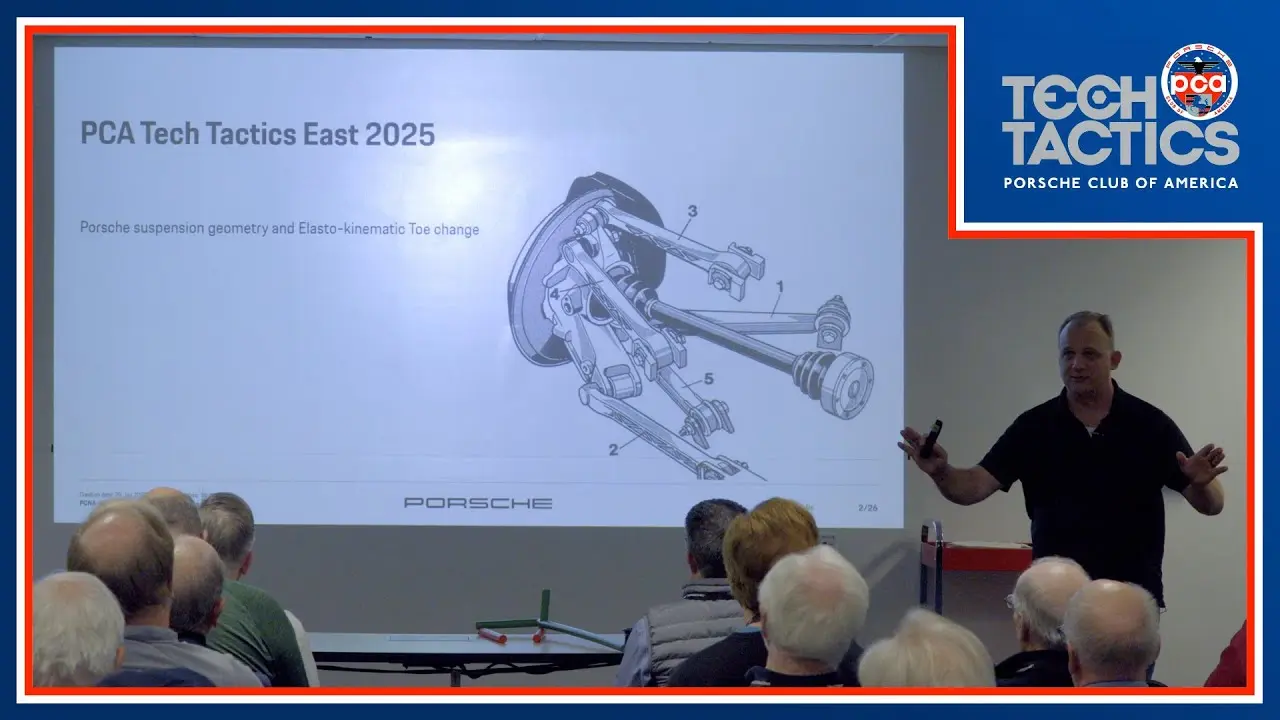
Elasto-Kinematic Toe Change: How Suspension Compliance Affects Handling and Tire Wear

Elasto-kinematic toe change is the alteration of a wheel's toe angle caused by the deflection of compliant suspension components—primarily bushings—under lateral forces during cornering or braking. Unlike purely kinematic toe change, which is a geometric property of the suspension linkage, elasto-kinematic effects arise from the elastic deformation of rubber or polyurethane bushings that connect suspension arms to the chassis or wheel carrier. This phenomenon is critical for understanding vehicle handling, tire wear, and the impact of suspension modifications.
Kinematic vs. Elasto-Kinematic Toe: Key Differences
Kinematic toe change is purely geometric, determined by the lengths and angles of suspension links and how they rotate as the wheel moves up and down. This curve exists even if all components are perfectly rigid. Elasto-kinematic toe change adds the effect of compliance: when lateral forces are applied, bushings deform, and the wheel carrier moves relative to the chassis. The total toe change under load is the sum of both effects.
For example, a double wishbone suspension might have a kinematic toe curve that stays nearly constant through travel, but if the rear compliance bushings are soft, lateral force will cause the rear wheels to toe out, leading to instability. Conversely, a well-designed multi-link suspension might use compliance to induce toe-in under cornering, enhancing grip and driver confidence.
The Physics of Toe Change Under Load
During cornering, lateral forces act at the tire contact patch and transmit through suspension links to the chassis. If bushings were infinitely stiff, the wheel would only move according to kinematic constraints. But because bushings are elastic, they deflect, allowing additional wheel movement.
Engineers prioritize bushing lateral stiffness and placement to control toe change, as soft lateral compliance can lead to excessive toe-out under cornering loads. The direction of toe change depends on the geometry of the suspension arm and the point of force application. For instance, in a trailing arm suspension, a lateral force at the tire contact patch creates a moment about the bushing axis, causing the arm to rotate and the toe to change.
Suspension geometry also plays a role: roll center height and instant center influence force transmission. A higher roll center may increase lateral force transfer through the links, affecting bushing deflection. Subframe mount compliance can also contribute, as the entire subframe may shift slightly under load.
How Suspension Design Influences Toe Change
Different suspension architectures have distinct elasto-kinematic toe change characteristics. Understanding these differences helps in diagnosing handling issues and selecting appropriate parts.
MacPherson strut designs often have a single lower control arm and a strut acting as the upper link. The lower control arm bushings are typically the main source of compliance. Because the strut mounts to the body via a top mount with some compliance, there is potential for significant toe change under load. Many MacPherson strut vehicles exhibit toe-out under braking due to the compliance of the lower control arm rear bushing. For example, certain Honda Civic models are known for this behavior, which can be mitigated by upgrading to stiffer aftermarket bushings.
Double wishbone suspensions use two control arms, allowing engineers to position bushings to control toe change more precisely. By orienting bushings and selecting stiffness, they can minimize unwanted toe change or induce a desired amount. The upper and lower arms can be designed so that lateral forces cause the wheel carrier to toe in, improving stability. This design is common in performance vehicles like the Acura NSX, where precise control of toe change contributes to its renowned handling.
Multi-link suspensions offer the most flexibility. With multiple links and bushings, engineers can fine-tune toe change characteristics. For example, a rear multi-link might have a toe link specifically designed to deflect under load, creating a passive rear-steer effect that enhances cornering performance. BMW's 5 Series uses a multi-link rear suspension that leverages elasto-kinematic toe-in under cornering to improve stability and driver confidence.
The design intent—comfort versus performance—also influences compliance. A comfort-oriented vehicle may use softer bushings to isolate road noise and harshness, but this can lead to excessive toe change and vague handling. A performance vehicle might use stiffer bushings to reduce compliance, but this can increase NVH. The challenge is to balance these competing demands.
Bump Steer vs. Toe Change: Clearing the Confusion
Bump steer and elasto-kinematic toe change are often confused because both affect toe angle, but they are distinct phenomena.
Bump steer is a geometric effect that occurs when the suspension moves vertically (jounce or rebound). It is caused by the relative lengths and angles of the suspension links. If the tie rod or toe link is not properly aligned with the suspension arms, the toe angle changes as the wheel travels up and down. Bump steer is independent of lateral forces; it happens even when driving straight over a bump.
Elasto-kinematic toe change is due to compliance under lateral load. It occurs when cornering forces deflect the bushings, causing the wheel to toe in or out. It is not a function of vertical travel but of the forces acting on the suspension.
Understanding the difference is crucial for diagnosing handling issues. If a car pulls to one side under braking but tracks straight over bumps, the problem might be elasto-kinematic toe change due to worn or soft bushings. If the car wanders over bumps but handles fine in corners, bump steer is more likely.
Real-World Effects: Handling, Stability, and Tire Wear
Elasto-kinematic toe change directly impacts vehicle handling and tire wear. Recognizing these effects helps in troubleshooting and making informed decisions about suspension modifications.
Stability: Toe-in under cornering loads increases stability by making the rear resist oversteer. This is why many rear suspensions are designed to toe in under lateral acceleration. Conversely, toe-out under load can cause the rear to step out, leading to oversteer and potential loss of control.
Tire wear: Excessive or inconsistent toe change can cause uneven tire wear. If the toe angle changes significantly during cornering, the tires are constantly scrubbing, wearing the edges of the tread, especially on the inside or outside shoulders. Properly tuned toe change minimizes scrub and extends tire life.
Grip: A well-designed toe curve can improve cornering grip. By allowing the rear to toe in slightly under load, the tires are better aligned with the direction of travel, increasing the contact patch and lateral grip. This gives the driver more confidence and allows for higher cornering speeds.
Misalignment: If bushings are worn or alignment is incorrect, the designed toe change characteristics are altered. This can lead to unpredictable handling, increased tire wear, and reduced safety. Regular inspection of bushings and alignment is essential.
Measuring and Tuning Toe Change in Your Vehicle
Toe change is not a standard alignment measurement; it requires dynamic measurement or simulation. However, there are ways to assess and adjust it.
Measurement: Professional alignment shops with specialized equipment can measure toe change curves by loading the suspension and measuring toe angle at different points, often on a dynamic alignment rig. For DIY enthusiasts, measuring toe change without such equipment is difficult, but you can check for excessive compliance by inspecting bushings for wear or using a dial indicator to measure deflection under load. A practical method is to place the car on an alignment rack, secure a dial indicator against the wheel rim, and apply lateral force by pushing on the vehicle while observing the deflection. This can give a rough indication of compliance.
Adjustment: Adjustable suspension components can alter the toe curve. For example, adjustable toe links allow you to change the length of the link, affecting kinematic toe change. Camber plates can also influence toe change by changing suspension geometry.
Bushing upgrades: Replacing soft rubber bushings with stiffer polyurethane or solid bushings reduces compliance, changing elasto-kinematic toe characteristics. This can improve handling precision but may increase harshness and NVH. When upgrading bushings, consider the effect on toe change and adjust alignment accordingly.
Alignment: After any suspension modification, a proper alignment is essential. If you change toe change characteristics, the static toe setting may need adjustment to achieve the desired dynamic behavior. A suspension specialist can help you understand your vehicle's toe change characteristics and how modifications affect them.
Manufacturer Insights: Designing for Performance and Comfort
Automotive manufacturers carefully design elasto-kinematic toe change to meet performance and comfort targets. For example, Hyundai and KIA use a variety of suspension bushings in their rear trailing arms to achieve specific handling characteristics. The rear trailing arm bushings (OEM part numbers like 55274-D3000 and 55275-D3000) are designed to provide a balance between compliance for comfort and stiffness for stability. By selecting the appropriate bushing compound and shape, engineers can tune toe change under cornering to promote understeer or oversteer as desired.
In performance-oriented models, manufacturers may use stiffer bushings or additional toe links to reduce compliance and improve response. In comfort-oriented models, softer bushings are used to absorb road imperfections, but this can lead to more toe change. The challenge is to optimize the trade-off.
Case Study: Porsche's Approach to Elasto-Kinematic Toe
Porsche is known for sophisticated suspension designs that leverage elasto-kinematic toe change to enhance handling. For example, the rear multi-link suspension in many Porsche models is designed to toe in under cornering loads, improving stability and allowing drivers to apply power earlier when exiting a corner. This is achieved through careful placement of bushings and links. Porsche engineers use simulation and extensive testing to fine-tune toe change characteristics, ensuring predictable behavior at the limit.
Common Misconceptions and FAQs
Misconception: Stiffer bushings always improve handling.
While stiffer bushings reduce compliance and improve precision, they can also increase harshness and reduce traction on uneven surfaces. The key is to match bushing stiffness to the intended use.
Misconception: Toe change is the same as bump steer.
As explained, they are different. Bump steer is a geometric effect from vertical travel, while elasto-kinematic toe change is from lateral load compliance.
FAQ: How do I know if my bushings are worn?
Look for cracks, tears, or excessive play. You can also check for uneven tire wear or vague handling. A visual inspection by a professional is recommended.
FAQ: Can I adjust toe change on my car?
Yes, by using adjustable suspension components or upgrading bushings. However, it's best to consult with a specialist to ensure changes are appropriate for your vehicle and driving needs.
Conclusion: Why Understanding Toe Change Matters
Understanding elasto-kinematic toe change is essential for anyone involved in suspension tuning, parts selection, or troubleshooting. It explains why a car handles the way it does and why certain modifications can have unintended consequences. By knowing how compliance affects toe angle, you can make informed decisions about bushing upgrades, alignment settings, and suspension modifications. Whether you're a mechanic diagnosing a handling issue or an enthusiast looking to improve performance, this knowledge is invaluable.