Damper Tuning and Remote Reservoirs: A Manufacturer's Guide to Setup, Adjustment, and Maintenance
Remote reservoir shocks are not just a performance upgrade; they are a tunable system that, when properly understood and adjusted, can significantly improve vehicle handling and ride quality across various terrains and driving conditions. This guide provides a systematic approach to understanding, adjusting, and maintaining these shocks for optimal vehicle control and durability.
How Remote Reservoir Shocks Work
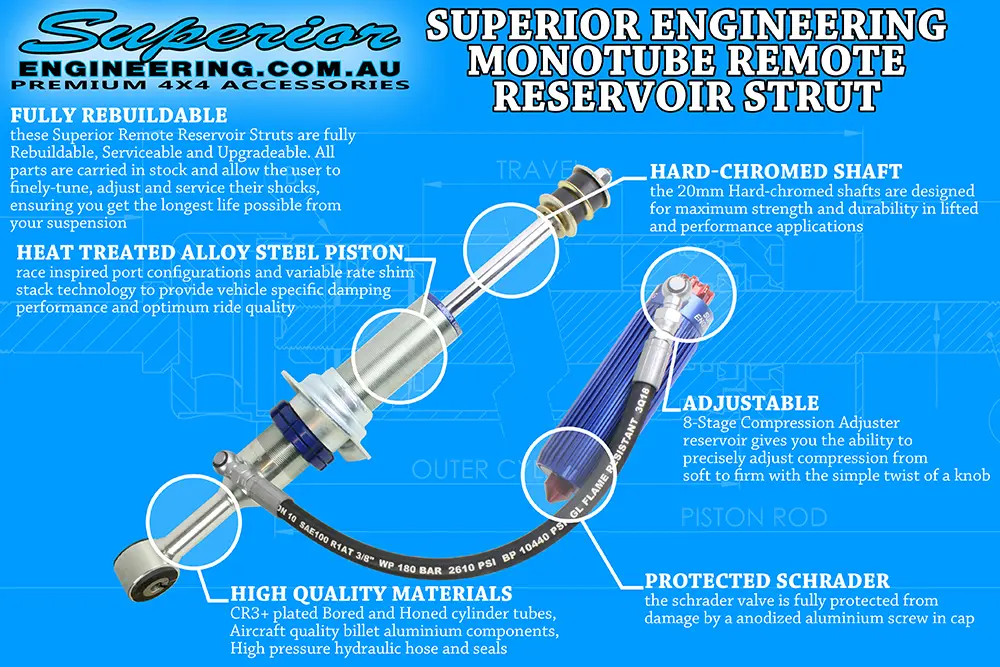
Remote reservoir shocks separate oil and nitrogen into two chambers connected by a hose, solving the aeration and heat dissipation problems that limit standard shocks. Unlike standard monotube or twin-tube designs, where oil and gas share a single cylinder, a remote reservoir places the nitrogen charge in a separate canister. This design increases oil volume, improves cooling, and virtually eliminates oil aeration—the foaming that causes inconsistent damping under hard use.
The basic function of a shock absorber is to control the motion of the suspension by forcing oil through valves. In a standard shock, the oil is subjected to high temperatures and pressures, which can cause the oil to foam (aerate) when gas mixes with it. Aeration leads to a loss of damping force, commonly known as shock fade. Remote reservoir shocks mitigate this by keeping the oil and nitrogen separated by a floating piston or bladder. The reservoir provides extra oil capacity, which helps dissipate heat more effectively. More oil means lower operating temperatures and less fade during prolonged use. Additionally, the separation prevents nitrogen from bubbling into the oil, ensuring consistent damping even in extreme conditions.
Key benefits of remote reservoir shocks include:
- Reduced oil aeration: The physical separation of oil and nitrogen prevents foaming, maintaining consistent damping.
- Consistent damping under hard use: Larger oil volume and better heat dissipation reduce fade during aggressive driving or off-road use.
- Adjustability options: Many remote reservoir shocks feature external compression and rebound adjusters, allowing fine-tuning without disassembly.
Compared to piggyback reservoirs, which mount directly to the shock body, remote reservoirs are connected by a hose. This allows more flexibility in mounting and can improve heat management by placing the reservoir away from the heat source. However, piggyback designs are more compact and may be preferred in tight packaging situations. Remote reservoirs generally offer greater oil capacity and cooling surface area, making them a popular choice for high-performance and off-road applications.
Step-by-Step Guide to Adjusting Compression and Rebound
Adjusting compression and rebound on remote reservoir shocks is straightforward if you follow a systematic process. Start with the manufacturer's baseline settings, then adjust rebound first to control body motion, followed by compression to handle impacts.
Compression controls how fast the shock compresses when the wheel hits a bump. Rebound controls how fast the shock extends after compression. Both affect vehicle dynamics: too much compression makes the ride harsh; too little causes bottoming out. Rebound affects stability—too much rebound makes the suspension pack down, while too little causes bouncing.
Step 1: Set baseline
Refer to the shock manufacturer's recommended settings for your vehicle and application. These are typically listed in the owner's manual or on the manufacturer's website. If not available, start with a middle setting on both adjusters.
Step 2: Adjust rebound first
Drive over a series of bumps or a test loop and observe how the vehicle behaves. If the rear of the vehicle continues to bounce after the bump, increase rebound damping (turn the adjuster clockwise). If the suspension feels stiff and doesn't settle, decrease rebound. Make small adjustments—typically 2-4 clicks—and test again.
Step 3: Adjust compression
After rebound is set, focus on compression. If the vehicle bottoms out harshly on large impacts, increase compression damping. If the ride is too harsh over small bumps, decrease compression. Again, make small changes and test.
Step 4: Evaluate changes
Use a consistent test loop with a variety of surfaces. Note changes in handling, body roll, and ride comfort. Keep a log of settings and observations.
Street vs. off-road tuning tips: For street driving, you generally want more rebound to control body motion at higher speeds. For off-road, reduce rebound to allow the wheels to follow rough terrain and maintain tire contact. Compression settings for off-road often need to be softer to absorb large impacts, but may need to be stiffer to prevent bottoming out on jumps.
Impact of Reservoir Size, Hose Length, and Nitrogen Pressure on Performance
Reservoir size, hose length, and nitrogen pressure directly affect shock performance. Larger reservoirs hold more oil, improving heat dissipation and reducing fade, but they may not fit in all mounting locations. Shorter, larger-diameter hoses reduce flow restriction and improve response, but must be routed to avoid kinks. Nitrogen pressure typically ranges from 150 to 300 psi; higher pressure raises the effective spring rate and reduces aeration, but too high can cause harshness.
Reservoir size
A larger reservoir increases oil volume, which absorbs more heat and delays the onset of fade. For example, a 2.0" reservoir holds more oil than a 1.5" reservoir. However, larger reservoirs add weight and require more mounting space. Choose the largest reservoir that fits your vehicle and packaging constraints.
Hose length and diameter
The hose connects the reservoir to the shock body. A shorter, larger-diameter hose minimizes flow restriction, allowing oil to move more freely and improving shock response. However, the hose must be routed without sharp bends or kinks, which can restrict flow and cause premature failure. Use high-quality hose and fittings rated for the pressures involved.
Nitrogen pressure
Nitrogen acts as a spring to compensate for the volume of the shock shaft as it enters the body. Typical pressures are 150-300 psi. Higher pressure increases the effective spring rate, which can help support the vehicle and reduce bottoming out, but it also makes the ride firmer. Too high pressure can cause harshness and may damage seals. Too low pressure can lead to cavitation and inconsistent damping. Always check and adjust nitrogen pressure with a proper charging kit, and follow the manufacturer's recommendations.
To check nitrogen pressure, you need a shock pump or nitrogen charging kit with a gauge. Remove the valve cap on the reservoir, attach the gauge, and read the pressure. Adjust by adding or releasing nitrogen as needed. Always use dry nitrogen, not compressed air, to avoid moisture contamination.
Troubleshooting Common Issues: Overheating and Oil Aeration
Overheating and oil aeration are the most common issues with remote reservoir shocks, but they are preventable with proper setup and maintenance.
Symptoms of overheating: Shock fade (loss of damping), a burnt oil smell, or the reservoir being too hot to touch (over 150°F). Overheating occurs when the shock is worked harder than its design limits. Causes include excessive damping settings, high ambient temperatures, or insufficient oil volume. To resolve, reduce damping settings, allow the shock to cool, and consider a larger reservoir or more frequent service intervals.
Oil aeration: If the oil becomes foamy, you'll notice inconsistent damping—the shock may feel spongy or lose effectiveness. Aeration is caused by low oil level, high nitrogen pressure, or worn seals that allow gas to enter the oil. Check the oil level and nitrogen pressure, and inspect seals for leaks. If aeration persists, the shock may need a rebuild.
Solutions: Adjust settings to reduce heat generation, check and correct oil level and nitrogen pressure, and replace worn seals. If the shock is severely overheated or aerated, a rebuild is necessary.
Maintenance and Rebuild Procedures for Remote Reservoir Shocks
Regular maintenance extends the life of remote reservoir shocks and ensures consistent performance. Inspect for leaks, check nitrogen pressure, and clean the shaft and body regularly. Rebuild intervals vary by manufacturer, but a general guideline is every 50,000 miles or after heavy off-road use.
Regular maintenance
- Visually inspect the shock body, shaft, and reservoir for oil leaks or damage.
- Check nitrogen pressure with a gauge; adjust if below spec.
- Clean the shaft and body to prevent dirt from damaging seals.
- Check all mounting bolts for proper torque.
Rebuild intervals
Follow the manufacturer's recommendations, but if you notice a decrease in performance, it's time for a rebuild. Heavy off-road use accelerates wear, so inspect more frequently.
Step-by-step rebuild overview
- Remove the shock from the vehicle.
- Disassemble the shock, noting the order of internal components.
- Clean all parts thoroughly.
- Replace seals, O-rings, and any worn components.
- Refill with the correct type and amount of oil.
- Recharge nitrogen to the specified pressure.
- Reassemble and test for proper operation.
Always use quality parts and follow torque specs. If you're not experienced, consider having a professional rebuild the shock.
Choosing the Right Remote Reservoir Shock: A Decision Framework
Selecting the right remote reservoir shock requires assessing your needs, comparing features, and considering quality and support. Here's a framework to guide your decision.
Assess your needs
Determine your vehicle type, primary use (street, track, off-road), and performance goals. For example, a desert racer needs a larger reservoir and more adjustability than a daily driver.
Compare features
Look for adjustability options (compression, rebound, ride height), reservoir size, and shaft diameter. More adjustability allows finer tuning but adds cost. Larger reservoirs offer better heat management but may not fit all vehicles.
Consider quality and support
Choose brands with a good warranty, customer service, and rebuild options. A shock that can be rebuilt is a better long-term investment than a disposable unit.
Budget vs. performance
Understand that more adjustability and larger reservoirs come at a higher cost. Determine what features are essential for your application and allocate your budget accordingly.
By following this framework, you can select a remote reservoir shock that meets your performance needs and fits your budget.
Conclusion: Getting the Most from Your Suspension
Mastering damper tuning with remote reservoirs gives you the tools to optimize vehicle control and durability. By understanding how these shocks work, adjusting compression and rebound correctly, and maintaining them properly, you can achieve consistent performance in any condition. Use the decision framework to choose the right shocks for your needs, and don't hesitate to experiment with settings to find what works best for your vehicle and driving style.