Wheel Hop Dynamics: Diagnose the Resonance Before You Buy Parts
Wheel hop is a self-excited limit-cycle oscillation, not a single failed component. The cycle begins when driveline torque winds up the suspension and powertrain compliance, storing energy. Traction breaks, the tire/wheel assembly snaps back, re-grips, and the cycle repeats at a frequency set by system stiffness and mass. Below a critical threshold of excitation — torque rate, available traction, and system compliance — the system settles into steady state. Above that threshold, it jumps to a limit cycle. That is why hop appears suddenly under certain conditions rather than gradually worsening, and why the upward force on the wheel comes from the release of stored torsional and suspension compliance energy, not from one bad part.
The goal is not to eliminate all compliance. It is to shift the resonance out of the excitation band or damp it below the bifurcation threshold. That means diagnosing the specific excitation source before buying parts.
Isolate the Excitation Source Before Touching Hardware
Before you buy a single component, isolate the excitation source. Vary one input at a time and record which changes reduce or eliminate hop.
Symptom-to-Cause Decision Tree
Run these tests in order. Each one isolates a different link in the chain.
Test 1 — Tire pressure sweep.
- Set cold pressures to spec. Reproduce hop.
- Add 3 psi to the rear tires. Reproduce hop.
- Add another 3 psi. Reproduce hop.
- If hop disappears or drops sharply at +3 to +6 psi: the excitation is tire-sidewall or technique-side. The sidewall is deflecting and releasing stored energy. Move to tire and technique fixes first.
- If hop frequency stays fixed and severity barely changes across the pressure sweep: the excitation is hardware-side. Move to bushing and damper diagnosis.
Test 2 — Launch RPM sweep.
- Launch at 1,800 RPM. Note hop presence and frequency.
- Launch at 2,500 RPM. Note hop presence and frequency.
- Launch at 3,000+ RPM. Note hop presence and frequency.
- If hop appears only above 3,000 RPM and disappears below 1,800 RPM: the excitation is launch technique and torque rate. Clutch release and throttle modulation are the fix.
- If hop persists at 1,800 RPM and above: the excitation is hardware-side. The driveline is winding up faster than the bushings and dampers can absorb.
Test 3 — Surface swap.
- Reproduce hop on a prepped surface (track, concrete).
- Reproduce hop on a street asphalt or uneven surface.
- If hop persists across both surfaces at the same RPM and pressure: the excitation is bushing compliance or damper control. Surface grip is not the variable.
- If hop only appears on one surface: the excitation is traction-related. Tire compound and pressure are the first levers.
Test 4 — Gear and load.
- Reproduce hop in first gear. Reproduce in second gear.
- Add 150–200 lb of ballast over the rear axle. Reproduce hop.
- If hop disappears in second gear or with added load: the excitation is torque rate and weight transfer. Technique and suspension geometry are the levers.
- If hop persists across gears and load: the excitation is hardware-side. Bushings and dampers are the levers.
What to Record
For every test, log: surface, launch RPM, tire pressure, gear, vehicle load, and whether hop is present. Note the frequency if you can — a phone accelerometer app or a passenger counting hops per second is enough. A hop that follows RPM is excitation-side. A hop that stays at the same frequency across RPM and surface is hardware-side.
Do not diagnose on cold tires or uneven surfaces. Both create false positives that lead to unnecessary parts purchases.
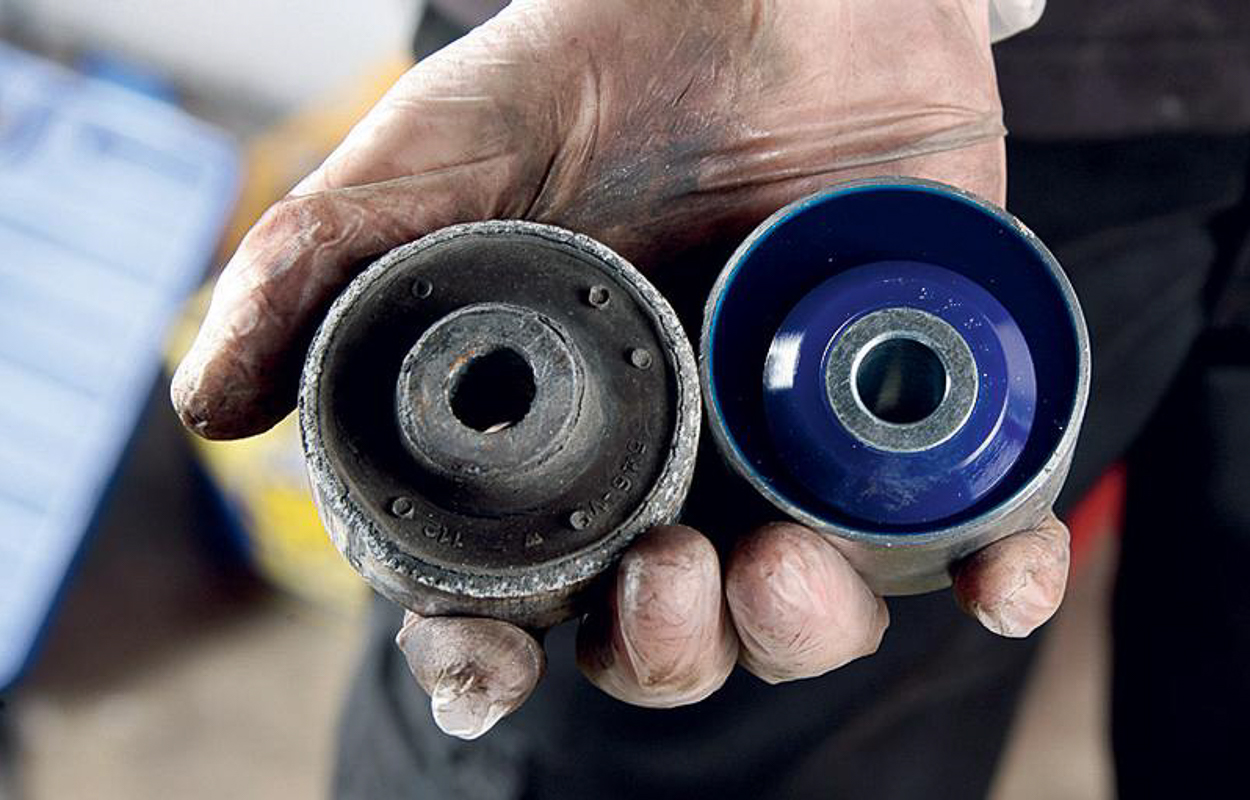
Bushings: Compliance Is a Tuning Tool, Not a Defect
Choose bushing material based on your actual use case and NVH tolerance, not "stiffest available." The wrong durometer moves the resonance frequency and can make hop worse if the damper and tire are not matched to the new stiffness.
Bushing Material Comparison
| Material | NVH Impact | Deflection Under Load | Typical Use Case | Effect on Hop |
|---|---|---|---|---|
| Rubber | Lowest — absorbs high-frequency noise | Highest — allows wind-up | Street cars where comfort matters | Can allow hop on high-torque launches if the rest of the system is stock |
| Polyurethane | Moderate — transmits more noise and vibration than rubber | Lower than rubber — reduces wind-up | Street/strip and track-day cars with matched dampers | Reduces hop when durometer is matched to the damper and tire; too hard for a daily can worsen hop by removing the compliance that absorbs wind-up |
| Spherical / heim | Highest — harsh, transmits all frequencies | Near zero — precise geometry control | Race use where the suspension is tuned around them | Eliminates bushing-side compliance as a variable, but requires matched dampers and tires; not appropriate for street cars with stock dampers |
Hyundai/Kia Bushing Part Numbers
[FACT_FROM_DATABASE] For Hyundai/Kia applications, we offer a range of rear trailing arm bushings (e.g., 55274-D3000, 55274-2W000) and large suspension bushings (e.g., 54584-2D000, 54584-3S100) in rubber and polyurethane to match your specific platform and use case.
[MODEL_ANALYSIS] The decision between rubber and polyurethane on these platforms should be driven by the diagnostic outcome: if hop persists across surfaces and RPM (Test 3 and Test 2 hardware-side), the bushing is a candidate. If hop disappears with pressure or RPM changes, the bushing is not the weak link yet.
Damper Tuning: Why "Max Stiff" Often Makes Hop Worse
Rebound control is critical: too little rebound lets the tire oscillate after a bump; too much rebound can pack down the suspension and reduce traction, worsening hop. Low-speed compression affects weight transfer and wind-up; high-speed compression handles impacts. Hop is typically a low-speed phenomenon, so tuning low-speed circuits matters more than cranking high-speed.
Starting Points for Adjustable Dampers
These are starting directions, not final settings. Change one click at a time and re-test the same launch.
- If hop follows rebound changes (hop gets worse when you add rebound): reduce low-speed rebound by 2 clicks. Re-test. If hop improves, reduce another 1 click.
- If hop gets worse when you reduce rebound: increase low-speed rebound by 1 click. Re-test.
- If hop is present but the tire is not packing down: increase low-speed compression by 1 click to slow weight transfer and wind-up. Re-test.
- If the car feels harsh over bumps after the compression change: back out 1 click of low-speed compression.
On street tires, max-stiff dampers reduce compliance and can increase hop frequency and severity. The goal is to damp the limit cycle, not eliminate all movement. Adjustable dampers should be tuned after bushings and tires are sorted — otherwise you are chasing a moving target.
Tires: The First and Cheapest Hop Fix
Sidewall stiffness: stiffer sidewalls resist deflection and can reduce hop on high-torque launches, but too stiff on a light car can reduce compliance and worsen hop. Aspect ratio: lower aspect ratio (shorter sidewall) generally reduces sidewall deflection but increases transmission of impact; higher aspect ratio can absorb more energy but may allow more wind-up.
Tread pattern and compound: softer compounds grip better and reduce slip-induced hop; aggressive tread blocks can flex and contribute to oscillation. Pressure: increasing pressure reduces sidewall deflection and can reduce hop; decreasing pressure increases grip but may worsen hop — test in 3 psi increments.
If Test 1 showed hop disappearing at +3 to +6 psi, tire and technique are your first fixes. Do not buy bushings until you have re-tested at the new pressure.
EV Wheel Hop: Instant Torque Meets Different Architecture
EVs can apply maximum torque from zero RPM, exciting the driveline and suspension resonance much faster than ICE — hop can appear without a clutch dump. Higher curb weight from battery mass increases load on bushings and dampers, changing the resonance frequency and requiring different tuning.
[MODEL_ANALYSIS] Regenerative braking can also excite hop during deceleration. The mechanism is torque reversal: regen applies negative torque through the same driveline path that launch torque uses, and if the regen ramp rate is aggressive, it can excite the same compliance that launch torque excites. This is less common in ICE vehicles because engine braking is smoother and does not reverse torque as abruptly. EV curb weight and instant torque change the excitation band, not just the resonance frequency — the same bushing and damper fixes apply, but the thresholds are different.
Cost-Benefit Ranking: Where Your Money Actually Reduces Hop
Use the diagnostic outcome to pick the fix. Do not buy parts before you have a diagnostic result.
| Diagnostic Outcome | First Fix | Second Fix | Third Fix |
|---|---|---|---|
| Hop disappears with +3 to +6 psi (Test 1) | Tire pressure (free) | Tire compound/sidewall (moderate cost) | Technique (free) |
| Hop disappears below 1,800 RPM (Test 2) | Launch technique (free) | Tire pressure (free) | Damper low-speed rebound (moderate cost) |
| Hop persists across surfaces (Test 3) | Bushing replacement at the weakest link (moderate cost) | Damper low-speed compression (moderate cost) | Traction aids (highest cost) |
| Hop follows rebound changes (damper test) | Damper low-speed rebound adjustment (free if adjustable) | Damper replacement (higher cost) | Bushing replacement (moderate cost) |
Technique (free): launch RPM, clutch release, throttle modulation — often the biggest single reduction in hop. Tires and pressure (low cost): pressure adjustment is free; tire selection is moderate cost and high impact. Bushings (moderate cost): targeted replacement of the weakest bushing (often subframe or control arm) can yield large gains, but only after technique and tires are sorted. Dampers (higher cost): tuning or replacement is effective but should be matched to bushing and tire changes. Traction aids (highest cost): LSD, traction bars, and driveline upgrades are last — they address specific excitation sources but are overkill if the weak link is elsewhere.
Putting It Together: A Diagnostic Workflow for Your Car
Step 1: Reproduce hop consistently and record conditions (surface, RPM, pressure, gear, load). Step 2: Run the four tests in order — pressure sweep, RPM sweep, surface swap, gear and load. Step 3: Use the decision tree to classify the excitation as technique/tire-side or hardware-side. Step 4: Inspect the weakest link in the chain: worn bushings, blown dampers, incorrect tire pressure. Step 5: Fix the weakest link first, then re-test before moving to the next component. Step 6: If hop persists, consider traction aids or driveline changes — but only after the basics are optimized.
[FACT_FROM_DATABASE] For Hyundai/Kia vehicles, we manufacture a comprehensive range of suspension bushings and control arms (e.g., 54500-S1AA0, 54500-CG000) to help you execute this workflow. Explore our automotive suspension components to find the right parts for your application.
FAQ
Does stiffer always mean less hop?
No. Stiffer bushings and dampers move the resonance frequency. If the tire and damper are not matched to the new stiffness, hop can get worse. Fix the weakest link, not every link.
What is the first thing to check?
Tire pressure. Add 3 psi to the rear and re-test. If hop disappears, the excitation is tire-sidewall or technique-side. If it stays the same, move to bushings and dampers.
Can I diagnose hop without instruments?
Yes. Use the four tests in this article. A passenger counting hops per second is enough to tell whether frequency follows RPM (excitation-side) or stays fixed (hardware-side).
Why does my EV hop without a clutch dump?
Instant torque from zero RPM excites the driveline and suspension resonance faster than ICE. Regen torque reversal can also excite hop during deceleration. The diagnostic tests still apply.
Should I buy bushings before tires?
No. Run the pressure sweep first. If hop disappears at +3 to +6 psi, tires and technique are your first fixes. Buy bushings only if hop persists across surfaces and RPM.
---
Related