Wheel Alignment Caster Adjustment: Diagnose the Symptom Before You Touch the Angle
Caster is the alignment angle that controls straight-line stability and steering return — not tire wear. If you are chasing feathered edges, cupping, or uneven shoulder wear, caster is almost never the culprit; camber, toe, or worn components are. The decision you actually face is whether your symptom — wander, vague on-center, poor return-to-center, or shimmy — implicates caster before you touch camber or toe, and if it does, which adjustment method your suspension architecture supports.
What Caster Actually Does — and What It Does Not
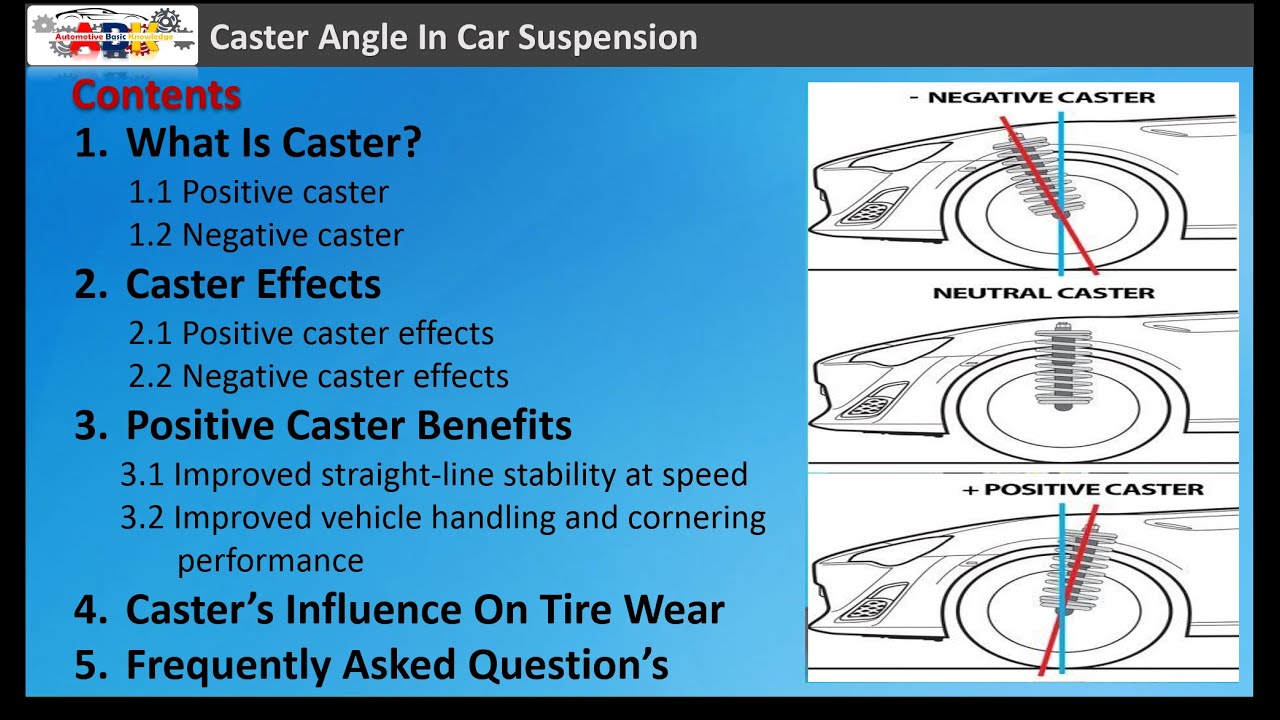
Caster is the forward or rearward tilt of the steering axis viewed from the side of the vehicle. It operates on a different axis than camber and toe. Camber tilts the top of the wheel inward or outward; toe angles the front of the tires inward or outward relative to each other. Both directly affect the tire contact patch and tread scrub. Caster influences steering feel and directional stability instead.
Positive caster means the steering axis leans rearward at the top. This increases steering effort at low speed but delivers strong high-speed stability and a pronounced return-to-center. Negative caster tilts the axis forward, reducing steering effort but degrading straight-line stability and self-centering. Most vehicles are designed with positive caster for exactly this reason.
If your complaint is feathered edges, cupping, or uneven shoulder wear, stop looking at caster. Inspect camber, toe, tire pressure, and worn ball joints, tie rods, or control arm bushings first. Caster adjustment only makes sense when the symptom matches what caster actually controls.
Symptom-to-Cause Triage: Which Complaints Actually Implicate Caster
Wander, vague on-center feel, and poor return-to-center are the classic caster-implicating symptoms. If the steering feels loose in the straight-ahead position, requires constant correction at highway speed, or does not snap back to center after a turn, caster is a legitimate suspect. These symptoms point to insufficient positive caster or a caster split between left and right sides.
Shimmy — a rapid oscillation in the steering wheel — is more often tire/wheel related, a balance issue, or a worn component than a pure caster problem. A steady pull to one side is more often camber, toe, tire conicity, or brake drag. Caster can contribute to a pull if there is a significant side-to-side split, but it is rarely the primary cause.
Before adjusting anything, inspect ball joints, tie rods, control arm bushings, and strut mounts. Worn components can mimic caster symptoms by introducing play into the steering axis. A caster reading taken on a vehicle with worn parts will not hold — the geometry shifts under load, and your adjustment becomes meaningless.
Use this decision sequence:
- Wander or poor return-to-center: check caster.
- Shimmy: check tires, balance, and wheel bearings first.
- Steady pull: check camber, toe, tire conicity, and brake drag before touching caster.
- Tire wear: caster is almost never the answer.
Adjustment Methods by Suspension Architecture
Caster adjustment is architecture-dependent, not universal. Before buying parts or attempting the job, identify which method — if any — your vehicle supports.
Shim-Based Adjustment
Common on older double-wishbone and some truck/SUV front ends. Shims stack at the control arm or frame pivot to change the fore-aft position of the upper or lower control arm. Adding or removing shims tilts the steering axis and changes caster. This method requires loosening the pivot bolts, inserting or removing shims, and re-torquing to specification.
Strut Rods (Tension or Compression Rods)
Allow caster change on certain Ford and other designs by lengthening or shortening the rod. Adjusting the rod moves the lower control arm fore or aft, which rotates the steering axis. This is a threaded adjustment, so changes are incremental and require a wrench and patience.
Eccentric Cams and Slotted Strut Mounts
Typical on MacPherson strut vehicles. The strut-to-knuckle interface or the strut-top mount may have an eccentric bolt or slot that allows the strut to be repositioned. Rotating the eccentric cam or sliding the strut in the slot changes caster. This is the most common modern adjustment method, but not all strut vehicles have it.
No Factory Provision
Many modern vehicles have no factory caster adjustment provision at all. In these cases, the correct answer is a geometry-correcting part — an offset bushing, adjustable control arm, or slotted mount — not a workaround like slotting the subframe or bending components. If your vehicle lacks a provision, no amount of shimming or adjusting will produce a correct caster change.
Tools, Measurement Limits, and When DIY Caster Adjustment Is Realistic
Caster cannot be measured accurately with a simple camber gauge or tape measure. It requires a turning-angle-based measurement — typically turning the wheel a set number of degrees left and right and reading the camber change — which a proper alignment rack performs. DIY caster measurement is limited to rough checks using turn-plate angle methods, and those are not a substitute for a rack reading.
The tools for the adjustment itself depend on architecture: shims and wrenches for shim-based systems, strut rod adjusters for rod-based systems, or eccentric cam wrenches for strut vehicles. But measurement still requires a rack. You can turn the wrench, but you cannot verify the result without proper equipment.
If the vehicle has no caster provision, no tool set enables a correct caster change. A geometry-correcting part is the only path. Buying tools to adjust a non-adjustable suspension is wasted money.
For DIYers with an adjustable suspension, the realistic workflow is: inspect components, identify the adjustment method, make a small change, then take the vehicle to a shop for measurement. Iterating without a rack is guesswork. If you cannot measure caster, you cannot adjust it correctly.
DIY vs Professional Caster Adjustment: The Rack Requirement
Any caster change alters toe on most suspensions. This is not optional — it is geometry. When you rotate the steering axis, the tie rod geometry changes, and toe moves. A toe re-check after caster adjustment is mandatory. This alone usually requires a rack, because toe must be measured and reset to specification.
DIY pros: lower cost, control over the process, and the satisfaction of doing the work yourself. DIY cons: measurement error, no baseline reading, and the risk of chasing the wrong angle. Without a rack, you are adjusting blind. You may improve one symptom and create another.
Professional pros: accurate caster and toe readings, a before/after printout, and the ability to see the full alignment picture. Professional cons: cost and dependence on shop competence. Not every shop is equally skilled at caster adjustment, especially on older or unusual architectures.
If the vehicle has no caster provision, neither DIY nor a standard alignment can add caster. A geometry-correcting part is required. After installing that part, a professional alignment is still necessary to verify caster and reset toe. The part changes the geometry; the rack confirms it.
Common Caster Adjustment Mistakes That Waste Time and Money
Adjusting caster to fix a camber or toe symptom. If the symptom does not implicate caster — if it is tire wear, a steady pull, or shimmy — caster adjustment will not solve it. The symptom must match the angle before you touch anything.
Ignoring ride height. Ride height changes alter caster. Worn springs, lift kits, and heavy loads change the suspension geometry and therefore the caster angle. If ride height is not resolved or accounted for before adjustment, your caster reading will be wrong, and your adjustment will not hold. Fix the ride height first.
Failing to re-check toe after a caster change. Toe is sensitive to caster changes. If you adjust caster and do not reset toe, you have traded one problem for another. Always re-check toe.
Adjusting caster on worn components. Worn ball joints, bushings, or strut mounts introduce play, and the geometry shifts under load. Replace worn components before adjusting caster. Otherwise, you are adjusting a moving target.
When There Is No Caster Adjustment: Geometry-Correcting Parts
Many modern vehicles ship with no caster adjustment provision from the factory. This is a design choice, not an oversight. The manufacturer set the caster at the factory and did not intend for it to be adjusted in service. In these cases, the correct path is a geometry-correcting part — an offset bushing, adjustable control arm, or slotted mount — rather than slotting, bending, or shimming outside the design.
After installing a geometry-correcting part, a professional alignment is still required to verify caster and reset toe. The part changes the geometry, but the rack confirms the result. Without an alignment, you do not know if the part achieved the desired caster or if toe is correct.
Parts selection should match the vehicle's architecture and the specific symptom — not a universal "caster kit." A part that works on a double-wishbone suspension may not fit or function on a MacPherson strut design. Identify your suspension type and the specific problem before selecting a part.
If you are unsure whether your vehicle has a caster provision, consult a service manual or a qualified alignment technician. Guessing leads to wasted money and unsafe geometry. The correct answer is always the one that matches the vehicle's design.
FAQ
Can caster adjustment fix uneven tire wear?
No. Caster does not control tread scrub. Camber, toe, tire pressure, and worn components cause uneven wear. Adjusting caster to fix a wear complaint will not solve it.
What symptoms actually point to caster?
Wander, vague on-center feel, and poor return-to-center. Shimmy is more often tire, balance, or worn-component related. A steady pull is more often camber, toe, tire conicity, or brake drag.
Do I need an alignment rack to adjust caster?
To adjust it correctly, yes. Caster requires a turning-angle-based measurement that a rack performs. You can turn the wrench, but you cannot verify the result without proper equipment.
What if my vehicle has no caster adjustment provision?
The correct answer is a geometry-correcting part — an offset bushing, adjustable control arm, or slotted mount — not a workaround. After installation, a professional alignment is still required to verify caster and reset toe.
Does adjusting caster change toe?
Yes, on most suspensions. When you rotate the steering axis, tie rod geometry changes and toe moves. A toe re-check after caster adjustment is mandatory.
---
Related