B2B Suspension Parts QC Checklist: What to Inspect Before Accepting a Shipment
Accepting a suspension shipment transfers liability from the supplier to you. That is the core fact driving every inspection decision. A non-compliant coil spring, ball joint, or shock absorber can cause loss of vehicle control. If you accept that shipment without documented inspection, you own the consequences.
Suspension components are safety-critical. Unlike cosmetic trim or interior accessories, a single defective part can lead to a crash, injury, and litigation. The B2B buyer — importer, distributor, or procurement manager — sits at the last point where non-compliant parts can be rejected without absorbing warranty or liability risk. After you sign the receiving document, the burden shifts to you.
Correcting defects before shipment is cheaper than after arrival. A spring rate issue caught at the supplier's facility costs a phone call and a rework order. The same defect discovered at your warehouse triggers freight costs, customs delays, return shipping, and potential line-down situations. Post-arrival rejection shifts those costs to the buyer.
Missing traceability or material documentation is a rejection trigger, not a paperwork follow-up item. If the shipment arrives without mill certs, heat treatment records, or batch codes linking parts to test reports, you cannot verify compliance. Accepting the shipment anyway creates liability exposure that no follow-up email can undo.
Defect Classification for Suspension Parts: Critical, Major, and Minor
Classify every defect before deciding to accept or reject. Suspension parts demand a three-tier taxonomy because not all defects carry the same risk.
Critical defects compromise safety or function. Examples include incorrect spring steel grade, missing heat treatment, ball joints with excessive play, dampers with no gas charge, and cracked or porous castings. Any critical defect requires rejecting the entire batch. There is no negotiation on safety.
Major defects will likely cause premature failure or customer complaints. Examples include spring rate beyond tolerance, bushing durometer out of spec, weld porosity on control arms, and boot seal leaks. Major defects may be rejected or negotiated depending on your AQL and safety margin. If the defect affects performance even marginally, reject.
Minor defects are cosmetic or non-functional. Paint runs, label misalignment, and minor surface rust on non-critical surfaces fall here. Accept these with a documented concession. Do not let minor defects distract from critical inspection.
| Defect class | What it compromises | Examples | Receiving action |
|---|---|---|---|
| Critical | Safety or function | Wrong spring steel grade, missing heat treatment, ball joint with excessive play, damper with no gas charge, cracked casting | Reject entire batch |
| Major | Service life or customer satisfaction | Spring rate out of tolerance, bushing durometer off-spec, weld porosity, boot seal leak | Reject or negotiate rework/sort |
| Minor | Cosmetics only | Paint runs, label misalignment, light surface rust on non-critical surfaces | Accept with documented concession |
Accept/reject criteria: critical = reject entire batch; major = reject or negotiate with supplier depending on AQL and safety margin; minor = accept with documented concession.
Pre-Shipment vs. Receiving Inspection: Where to Catch Defects Before They Become Your Problem
Pre-shipment inspection catches defects before freight, customs, and handling costs are incurred. Correcting a spring rate issue at the supplier is cheaper than returning a container. This is not a theoretical cost difference — it is the difference between a rework order and a total loss on freight and duties.
Receiving inspection is your last line of defense. It should focus on verifying that pre-shipment checks were performed and that documentation matches the physical shipment. Do not repeat the supplier's work; verify it.
Require suppliers to provide pre-shipment inspection reports for safety-critical parameters — spring rate, damping force, ball joint torque — before shipment. These reports become part of your acceptance criteria. If the supplier cannot provide them, you have no baseline for comparison.
If pre-shipment inspection is not possible, your receiving inspection must expand to include destructive or performance testing. This increases cost and time, and it may not be feasible for every shipment. Plan for it only when supplier quality is unproven.
Suspension-Specific Inspection Criteria: What to Measure and How to Judge Accept/Reject
Coil Springs: Material, Dimensions, Load Testing
Verify material grade via material cert. SAE 9254 spring steel is a common specification for coil springs. Check free length, coil diameter, and spring rate against specification. Reject if rate deviates beyond agreed tolerance.
Spring rate is the single most important functional parameter. A spring that is too soft or too stiff changes vehicle handling and load capacity. If you cannot test rate in-house, rely on supplier test reports and verify batch codes match.
Shock Absorbers/Struts: Leakage, Damping Force, Rod Finish
Check for oil leakage, rod surface finish, and damping force. Reject if damping force is outside specified range or if gas charge is absent. Oil leakage at the seal indicates internal wear or poor assembly.
Rod surface finish matters. Scoring or pitting on the rod will destroy the seal and cause leakage in service. Inspect the rod for smoothness and the dust boot for cracks or tears.
Damping force testing requires a shock dynamometer. If you do not have one, require supplier test data for each batch. Without damping force verification, you are accepting a black box.
Bushings: Material Hardness, Dimensions, Bonding
Verify durometer (hardness) against specification. Check bonding integrity for rubber-to-metal bushings. Reject if hardness is out of tolerance or bonding is incomplete.
Bushing durometer affects ride comfort and handling. A bushing that is too hard transmits noise and vibration; too soft and it allows excessive deflection. Both are rejectable.
For rubber-to-metal bushings, inspect the bond line. Any separation between rubber and metal is a critical defect. This is a common failure point in aftermarket bushings.
Control Arms: Geometry, Weld Quality, Ball Joint Torque
Verify geometry (mounting points, length) and weld quality. Reject if dimensions deviate or welds show porosity or cracks.
Control arm welds are safety-critical. Porosity, undercut, or incomplete penetration can lead to catastrophic failure. Visual inspection is the first step; if welds look suspect, request weld inspection reports or perform dye penetrant testing.
Ball joint torque is a key functional check. Measure torque to rotate the ball joint stud. Reject if torque is below minimum specification. A ball joint that rotates too freely will wear rapidly and may separate in service.
Ball Joints/Tie Rod Ends: Play, Boot Integrity, Grease Retention
Measure play and torque to rotate. Inspect boot integrity and grease retention. Reject if torque is below minimum or boot is damaged.
Boot integrity is critical. A torn or cracked boot allows contamination to enter the joint, leading to premature wear. Check that the boot is properly seated and that grease is retained.
Material Grade, Heat Treatment, and Traceability: The Documentation You Must Demand
Require material certificates (mill certs) for spring steel (e.g., SAE 9254), forged vs. cast control arms, and bushing compounds. Reject if certs are missing or grade does not match specification.
Heat treatment affects fatigue life and strength. For springs and ball joints, require heat treatment records or hardness test results. Reject if absent. Heat treatment is invisible in the finished part; documentation is your only proof.
Safety-critical suspension parts must have batch codes that link to material certs and test reports. Missing or unreadable batch codes are a rejection trigger. Without batch codes, you cannot trace a defective part back to its production lot.
Documentation required with shipment: material certs, heat treatment records, dimensional inspection reports, performance test reports (e.g., spring rate, damping force), and batch code list. If any document is missing, treat it as a non-conformance.
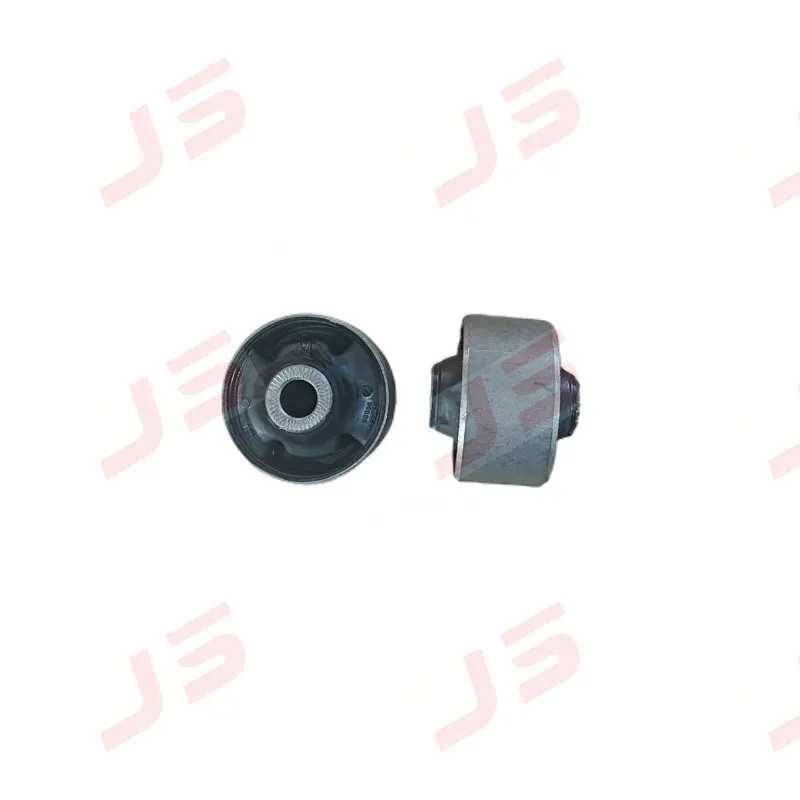
For bushing products, such as the Large suspension bushing — 54584-2D000, verify that the rubber compound meets the specified durometer and that bonding to the metal sleeve is complete. Batch codes on bushings should link to rubber compound certs.
Liability and Warranty Implications of Accepting Non-Compliant Suspension Parts
If a non-compliant suspension part causes an accident, the B2B buyer who accepted the shipment without inspection may share liability, especially if traceability is missing.
Warranty claims from downstream customers (mechanics, DIY users) can be denied by the supplier if you cannot prove the parts were non-compliant at the time of acceptance. Your receiving inspection records are your evidence.
Accepting a shipment with known critical defects — or without required documentation — can be construed as a waiver of the right to reject later. Once you accept, you lose the right to claim the defect was present at delivery.
Documented receiving inspection with accept/reject criteria is your primary defense against liability and warranty disputes. Keep records for at least the warranty period.
Building a Risk-Based Receiving Protocol: Sampling, Documentation, and Supplier Audits
Use AQL-based sampling for dimensional and cosmetic checks, but perform 100% inspection on critical-to-safety parameters (e.g., ball joint torque, spring rate) when feasible. Sampling plans reduce inspection time but must not compromise safety.
Keep receiving inspection records, material certs, and batch codes for at least the warranty period. These are needed for traceability and liability defense. Store them digitally and back them up.
Periodically audit the supplier's QC process for suspension parts, including material verification, heat treatment, and performance testing. An audit is not a one-time event; schedule them annually or when supplier changes occur.
Define a clear process for reject, rework, or negotiate. Critical defects should trigger immediate rejection and a supplier corrective action request. Major defects may be negotiated if the supplier agrees to sort or rework.
For control arms, such as the Control Arm — 54500-S1AA0, verify that the ball joint torque meets specification and that welds are free of porosity. These checks are non-negotiable for safety-critical components.
Conclusion: Building a Risk-Based QC Strategy
A suspension shipment is not a box of parts; it is a bundle of liability. Your receiving inspection protocol must prioritize safety-critical, hard-to-reverse checks — material traceability, spring rate, damping force, ball joint torque, bushing durometer — before cosmetic ones. Document everything. Reject missing documentation. Treat critical defects as batch rejection triggers. This protocol protects your customers, your business, and your legal standing.

FAQ
What is the difference between critical, major, and minor defects?
Critical defects compromise safety or function (wrong steel grade, missing heat treatment, ball joint play) and require rejecting the entire batch. Major defects cause premature failure or complaints (spring rate out of tolerance, weld porosity) and may be rejected or negotiated. Minor defects are cosmetic (paint runs, label misalignment) and can be accepted with a documented concession.
Should I inspect 100% of parts or use sampling?
Use AQL-based sampling for dimensional and cosmetic checks, but perform 100% inspection on critical-to-safety parameters such as ball joint torque and spring rate when feasible. Sampling reduces inspection time but must never compromise safety.
What documentation must accompany a suspension parts shipment?
Material certificates (mill certs), heat treatment records, dimensional inspection reports, performance test reports (spring rate, damping force), and a batch code list linking parts to test reports. If any document is missing, treat it as a non-conformance.
What should I do if I find a critical defect at receiving?
Reject the entire batch immediately, document the defect with photos and measurements, and issue a supplier corrective action request. Do not negotiate on safety-critical defects.
How can I verify spring rate or damping force without lab equipment?
Require the supplier to provide batch-level test reports for spring rate and damping force before shipment. Verify that batch codes on the parts match the reports. If the supplier cannot provide them, expand your receiving inspection or arrange third-party testing.
---
Related