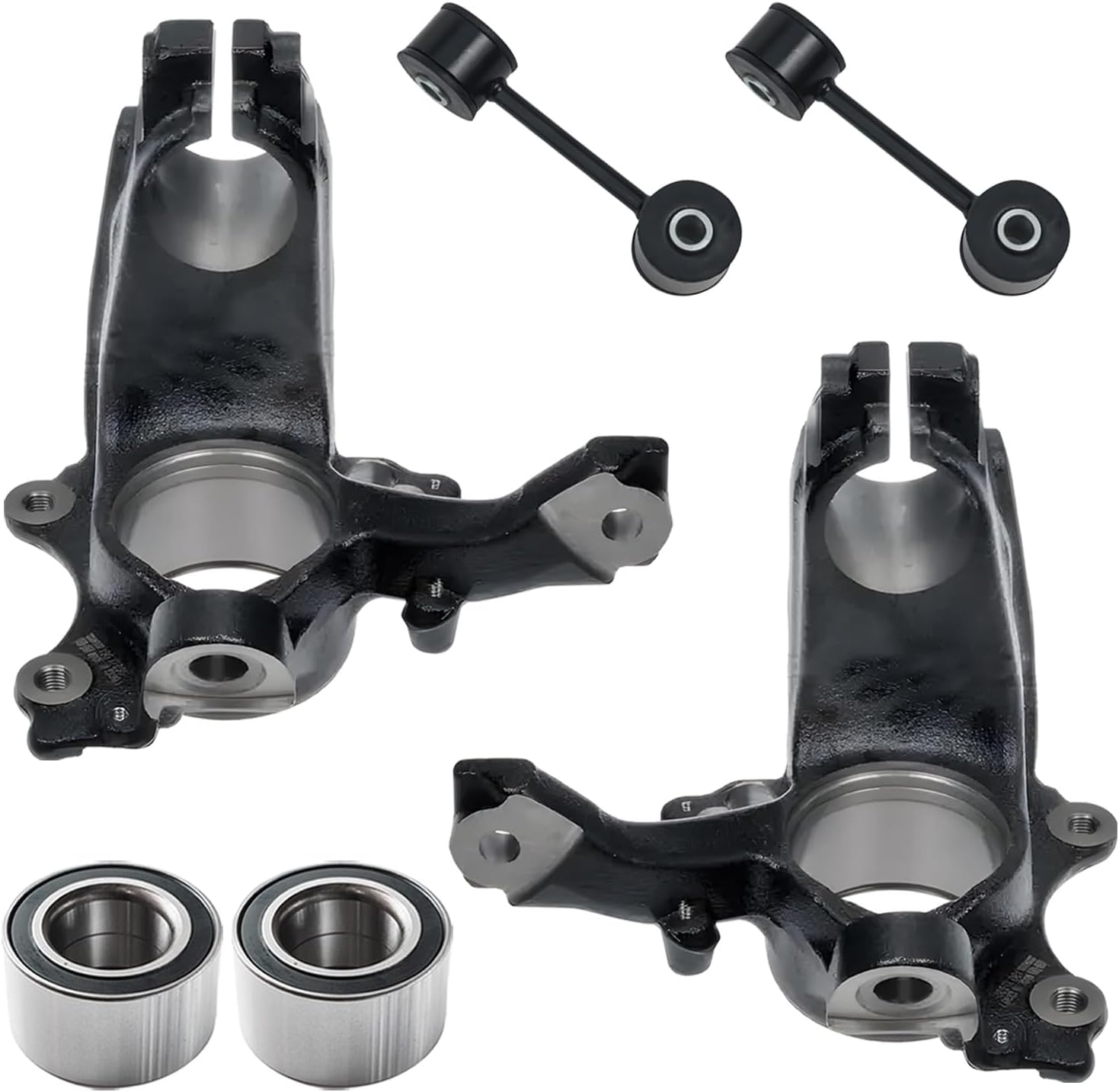
Sway Bar Links Wholesale: A B2B Buying Guide for Distributors
A $0.50 per-unit saving on a sway bar link can be erased by a 2% increase in warranty returns. That is the entire argument against unit-price sourcing in one line. For distributors and importers, the real cost of a sway bar link is set by material grade, manufacturer process control, compliance coverage, and supply reliability — not by the number on the quote.
Most wholesale sway bar link pages give you a price and an MOQ. They do not give you a total-cost-of-ownership framework, which is why so many buyers default to the cheapest quote and absorb the consequences after installation. This guide gives you the framework.
Why Unit Price Is the Wrong Metric
The lowest quoted unit price rarely produces the lowest total cost. A sway bar link's true cost to a distributor includes unit price, warranty claim rate, return processing, and lost customer lifetime value.
Use this formula to compare quotes objectively:
Total Cost = (Unit Price × Quantity) + (Warranty Rate × Replacement Cost) + (Return Rate × Processing Cost) + (Customer Churn Cost)
- Replacement cost includes the part, any labor credit offered, and inbound freight.
- Processing cost covers inspection, restocking, and disposal.
- Customer churn cost is the hardest to quantify and the most damaging. A mechanic who installs a link that fails prematurely may never buy from you again.
Action step: Before negotiating unit price, request warranty and return data from each supplier. If they cannot provide it, treat that as a risk signal. Build a spreadsheet that applies the formula above to every quote. The supplier with the highest unit price may deliver the lowest total cost.
Material Grade and Construction: Steel vs. Aluminum
Steel offers higher strength and fatigue resistance. Aluminum reduces weight but may require thicker sections to match steel strength, which affects cost and fit. For most wholesale sway bar link applications, steel remains the default because it tolerates road salt, potholes, and repeated cyclic loads without yielding.
Vague claims like "high-strength steel" are not specifications. Request these instead:
- Steel grade — e.g., 1045, 4140
- Heat treatment
- Surface finish — e.g., zinc plating, powder coating
- Aluminum alloy — e.g., 6061-T6, 7075
A 1045 carbon steel link with proper heat treatment will outperform a generic mild steel link in fatigue life. 4140 offers higher hardenability for heavy-duty applications. For aluminum, 6061-T6 is common; 7075 provides higher strength at a cost premium.
Corrosion resistance matters most in road-salt regions. Specify salt-spray test hours (e.g., ASTM B117) as a performance indicator. A link that passes 500 hours of salt spray will outlast one that passes 200 hours in rust-belt markets. Ask for test reports, not claims.
Action step: Create a material specification sheet for each SKU you source. Require suppliers to provide grade, heat treatment, and salt-spray results. Reject any supplier that cannot document these.
Manufacturer Capability: Separating Factories from Trading Companies
In-house bushing and ball joint production, fatigue testing, and anti-corrosion treatment are capability signals, not marketing fluff. They indicate process control that trading companies cannot replicate.
Trading companies often cannot provide process control documentation, test reports, or engineering support. They may source from multiple factories, producing inconsistent quality across batches. A true manufacturer controls the process from raw material to assembly.
Ask for:
- Factory audit reports
- In-house testing equipment list (fatigue testers, salt spray chambers)
- Evidence of vertical integration (stamping, machining, assembly)
A manufacturer that stamps its own brackets and machines its own ball studs holds tighter tolerances than one assembling purchased components. Willingness to share process control data — SPC charts, PPAP documents — correlates with consistent quality. If a supplier hesitates to share this data, assume they do not have it.
Action step: During supplier qualification, request a virtual factory tour or video walkthrough. Ask to see the fatigue tester in operation. Verify that the ball joint production line is in-house.
Certification and Compliance: What Each Market Requires
Key standards: ISO 9001 (quality management), IATF 16949 (automotive quality), DOT (US safety), TÜV (German safety), and REACH/RoHS (environmental). These are not interchangeable. ISO 9001 covers general quality systems; IATF 16949 adds automotive-specific requirements like PPAP and traceability.
Market-specific mandates carry real consequences. Selling into Germany without TÜV documentation can result in customs seizures. Selling into the US without DOT compliance may expose you to liability.
Request certificates with scope covering sway bar links and verify validity through issuing bodies. A certificate for "automotive parts" may not cover suspension components. Check the scope statement carefully.
Compliance is a cost of entry, not a differentiator. Do not treat certification as a selling point — treat it as the minimum requirement to do business.
Action step: Build a compliance matrix for each market you serve. List required certifications and verify each supplier's certificates before placing orders.
B2B Ordering Logistics: MOQs, Lead Times, Shipping, and Payment
Typical MOQs for sway bar links run 500–2,000 units per SKU, but they can be negotiated for mixed containers. If you need a lower MOQ, offer to combine multiple SKUs into one container. Some manufacturers will accept 500 units per SKU if you order 10 SKUs.
Lead times: 30–60 days for production, plus shipping. Ocean freight from Asia to the US typically adds 20–30 days; customs clearance adds 3–7 days. Plan for 60–90 days total from order to warehouse.
Shipping terms:
- FOB — you arrange freight and insurance.
- CIF — the supplier arranges freight and insurance to your port.
- DDP — the supplier delivers to your door, handling all duties and customs. Easiest, but often carries a 5–10% premium.
Payment methods: T/T, L/C, PayPal. Negotiate terms based on order history.
Action step: For your first order, use FOB and a freight forwarder you trust. Once you establish volume, negotiate DDP for simplicity. Start with T/T (30% deposit, 70% before shipment) and move to L/C for larger orders.
Supplier Reliability and Technical Support
Reliability indicators: on-time delivery rate, responsiveness to inquiries, willingness to provide technical data, and after-sales support. A supplier that delivers late disrupts your inventory planning. A supplier that ignores technical questions leaves you guessing on fitment.
Request references from other distributors. Ask about engineering support for fitment and installation queries. A supplier with strong technical support reduces returns by helping distributors and their customers select correct parts. If a mechanic calls you with a fitment question, you want to reach your supplier and get an answer within hours, not days.
Action step: During supplier evaluation, ask for three references from distributors in your region. Call them. Ask about on-time delivery, response time, and how the supplier handles quality issues.
A Weighted Decision Framework for Sway Bar Link Sourcing
Six steps:
- Define requirements (material, compliance, volume).
- Shortlist suppliers based on capability signals.
- Request quotes with TCO breakdown.
- Validate certifications and test reports.
- Negotiate logistics and payment terms.
- Pilot order and evaluate performance.
Score each supplier on a 1–5 scale for every criterion, multiply by the weight, and compare total scores:
| Criterion | Weight | What to Evaluate |
|---|---|---|
| Manufacturing capability | 30% | In-house bushing and ball joint production, fatigue testing, process control data |
| Material grade | 25% | Documented steel grade, heat treatment, salt-spray test results |
| Compliance | 20% | IATF 16949 plus DOT, TÜV, or REACH/RoHS as required by target markets |
| Logistics | 15% | MOQ flexibility, lead time reliability, shipping terms |
| Support | 10% | Technical response time, distributor references, after-sales handling |
Capability and material determine product quality; logistics and support are secondary. Use this scorecard to compare suppliers objectively and avoid defaulting to unit price.
Action step: Build a scorecard in a spreadsheet. Score each supplier on a 1–5 scale for each criterion. Multiply by the weight. The highest total score wins. Re-evaluate annually.
For related suspension components, consider our Front Stabilizer Link Ball Joints — 54830-0U000 and Front Lower Ball Joint — 54530-0U000 to consolidate sourcing.

FAQ
What is a typical MOQ for wholesale sway bar links?
500–2,000 units per SKU. Mixed-container orders can lower the per-SKU minimum — some manufacturers accept 500 units per SKU if you order 10 SKUs.
How long does a sway bar link order take to reach my warehouse?
Plan for 60–90 days total: 30–60 days production, 20–30 days ocean freight from Asia to the US, and 3–7 days customs clearance.
Which steel grade should I specify?
1045 carbon steel with proper heat treatment outperforms generic mild steel in fatigue life. 4140 offers higher hardenability for heavy-duty applications.
Is ISO 9001 enough to sell sway bar links?
No. ISO 9001 covers general quality systems. IATF 16949 adds automotive-specific requirements like PPAP and traceability. Market-specific mandates (DOT, TÜV, REACH/RoHS) apply separately.
How do I verify a supplier is a real manufacturer?
Request a virtual factory tour, an in-house testing equipment list, and evidence of vertical integration. If they hesitate to share process control data, assume they do not have it.
---
Related