How to Choose Control Arms for B2B Wholesale: Stamped Steel vs Forged vs Cast Iron
Control arm material selection for wholesale is a commercial calculation, not a strength contest. The right material is the one that matches your order volume, target vehicle platform, and market positioning — so tooling investment, per-unit cost, and end-user application align profitably.
A stamped steel arm that meets OEM specifications for a Chevy Silverado 1500 daily driver is the correct sourcing decision if your program targets high-volume, cost-sensitive resellers. A forged arm is the right call when your market demands off-road capability and will absorb a higher per-unit cost. Cast iron is a niche material best reserved for specific heavy-duty applications where its weight penalty is offset by durability and cost advantages at volume.
Each material type carries a distinct cost structure, tooling threshold, and MOQ profile. This article maps those economics to your commercial reality — not a generic "best material" ranking.
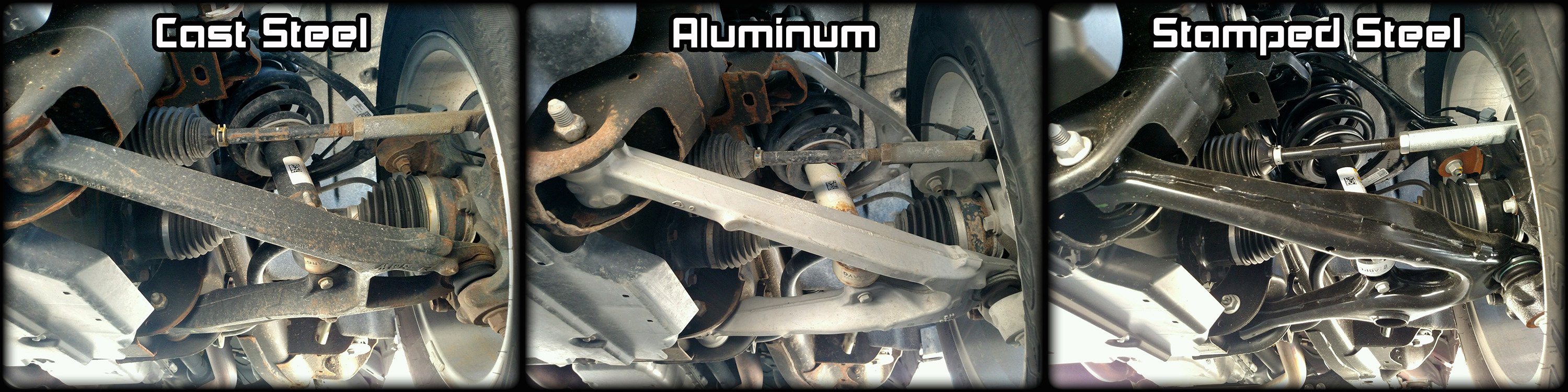
Visual Identification: How to Tell Stamped, Forged, and Cast Control Arms Apart
Material substitution is a real risk in wholesale orders. A supplier may claim "forged" but deliver castings. Visual inspection is your first line of defense during sample reviews and incoming shipment audits.
Stamped Steel
Formed from sheet steel pressed into shape. Look for:
- Visible seams where stamped halves are welded together
- Uniform thickness across the part
- Hollow or open-channel cross-section
- Smooth surface with minor forming marks
If you see a welded seam running along the length of the arm, it's stamped.
Forged Steel
Exhibits a smooth, continuous grain structure with no seams. Look for:
- Parting line marks from the forging die — a thin line where the two die halves met
- Denser, more uniform surface than cast iron
- Slightly textured appearance from the forging process
- Solid, not hollow, cross-section
- More organic, flowing shape compared to the angular look of stamped arms
Cast Iron
Rough, grainy surface texture with visible mold lines. Look for:
- Small pits or irregularities from the casting process
- Heavier and bulkier than stamped or forged equivalents
- Solid cross-section
If the surface is too smooth for cast iron but lacks forging parting lines, it may be a stamped part that's been painted or coated to obscure seams. Request material certification and inspect for these visual cues to prevent substitution.
Material Properties and Fitment: Weight, Strength, and Compatibility
Cast iron is the heaviest, stamped steel is the lightest, and forged steel falls in between but offers a higher strength-to-weight ratio than cast iron.
- Forged steel provides superior fatigue resistance and strength, making it suitable for heavy-duty and off-road applications.
- Stamped steel is adequate for light-duty applications and offers good energy absorption in a crash.
- Cast iron provides good compressive strength but is brittle; it can crack under impact rather than deform.
Fitment considerations are critical. Ball joint sizing and knuckle material matching affect installation and longevity. A control arm designed for a steel knuckle may not fit an aluminum knuckle without the correct ball joint taper. Mismatched materials can accelerate wear or cause installation issues.
For example, if you're sourcing control arms for a 2014-2020 Chevy Silverado 1500, you must verify whether the vehicle has stamped steel or aluminum control arms from the factory, as the ball joint taper and mounting points differ. A common mistake is assuming all Silverado 1500 control arms are interchangeable; they are not. The 2014-2020 platform saw a mix of stamped steel and aluminum arms depending on trim and year.
Buyers must verify ball joint taper and knuckle material compatibility when specifying control arms for a given vehicle platform. Request the ball joint taper dimensions and compare them to the vehicle's knuckle specification. If you're private-labeling, ensure your supplier can provide the correct taper specification for your target platform.
Cost Structure and MOQs: Tooling Investment, Per-Unit Economics, and Volume Thresholds
Stamped Steel
- Tooling investment: lowest tier — stamping dies cost a fraction of forging dies.
- Per-unit cost: lowest at volume, making stamped arms the most price-competitive option for high-volume programs.
- MOQ: typically the lowest threshold of the three processes — suitable for buyers testing a new SKU.
- Ideal for cost-sensitive, high-volume programs.
Forged Steel
- Tooling investment: highest tier — forging dies are the most expensive of the three processes.
- Per-unit cost: highest, reflecting tooling amortization and process complexity.
- MOQ: moderate to high — needed to amortize the tooling investment over the program.
- Per-unit cost drops significantly at higher volumes.
Cast Iron
- Tooling investment: moderate — patterns and molds sit between stamping and forging in cost.
- Per-unit cost: moderate at volume.
- MOQ: moderate to high — foundries require minimum run sizes.
- Weight penalties may increase logistics costs, especially for air freight.
When modeling your program, calculate the total landed cost per unit, including tooling amortization, per-unit price, freight, and duties. Published cost ranges vary widely by region and volume, so request a formal landed-cost quote from your manufacturer rather than relying on generic figures.
Supply Chain and Lead Times: What B2B Buyers Need to Know
Stamped Steel
- Lead times: typically the shortest of the three processes.
- Highly scalable due to simpler tooling and widely available raw materials.
- Resilient supply chain: many stamping suppliers exist, and raw steel coil is globally available.
- If one supplier faces disruption, you can often shift production to another with similar tooling.
Forged Steel
- Lead times: typically the longest — specialized forging equipment and higher tooling complexity extend the timeline.
- Supply chain resilience may be lower if sourcing from limited suppliers, as forging capacity is concentrated.
- If your supplier's forge goes down, finding an alternative with the same tooling can take weeks.
Cast Iron
- Lead times: moderate — between stamped and forged.
- Can be affected by foundry capacity and raw material availability.
- Foundries often have long lead times for new tooling and may prioritize larger customers.
- Weight may increase shipping costs and lead times, especially for ocean freight.
Buyers should assess supplier diversification and lead time variability when choosing material types — confirm current lead times in writing before committing to a program.
Use-Case Recommendations: Mapping Material Choice to End-User Applications
Daily Driving
Stamped steel is the pragmatic default for high-volume, cost-sensitive programs on light-duty trucks and passenger vehicles — see JS Suspension's control arm catalog for OE-specification options.
Off-Road
Forged steel is the right specification when the target market demands heavy-duty or off-road capability and can absorb a higher per-unit cost.
Fleet
Stamped steel or cast iron may be suitable depending on vehicle class and duty cycle. For light-duty fleets, stamped steel minimizes total cost of ownership; for heavier vocational vehicles, cast iron's durability can justify its weight penalty.
Performance
Forged steel (or forged aluminum, if applicable) for high-performance applications requiring superior strength-to-weight ratio.
Quality Control and Certifications: Ensuring Wholesale Supply Meets Specification
- Material certifications: Require mill certificates to verify material type and grade. Review them against your purchase specification on every new production run.
- Dimensional and fitment checks: Ball joint taper and mounting hole locations are critical — verify against the target vehicle's specifications before approving mass production.
- PPAP documentation: For OEM-level programs, require PPAP or equivalent documentation from your supplier.
- Third-party inspection: For large orders or new suppliers, hire a third-party inspection firm to verify material and dimensions before shipment.
Decision Matrix: Choosing the Right Material for Your Market
Use this matrix to select the optimal material based on order volume, target vehicle segment, and market positioning.
| Material | Order Volume | Target Segment | Market Positioning | Tooling | MOQ | Lead Time | Per-Unit Cost |
|---|---|---|---|---|---|---|---|
| Stamped steel | High | Light-duty | Cost-sensitive | Low | Low | Short | Low |
| Forged steel | Medium | Heavy-duty / Off-road / Performance | Premium | High | Medium-High | Long | High |
| Cast iron | Medium-High | Heavy-duty | Niche | Moderate | Medium-High | Medium | Medium |
When applying the matrix, start with your target vehicle segment. If you're sourcing for 2014-2020 Silverado 1500 daily drivers at high volume, stamped steel wins on landed cost; if your customers lift their trucks and tow, forged justifies its premium.
Conclusion: Partnering with a Manufacturer for Strategic Sourcing
Choosing the right control arm material for B2B wholesale is a commercial decision that balances order volume, target segment, tooling economics, and supply chain resilience. Stamped steel wins on cost and scalability, forged steel wins on strength and premium positioning, and cast iron fills a niche heavy-duty role.
When evaluating suppliers, request material certifications, dimensional reports, and PPAP documentation — and start the conversation with a manufacturer that controls its own tooling and quality process, like JS Suspension's control arm line.

FAQ
Q: What is the best control arm material for high-volume wholesale?
A: Stamped steel is the pragmatic default for high-volume, cost-sensitive programs on light-duty trucks and passenger vehicles — it offers the lowest tooling investment, the lowest per-unit cost at volume, and the shortest lead times.
Q: When should I choose forged steel over stamped steel?
A: Choose forged steel when your target market demands heavy-duty or off-road capability and can absorb a higher per-unit cost. Forged arms command a premium price but deliver superior fatigue resistance.
Q: Is cast iron ever the right choice for control arms?
A: Cast iron is a niche material best reserved for specific heavy-duty applications where its weight penalty is offset by durability and cost advantages at volume.
Q: How can I verify that a supplier is providing the correct material?
A: Request material certifications (mill certificates for steel, forging process documentation for forged arms), inspect sample parts for the visual cues described above, and use third-party inspection for large orders or new suppliers.
Q: What are typical MOQs for control arms?
A: MOQs vary by material and supplier: stamped steel typically carries the lowest MOQ threshold, while forged and cast iron require higher commitments to amortize tooling. Confirm exact MOQs with your manufacturer during the RFQ process.
Q: How do lead times differ between materials?
A: Stamped steel typically offers the shortest lead times, forged steel the longest (due to specialized equipment and tooling complexity), and cast iron falls in between. Always confirm current lead times in writing before committing to a program.
Related