Suspension Spring Rate Setup: A Practical Guide to Calculation, Selection, and Tuning

Spring rate is the most critical factor in suspension tuning, directly influencing body roll, pitch, dive, tire grip, and ride comfort. Selecting the correct spring rate is not about brand reputation or anecdotal advice—it's about applying physics and precise measurements. This guide provides a data-driven methodology to calculate ideal spring rates using corner weights, motion ratio, and target ride frequency, enabling you to make informed decisions for your vehicle's intended use.
What is Spring Rate? Definition and Units
Spring rate quantifies the force required to compress a spring by a unit distance. In imperial units, it's pounds per inch (lb/in); in metric, Newtons per millimeter (N/mm). For instance, a 400 lb/in spring needs 400 pounds of force to compress one inch. This value dictates how the suspension responds to bumps, weight transfer, and aerodynamic loads. Higher rates reduce body movement but can compromise ride comfort; lower rates allow more travel but may induce excessive roll or bottoming out.
Key Concepts: Wheel Rate, Motion Ratio, and Ride Frequency
Wheel Rate vs. Spring Rate
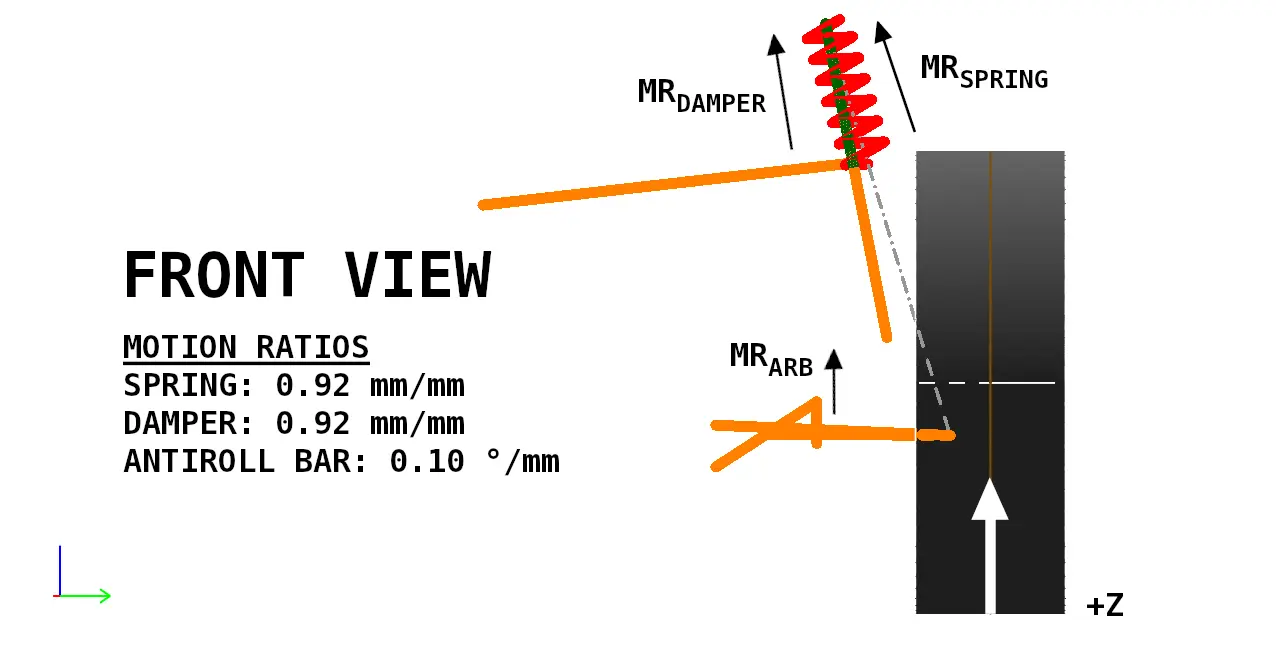
Wheel rate is the effective spring rate at the tire contact patch, not at the spring itself. Due to suspension geometry, the spring often mounts inboard, making wheel rate lower than spring rate. The relationship is defined by motion ratio (MR): Wheel Rate = Spring Rate × (MR)². Calculations must use wheel rate, not spring rate, to ensure correct spring selection.
How to Measure Motion Ratio
Motion ratio is the ratio of spring compression to wheel travel. For MacPherson struts, MR is near 1.0. For double wishbone or multi-link designs, the spring may attach to the control arm at a point between the chassis and wheel. To measure, raise the vehicle, remove the spring, and cycle the suspension while measuring vertical movement at the wheel and spring mount. Alternatively, measure distances from the inner pivot to the spring mount and to the wheel; MR = (spring mount distance) / (wheel distance). Example: if spring mount is 12 inches from pivot and wheel is 16 inches, MR = 0.75.
Understanding Ride Frequency
Ride frequency is the natural frequency of the sprung mass (vehicle body) on its springs, measured in Hertz (Hz). It dictates how quickly the suspension reacts to road inputs. Typical ranges: street cars 1.0–1.5 Hz (comfort), track cars 1.5–2.5 Hz (control), off-road 0.8–1.2 Hz (articulation). Selecting the appropriate ride frequency is the foundational step in spring rate calculation.
Step-by-Step Guide to Calculating Spring Rate
Step 1: Determine Corner Weights
Corner weight is the load supported by each wheel. Professional corner weight scales provide accurate data; if unavailable, a DIY method using bathroom scales on rigid boards can approximate, but ensure the vehicle is level. For a 2,800 lb sports car with 50/50 distribution, each corner carries 700 lb, but real-world distribution varies—measure each corner individually.
Step 2: Calculate Motion Ratio
Measure MR for front and rear suspensions as described. MacPherson struts often have MR 0.95–1.0; double wishbone designs may be 0.7–0.9. Record MR for each axle.
Step 3: Set Target Ride Frequency
Choose a ride frequency based on primary use: street 1.2 Hz, track 1.8 Hz, off-road 1.0 Hz. For balanced handling, start with the same frequency front and rear; later adjustments can address pitch.
Step 4: Calculate Spring Rate
Use the formula: Spring Rate (lb/in) = (2π × Ride Frequency)² × Corner Weight × MR² / 386.4. The constant 386.4 converts units for Hz². Example: 2,800 lb car, 700 lb corner weight, MR = 0.95, target 1.5 Hz. Calculation: (2π × 1.5)² = (9.42)² = 88.8; 88.8 × 700 × (0.95)² = 88.8 × 700 × 0.9025 = 56,100; divide by 386.4 = 145 lb/in. For a track setup at 2.0 Hz: (12.57)² = 158; 158 × 700 × 0.9025 = 110,600; /386.4 = 286 lb/in. This illustrates sensitivity to frequency.
Choosing Spring Rate for Your Application
Street Driving
Prioritize ride comfort and tire contact. Frequencies 1.0–1.5 Hz. For a Mazda MX-5 (2,300 lb, 50/50, MR ~0.95), 1.2 Hz yields ~100 lb/in—compliant yet controlled.
Track and Autocross
Higher rates minimize body roll and improve response. Frequencies 1.5–2.5 Hz. Same MX-5 at 2.0 Hz yields ~280 lb/in, reducing weight transfer and enabling aggressive damping.
Drag Racing
Focus on weight transfer for rear traction. Soft front springs allow nose rise; stiffer rear controls squat. Frequencies ~1.0 Hz front, 1.5 Hz rear. For a Mustang, this might translate to 150 lb/in front and 250 lb/in rear.
Off-Road and Towing
Off-road needs low rates for articulation (0.8–1.2 Hz). Towing requires higher rear rates to control sag (1.2–1.8 Hz). A Jeep Wrangler might use 100 lb/in front, 150 lb/in rear; a towing truck might need 200 lb/in rear to prevent sag.
Common Mistakes and How to Avoid Them
- Ignoring motion ratio: Using spring rate as wheel rate leads to incorrect rates. Always calculate wheel rate.
- Choosing based on brand or looks: Data over preference.
- Overly stiff springs for street: Ruin ride quality without handling benefit.
- Ignoring suspension travel and bump stops: Causes bottoming out.
- Diagnosing issues: If car bottoms out, springs too soft; if harsh and skipping, too stiff. Verify actual spring rate with a tester if mismatch suspected.
Spring Rate and Damping: Getting the Balance Right
Spring rate and damping are interdependent. Higher spring rates require increased damping to control oscillations. A rule of thumb: match damper forces to spring rate, e.g., 300 lb/in spring may need ~80% critical damping. Pairing high-rate springs with stock dampers is a common error, leading to a bouncy ride.
How Spring Rate Affects Handling Balance
Spring rate changes influence understeer/oversteer. Increasing front rate relative to rear increases understeer; increasing rear rate relative to front increases oversteer. This occurs because stiffer springs reduce weight transfer to that axle, increasing grip. For understeer, increase rear rate or decrease front. However, spring rate is one variable; damping and sway bars also matter. Make one change at a time and test.
Manufacturer's Perspective: Quality and Tolerances
Spring quality is paramount. Rate tolerances vary: some manufacturers ±2%, others ±5%. A ±5% tolerance on a 300 lb/in spring means actual rate could be 285–315 lb/in, significantly affecting handling. Material quality matters: chrome silicon steel is lighter and more durable than chrome vanadium. Manufacturing processes (cold vs. hot winding) affect consistency. Purchase from reputable manufacturers that test each spring and provide a certificate of rate. Verify spring rate with a tester before installation when possible.
Conclusion and Next Steps
Calculating correct spring rate is straightforward: measure corner weights, determine motion ratio, choose target ride frequency, apply the formula. Avoid guesswork and common mistakes. Remember spring rate is one component—damping, sway bars, and alignment also require tuning. For quality springs and components, explore our automotive suspension components and manufacturing facility to see our quality assurance. If uncertain, consult a professional or use a spring rate calculator. Now you have the knowledge to set up your suspension with confidence.
FAQ
Q: What is the difference between spring rate and wheel rate?
A: Spring rate is measured at the spring; wheel rate is the effective rate at the tire, accounting for motion ratio. Wheel rate = Spring Rate × (MR)².
Q: How do I measure motion ratio?
A: Measure vertical movement of the wheel and spring mount while cycling suspension, or use pivot distances: MR = spring mount distance / wheel distance.
Q: What ride frequency should I use for street driving?
A: Typically 1.0–1.5 Hz for comfort and control.
Q: Can I use stock dampers with higher-rate springs?
A: No, dampers must match spring rate to control oscillations; otherwise, ride quality suffers.
Q: How does spring rate affect understeer/oversteer?
A: Increasing front rate relative to rear increases understeer; increasing rear rate relative to front increases oversteer.
Q: Why is spring quality important?
A: Tolerances and material affect actual rate and durability, impacting handling consistency.