Roll Steer vs. Bump Steer: Diagnose the Difference, Then Fix It by Use Case
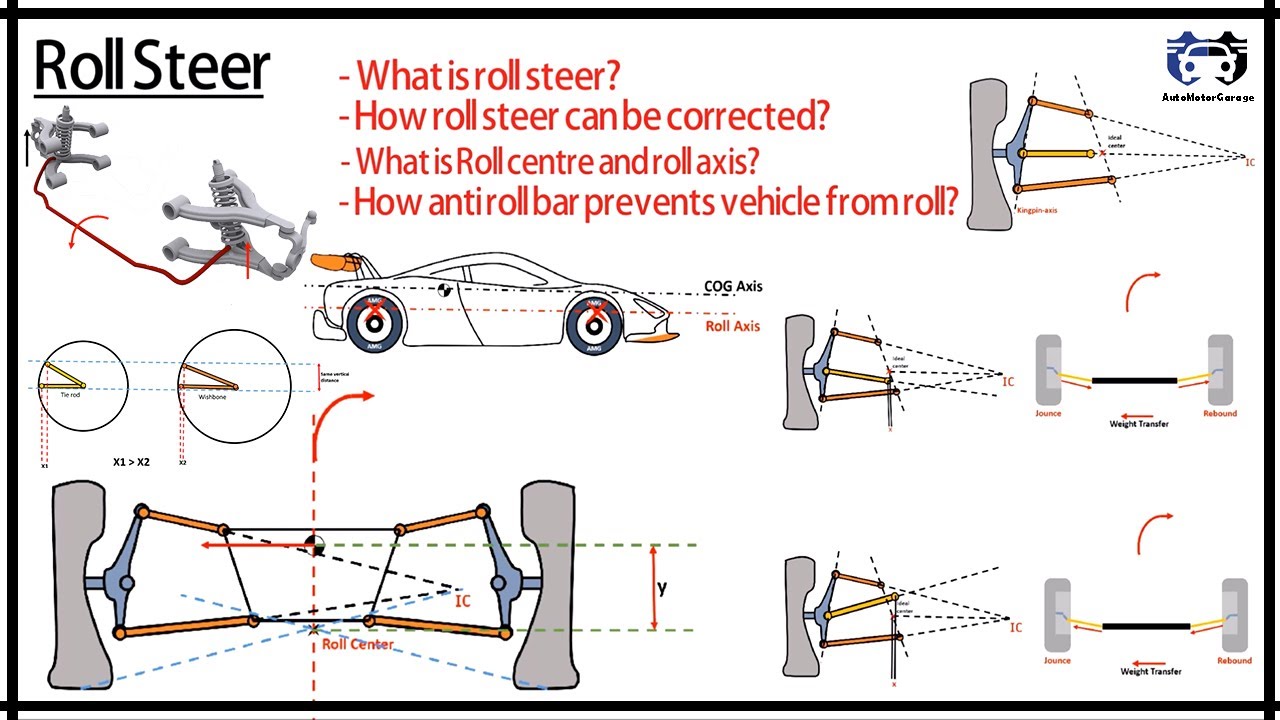
Roll steer is toe change caused by body roll—chassis rotation about the roll axis. Bump steer is toe change caused by vertical suspension travel—the wheel moving up or down relative to the chassis. They can occur simultaneously, but they require different diagnostic inputs and different corrections. Confuse them and you will buy the wrong parts.
The critical distinction: roll steer needs a roll input (cornering load), while bump steer needs a single-wheel bump input. A car can show zero bump steer on a bump-steer gauge and still exhibit significant roll steer on track—because the gauge does not roll the chassis. It only moves one wheel through its travel. That is why a car that passes a bump-steer check can still feel unpredictable mid-corner.
Breakdown roll steer—a term that appears in enthusiast forums—refers to roll steer that changes non-linearly as the suspension compresses through its travel. It is not a separate phenomenon; it is a behavior of the roll steer curve. When the curve is non-linear, the rear toe changes at a different rate at different roll angles, producing inconsistent handling that is hard to predict.
Before you touch a single component, confirm which phenomenon you are dealing with. If the symptom appears only in corners, it is roll steer. If it appears when you hit a bump while driving straight, it is bump steer. If it appears in both, you have both—and you must diagnose them separately.
What Actually Causes Roll Steer: Linkage Arcs, Roll Center Height, and Toe Curves
Roll steer is produced by suspension linkage arcs. As the body rolls, the control arms, trailing arms, or leaf springs sweep through arcs that change the lateral position of the wheel, producing toe change. The geometry of those arcs—their length, angle, and pivot points—determines how much toe change occurs per degree of roll.
Roll center height interacts directly with this. The distance between the roll center and the center of gravity determines how much the body rolls for a given lateral load. More roll means more roll steer for a given toe curve. If you lower the roll center without adjusting the toe curve, you increase body roll and therefore increase roll steer.
Ride height changes move the suspension links out of their designed operating range, altering both the roll center and the roll steer curve. Lowering a car without correcting the roll center is one of the most common causes of unexpected roll steer. The toe curve—the relationship between suspension position and toe angle—is the slope of that curve evaluated over the roll travel, not a single number. You need to know the curve, not just a static toe setting.
To target the right correction, you must identify which of these causes is dominant on your car. Measure first, then decide.
How Roll Steer Changes Handling: Rear Steer Feel, Instability, and Tire Wear
Rear roll steer can produce a rear-steer feel—the car's rear axle steers the car. This can be stabilizing (toe-in under roll) or destabilizing (toe-out under roll). Toe-in under roll tends to stabilize the car because the rear wheels point inward, creating a self-centering effect. Toe-out under roll does the opposite: it reduces directional stability and can make the car feel like it is trying to spin.
Instability typically appears as mid-corner correction or unpredictable transition behavior when the roll steer curve is non-linear (breakdown roll steer). The driver makes a correction, the rear toe changes, and the car reacts differently than expected. This is not a spring or shock problem—it is a geometry problem.
Tire wear from roll steer shows as asymmetric shoulder wear on the inside or outside of the tire, distinct from camber wear or toe wear. Camber wear is typically uniform across the tread, while toe wear produces feathered edges. Roll steer wear is load-dependent and often appears on one side more than the other, depending on cornering direction.
Roll steer becomes a safety issue when it produces toe-out on the rear axle under cornering load. That reduces directional stability and can lead to loss of control in emergency maneuvers. If you measure rear toe-out under roll, correct it before you drive aggressively.
Step-by-Step: Measuring Roll Steer on Your Car Without a Chassis Rig
You can measure roll steer in your garage with basic tools. You need toe plates or a string alignment setup, a digital angle finder or camber gauge, a way to induce roll (corner weight or a measured lateral load), and a flat surface.
The procedure: measure toe at static ride height, then induce a known roll angle—by loading one side or using a roll fixture—and re-measure toe. The change in toe per degree of roll is your roll steer. For example, if you measure 0.2 degrees of toe change for 1 degree of roll, your roll steer is 0.2 degrees per degree.
Record both front and rear. Rear roll steer is usually the dominant handling factor, but front roll steer affects turn-in feel. Repeat at multiple roll angles to detect breakdown roll steer—non-linear toe change. If the toe change is not proportional to roll angle, you have a non-linear curve, which is harder to tune but more important to correct.
This measurement turns guesswork into data. Do it before you buy any parts.
Correcting Roll Steer by Suspension Type: MacPherson Strut, Double Wishbone, and Solid Axle
On a MacPherson strut, roll steer is primarily corrected by adjusting the lower control arm angle, roll center via ball joint or tie rod end height, and strut mount position. Component selection includes adjustable camber/caster plates and roll-center correction kits. These parts allow you to change the geometry without replacing the entire strut.
On a double wishbone, roll steer is corrected by changing the upper and lower control arm pivot heights and lengths, which changes the roll center and the toe curve. Adjustable arms and roll-center kits are the primary tools. For Hyundai and Kia applications, control arms such as Control Arm — 54500-S1AA0 and Control Arm — 54500-2S000 provide the foundation, while Large suspension bushing — 54584-2D000 and Large suspension bushing — 54584-3S100 can restore proper geometry when original bushings have degraded.
On a solid axle, roll steer is corrected by changing the panhard bar or watts link height, trailing arm angle, and leaf spring or link geometry. The goal is to keep the axle parallel to the chassis under roll. For Hyundai and Kia vehicles with rear trailing arms, Rear Trailing Arm Bushing — 55274-D3000 and Rear Trailing Arm Bushing — 55274-2W000 are critical components that, when worn, allow excessive axle movement and unpredictable roll steer.
Across all types: correction starts with measurement, then component selection—not with buying parts and hoping.
Acceptable Roll Steer Angles: Quantitative Targets for Street, Track, and Off-Road
For street use, target near-zero rear roll steer—toe change less than approximately 0.1 degrees per degree of roll—for stability and tire wear. Some front roll steer may be acceptable for turn-in feel, but rear roll steer should be minimized. This is a starting target, not an absolute; the correct value depends on the car, the driver, and the tire.
For track use, some rear roll steer (toe-in under roll) can be accepted or even desired for rotation. The target is typically a small, linear, stabilizing roll steer rather than zero. A car with 0.1 to 0.2 degrees of toe-in per degree of roll can rotate better without becoming unstable. However, the curve must be linear—non-linear roll steer on track is unpredictable and dangerous.
For off-road use, roll steer must be evaluated over articulation, not just body roll. The target is predictable toe change over the full articulation range, not a single number. A solid axle that toes in predictably as it articulates is manageable; one that toes out unpredictably is a liability on trails.
These are starting targets, not absolutes. The correct value depends on the car, the driver, and the tire. Use them as a baseline, then tune to your preference.
Before and After: Real-World Roll Steer Corrections and What Changed
Example 1—Street double wishbone: A customer measured 0.4 degrees of rear toe-out per degree of roll. We corrected it via a roll center kit and adjustable lower arms. The result was 0.05 degrees of toe-in per degree of roll and elimination of mid-corner correction. The driver reported the car felt planted and predictable.
Example 2—Track MacPherson strut: A customer measured 0.2 degrees of rear toe-in per degree of roll. We retained it intentionally for rotation. The result was improved turn-in without instability. The driver noted the car rotated better without feeling loose.
Example 3—Off-road solid axle: A customer measured non-linear toe change over articulation. We corrected it via panhard bar height and trailing arm angle. The result was predictable toe through the articulation range. The driver reported the vehicle felt more stable on uneven terrain.
Each example includes the measurement before, the component changed, and the measurement after—not just a subjective "it felt better." That is how you validate a correction.
Choosing Components: What to Buy After You've Measured Your Roll Steer
If your measurement shows rear toe-out under roll on a double wishbone car, prioritize a roll center correction kit and adjustable lower control arms over stiffer springs. Stiffer springs reduce roll but do not correct the geometry that produces roll steer. For Hyundai and Kia applications, Control Arm — 54500-2W000 and Control Arm — 54500-2W100 are examples of arms that can be used with adjustable components to correct geometry.
If your measurement shows non-linear roll steer (breakdown), prioritize components that restore the suspension link geometry to its designed range—often ride height correction before adjustable arms. Worn bushings can also cause non-linear roll steer. Rear Trailing Arm Bushing — 55274-4T000 and Rear Trailing Arm Bushing — 55274-4Q000 are common replacement points on Hyundai and Kia vehicles.
If your measurement shows acceptable roll steer for your use case, do not buy parts—spend the money on tires or alignment instead. Over-correcting a characteristic that is actually helping you can make the car worse.
For wholesale/importers: the highest-demand roll steer correction components are roll center kits, adjustable control arms, and panhard/watts link kits—but demand should be validated against actual fitment data, not assumed. For Hyundai and Kia, Control Arm — 54500-S8100 and Control Arm — 54500-4L000 are examples of arms that may be used in roll steer correction, depending on the specific model and application.
FAQ
Can I have both roll steer and bump steer?
Yes. They can occur simultaneously, but they require separate diagnosis. Roll steer appears only in corners; bump steer appears when you hit a bump while driving straight. If both symptoms are present, measure each independently.
How do I know if my handling problem is roll steer or bump steer?
If the symptom appears only in corners, it is roll steer. If it appears when you hit a bump while driving straight, it is bump steer. If it appears in both, you have both—and you must diagnose them separately.
What is breakdown roll steer?
Breakdown roll steer is roll steer that changes non-linearly as the suspension compresses through its travel. It is a behavior of the roll steer curve, not a separate phenomenon. When the curve is non-linear, the rear toe changes at a different rate at different roll angles, producing inconsistent handling.
Can I correct roll steer with stiffer springs?
No. Stiffer springs reduce roll but do not correct the geometry that produces roll steer. Correction starts with measurement, then component selection—not with buying parts and hoping.
What is an acceptable amount of roll steer for a street car?
Target near-zero rear roll steer—toe change less than approximately 0.1 degrees per degree of roll—for stability and tire wear. Some front roll steer may be acceptable for turn-in feel, but rear roll steer should be minimized.
What is an acceptable amount of roll steer for a track car?
Some rear roll steer (toe-in under roll) can be accepted or even desired for rotation. The target is typically a small, linear, stabilizing roll steer rather than zero. A car with 0.1 to 0.2 degrees of toe-in per degree of roll can rotate better without becoming unstable. However, the curve must be linear.
What is an acceptable amount of roll steer for an off-road vehicle?
Roll steer must be evaluated over articulation, not just body roll. The target is predictable toe change over the full articulation range, not a single number. A solid axle that toes in predictably as it articulates is manageable; one that toes out unpredictably is a liability on trails.