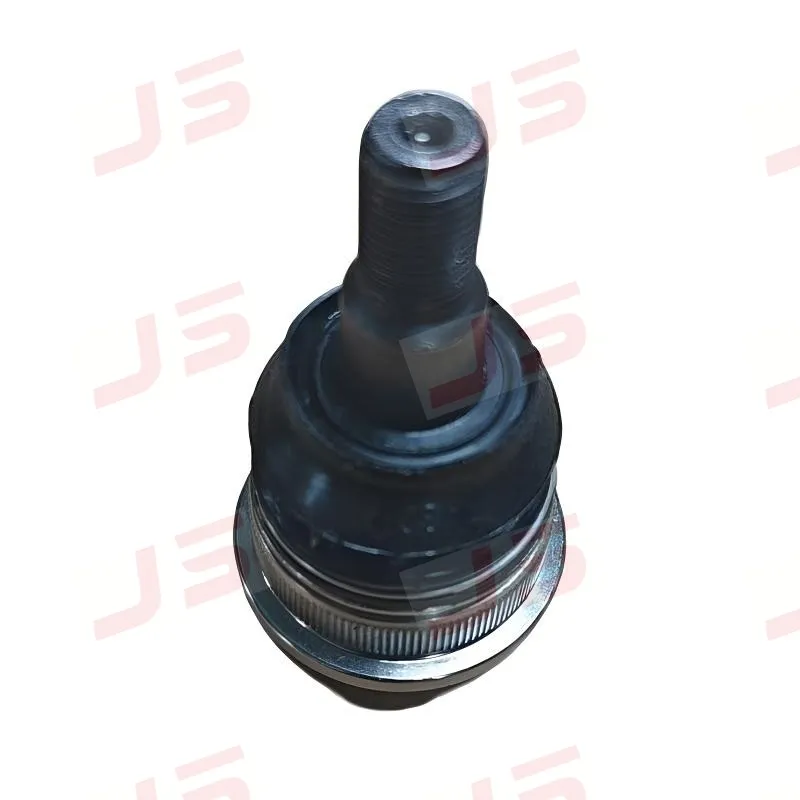
Tie Rod End vs Ball Joint: Diagnosing Which One Causes Your Front-End Clunk
A front-end clunk is a tie rod end problem if it follows steering input and shows horizontal wheel play, and a ball joint problem if it follows bumps and shows vertical wheel play. The noise itself cannot separate the two — in many cases the sound character is nearly identical. Diagnose by condition and play direction, not by sound.
The Clunk Isn't the Clue — The Condition That Produces It Is
The same word describes two different failure modes. A tie rod end clunk is tied to steering input and shows up as horizontal (side-to-side) wheel play. A ball joint clunk is tied to bumps and turning and shows up as vertical (up-down) wheel play.
The diagnostic decision is binary: does the noise follow the steering wheel or the road surface?
- Steering input — turning, lane changes, or play felt through the steering wheel — points to the tie rod end.
- Bump input — bumps, dips, or suspension articulation — points to the ball joint.
- Both conditions — you may have wear in both components, or a third source entirely.
This matters because most DIY mechanics start by searching for "what does a bad ball joint sound like" and end up chasing noise instead of behavior. The condition that produces the clunk is the reliable discriminator. Sound is a weak secondary confirmation at best.
Two-Minute Wheel-Play Test: Horizontal Play Points to Tie Rod, Vertical Play Points to Ball Joint
Raise the front wheel off the ground. Grab the tire at 9 and 3 o'clock and rock it side-to-side. If you feel or hear a clunk, that horizontal play indicates tie rod end wear. Now grab the tire at 12 and 6 o'clock and rock it up and down. Vertical play indicates ball joint wear.
A pry bar under the tire, loaded upward, is the standard way to unload the ball joint and feel vertical movement. A helper watching the joint while you pry makes the play visible — you will see the stud move in the socket or the housing shift relative to the control arm. For the tie rod end, have the helper watch the joint while you rock the tire at 9 and 3; any perceptible movement between the tie rod end stud and the steering knuckle confirms wear.
Pass/fail is defined by feel and sight: any perceptible clunk, looseness, or visible joint movement under load is a fail. "Tight but noisy" is not a pass for a safety-critical joint. A joint that feels tight but produces a clunk under load is already worn — the play may only appear when the suspension is loaded in a specific direction. If you cannot reproduce the clunk with the wheel in the air, load the suspension with the tire on a ramp or have a helper rock the steering while you watch and feel the joint.
Sound and Condition Mapping: When the Clunk Happens Tells You Which Joint Is Worn
Tie rod end clunk typically appears or worsens with steering input — turning, lane changes, or steering wheel play — and can present as a clunk even when driving straight if the joint has developed enough play. Ball joint clunk typically appears over bumps, dips, and during turning as the suspension articulates and the worn joint loads and unloads.
Sound character is a weak discriminator on its own — a single "clunk" can come from either joint — so use the condition (steering vs bump) as the primary filter and sound as a secondary confirmation. A tie rod end clunk often has a sharper, more metallic quality because the joint is directly connected to the steering rack and transmits noise through the steering column. A ball joint clunk tends to be duller and more felt through the floor or firewall because the joint is loaded by the suspension. These are tendencies, not rules. Do not buy parts based on sound alone.
| Diagnostic Signal | Tie Rod End | Ball Joint |
|---|---|---|
| Noise follows | Steering input (turning, lane changes) | Bumps, dips, suspension articulation |
| Wheel-play direction | Horizontal (9-and-3 test) | Vertical (12-and-6 test) |
| Typical sound character | Sharper, more metallic | Duller, felt through floor |
| Failure consequence | Steering loss, toe change | Separation under load, loss of wheel control |
| Replace in pairs | Yes, same axle | Yes, same axle |
| Alignment after replacement | Required (sets toe) | Check recommended |
Before You Buy a Tie Rod End or Ball Joint: Rule Out Sway Bar Links, Strut Mounts, and Control Arm Bushings
Sway bar links commonly clunk over bumps and during turns at low speed, and their noise often mimics a ball joint or tie rod clunk but localizes to the bar end rather than the steering or load-bearing joint. Grab the sway bar link and try to move it by hand — any looseness or rattle is a fail. Front stabilizer link ball joints are a frequent culprit and are often replaced in pairs; if you drive a Hyundai or Kia, we stock Front Stabilizer Link Ball Joints — 54830-0U000, Front Stabilizer Link Ball Joints — 54830-2S000, Front Stabilizer Link Ball Joints — 54830-2B000, Front Stabilizer Link Ball Joints — 54830-0Q000, Front Stabilizer Link Ball Joints — 54830-B3000, and Front Stabilizer Link Ball Joints — 54830-C3000.
Strut mounts can produce a clunk or pop during steering and over bumps, and may also cause a spring-twist noise that a tie rod or ball joint would not. Open the hood and watch the top of the strut tower while a helper turns the steering wheel — if the mount bearing binds or the rubber isolates poorly, you will see the spring jump or hear a twang. Control arm bushings can clunk under braking, acceleration, or bump loads as the arm shifts in the worn bushing, producing a duller, more "thud-like" sound than a joint clunk. Inspect the control arm bushings with a pry bar — any excessive movement or cracked rubber is a fail. If you need control arms for a Hyundai or Kia, we carry Control Arm — 54500-CG000 and many other fitments.
Replace in Pairs, Then Align: Matching the Repair Scope to the Diagnosis
Tie rod ends and ball joints should be replaced in pairs on the same axle when wear is comparable, because the opposite side has seen the same mileage and load history. If one side is worn and the other is not, you can replace only the worn side, but expect to do the other soon. For a daily driver, doing both sides at once saves you a second alignment and a second teardown.
Alignment is required after tie rod end replacement because the tie rod end sets toe; changing it without an alignment leaves the vehicle with incorrect toe and accelerated tire wear. Even if you mark the tie rod threads and count turns, toe will be off enough to matter. Ball joint replacement does not inherently change alignment settings the way a tie rod end does, but an alignment check is still prudent after any suspension work that disturbs the geometry. If you are replacing a control arm, the alignment will definitely change because the arm locates the ball joint and the bushing pivot points.
Why Driving on a Worn Ball Joint or Tie Rod End Is a Safety Decision, Not a Maintenance Deferral
A worn ball joint can separate under load, allowing the control arm to disconnect from the knuckle and causing loss of wheel control. A worn tie rod end can separate or cause severe steering loss, and even before separation it degrades steering precision and can accelerate tire wear. Misdiagnosis cuts both ways: replacing the wrong part leaves the actual safety-critical wear in place, and ignoring a failed joint because "it only clunks sometimes" is the highest-risk outcome.
A clunk that appears only occasionally is still a clunk. The joint is already loose enough to move under load. The next stage is rapid wear, and the stage after that is separation. If your wheel-play test shows any play, treat it as a stop-driving condition until the part is replaced. Do not schedule it for "next month."
Your Next Step: Run the Test, Match the Play Direction, Buy the Right Part
- Note when the clunk happens (steering input vs bumps vs both) to set your primary suspect.
- Raise the front end and run the 9-and-3 and 12-and-6 wheel-play checks plus a pry-bar check to confirm horizontal vs vertical play.
- If play is confirmed, plan the pair replacement on that axle and schedule the alignment — and if no play is found, move to sway bar links, strut mounts, and control arm bushings.
When you are ready to order, match the play direction to the part: horizontal play → tie rod end (or rack end); vertical play → ball joint (or control arm, if the bushing is also worn). If you drive a Hyundai or Kia, we stock a wide range of control arms, bushings, and stabilizer links to complete the repair. Browse our Control Arm — 54500-CG000 and related suspension components, and always confirm fitment by VIN or OEM number before ordering.
FAQ
Can a bad tie rod end and a bad ball joint make the same sound?
Yes. A single "clunk" can come from either joint, which is why sound alone cannot separate them. Use the condition that produces the noise — steering input vs bump input — as the primary filter, and sound as a weak secondary confirmation.
Do I need an alignment after replacing a ball joint?
Ball joint replacement does not inherently change alignment settings the way a tie rod end does, but an alignment check is still prudent after any suspension work that disturbs the geometry. If you are replacing a control arm, the alignment will definitely change.
Can I replace just one tie rod end or ball joint?
If one side is worn and the other is not, you can replace only the worn side, but expect to do the other soon. For a daily driver, doing both sides at once saves you a second alignment and a second teardown.
What if the wheel-play test shows no play but the clunk is still there?
Move to sway bar links, strut mounts, and control arm bushings. Sway bar links commonly clunk over bumps and during turns at low speed and often mimic a ball joint or tie rod clunk. Strut mounts can clunk or pop during steering and over bumps. Control arm bushings can clunk under braking, acceleration, or bump loads.