
Subframe bushings are the rubber or hydraulic mounts that bolt the subframe — the structural cradle carrying the engine, transmission, and suspension — to the vehicle body. They isolate vibration and let the subframe absorb road shock without transmitting it into the cabin. When they wear out, the number-one symptom is a dull thud or knock over bumps, often felt through the floor, followed by vague steering and an alignment that won't hold.
Subframe bushings are the most misdiagnosed suspension component on a unibody vehicle. The symptom list — clunking over bumps, vague or wandering steering, uneven tire wear, vibration through the chassis or steering wheel, and misalignment that won't hold — overlaps almost perfectly with worn control arm bushings, sway bar links, strut mounts, ball joints, and engine/transmission mounts. The symptom alone is not proof. Match the symptom to the most likely component, confirm with a physical inspection, and only then decide whether to replace with stock rubber or an upgraded material based on how the vehicle is actually used.
Symptom-to-Component: Ranking the Suspects
Ranked by how often each symptom traces back to the subframe bushings themselves:
- Clunking or knocking over bumps — the most common presenting complaint. The subframe shifts against the body when the bushing rubber has separated or collapsed.
- Vague or wandering steering — the subframe moves laterally under cornering load, changing suspension geometry mid-turn.
- Vibration through the chassis or steering wheel — road and drivetrain NVH that the bushing was designed to isolate now transmits directly into the cabin.
- Uneven tire wear — alignment shifts as the subframe moves, so the wear pattern changes even after an alignment.
- Misalignment that won't hold — the alignment shop sets it, and it drifts back within weeks because the subframe is moving under load.
Differentiating From the Usual Suspects
- Control arm bushings — clunk on turn-in or braking, often one corner at a time. Subframe bushings clunk on both sides over the same bump.
- Sway bar links — sharp, metallic rattle over small sharp bumps at low speed. Subframe bushings produce a duller, heavier thud.
- Strut mounts — noise when turning the steering wheel at a standstill, plus a spring-pop feel. Subframe bushings don't change with steering input at rest.
- Ball joints — clunk on steering input and a shimmy at speed; check with the wheel loaded. Subframe bushings don't produce steering-input-specific noise.
- Engine/transmission mounts — clunk on throttle tip-in and lift-off, not on road bumps. Subframe bushings respond to road input, not torque changes.
The Diagnostic Sequence
Identify which input triggers the symptom — bump, steering, throttle, or braking — match it to the component that responds to that input, then confirm with a physical test on the lift. If the symptom appears on both sides over the same bump and doesn't change with throttle or steering input, subframe bushings move to the top of the list.
| Symptom | Points to subframe bushings when… | Look-alike causes to rule out |
|---|---|---|
| Clunking or knocking over bumps | Dull, heavy thud on both sides over the same bump | Sway bar links (sharp metallic rattle), strut mounts, ball joints |
| Vibration through cabin or steering wheel | Felt through the floor and seat at speed, not just the wheel | Wheel balance, worn tires, engine/transmission mounts |
| Vague or wandering steering | Geometry changes mid-turn as the subframe shifts | Worn tie rods, ball joints, control arm bushings |
| Uneven tire wear | Wear pattern changes even after a fresh alignment | Worn struts, incorrect tire pressure, ball joints |
| Alignment that won't hold | Drifts back within weeks of being set | Worn control arm bushings, bent suspension components |
What a Bad Subframe Bushing Sounds Like — and What It Doesn't
Subframe bushings typically produce a dull thud or a creak over bumps, not a sharp metallic clunk. That distinction eliminates half the suspect list before you put the car on a lift.
- Dull thud — the subframe body contacting the chassis through collapsed or separated rubber. Heaviest over expansion joints, speed bumps, and potholes. This is the classic subframe bushing noise.
- Creak or groan — rubber binding against metal as the subframe shifts. Common on older bushings that have hardened but not yet torn. Often heard at low speed over uneven pavement.
- Metallic clunk — usually not subframe bushings. Point the diagnostic at sway bar links, ball joints, strut mounts, or loose subframe bolts. A metallic clunk has a higher frequency and a sharper attack than bushing noise.
- Rattle over small sharp bumps — sway bar links or worn strut bearings, not subframe bushings.
- Clunk on throttle tip-in only — engine or transmission mount, not subframe bushings.
Noise alone is not definitive. A creak can also come from a dry sway bar bushing; a thud can come from a collapsed strut mount. Use the noise as a clue to narrow the suspect list, then confirm with the physical inspection below. If the noise is metallic, deprioritize subframe bushings and check links, joints, and mounts first.
How to Check Subframe Bushings: Visual Inspection and Pry Bar Test
Confirm subframe bushing failure with two checks: a visual inspection for cracking, separation, or fluid leakage, and a pry bar load test with the vehicle safely supported. Do not replace on noise alone.
Visual inspection. With the vehicle on a lift or safely on jack stands, locate the subframe mounting points where the subframe bolts to the chassis. Inspect each bushing for:
- Cracks radiating from the center bore or the outer shell.
- Separation between the rubber and the metal sleeve — the rubber pulls away from the bonded surface.
- Collapse or sag — the bushing no longer holds the subframe centered.
- Fluid residue on hydraulic bushings — a wet, oily stain around the bushing indicates the fluid chamber has ruptured. Once a hydraulic bushing leaks, it is failed; there is no repair.
Pry bar / load test. With the vehicle safely supported and the suspension at ride height where possible:
- Place a pry bar between the subframe and the chassis at each mounting point.
- Apply moderate force to load the bushing in the direction it resists under driving loads — typically vertical and lateral.
- Watch for movement. A healthy bushing allows minimal deflection and returns to position. A failed bushing allows visible slop, often with a clunk you can feel through the bar.
- Compare side to side. Asymmetrical movement is a strong indicator of failure on one side.
If the bushing passes both checks, look elsewhere. If it fails either, you have your answer. Confirm the diagnosis before ordering parts — replacing subframe bushings is labor-intensive, and misdiagnosis is expensive.
The Cost of Waiting: Consequences of Delayed Subframe Bushing Replacement
Delaying subframe bushing replacement accelerates wear on every component bolted to the subframe and degrades handling in ways that matter at highway speed. The bushings locate the subframe; when they fail, the subframe moves, and everything attached to it moves with it.
- Accelerated wear on adjacent components — control arms, sway bar links, and strut mounts absorb the extra movement. Their bushings and joints wear faster because they are now doing work the subframe bushings were designed to do.
- Alignment drift and uneven tire wear — the subframe shifts under load, so alignment angles change dynamically. An alignment shop can set the car straight, but it won't hold. Tires wear unevenly, and the wear pattern changes as the subframe moves.
- Safety-relevant handling degradation — vague steering, delayed response, and rear-end instability at highway speeds. In a panic maneuver, a subframe that moves under load changes the car's behavior mid-correction. This is not a comfort issue; it is a control issue.
The longer you wait, the more parts you replace. A subframe bushing job done early is a bushing job. Done late, it becomes a bushing job plus control arms, links, mounts, and tires.
OEM vs. Aftermarket Subframe Bushings: Choose by Use, Not Marketing
Choose the bushing material based on how the vehicle is actually driven, not on marketing claims about stiffness or performance. The three practical options are stock rubber, polyurethane, and solid.
- Stock rubber — best for daily comfort and OEM-like NVH. If the car is a commuter, a family vehicle, or anything where road noise and vibration matter, stock rubber is the correct choice. It isolates noise and absorbs impact the way the original design intended.
- Polyurethane — stiffer than rubber, better for performance driving where reduced subframe movement improves steering precision and geometry consistency under load. The trade-off is increased NVH: more road noise, more vibration, and a firmer feel over bumps. Choose polyurethane when the car sees track days, autocross, or spirited driving and you accept the comfort penalty.
- Solid — for track or off-road use where maximum durability and zero deflection are the priority. Solid bushings transmit nearly all NVH into the cabin and are harsh on the street. They are the right choice only when the vehicle is not a daily driver and the use case justifies the trade-off.
Decision framework: daily driver → stock rubber. Performance car that still sees street use → polyurethane. Track or off-road only → solid. Do not buy polyurethane or solid bushings for a daily driver and then complain about noise — the NVH increase is inherent to the material, not a defect.
For buyers sourcing replacement bushings, the key quality indicators are the rubber-to-metal bonding strength, resistance to cracking and aging, and exact fitment to the OE part number. Hydraulic bushings add a fluid chamber for extra isolation — any fluid residue means the chamber has ruptured and the bushing is failed.
For Hyundai and Kia applications, we manufacture a range of suspension bushings including Large suspension bushing — 54584-2D000 and Large suspension bushing — 54584-3S100, along with rear trailing arm bushings such as Rear Trailing Arm Bushing — 55274-2W000 and Rear Trailing Arm Bushing — 55274-D3000. Match the part number to your platform before ordering.
Preventative Inspection Intervals and Risk Factors
Inspect subframe bushings every 50,000 miles or 5 years, or whenever suspension work is performed. Early detection prevents collateral damage to control arms, links, mounts, and tires.
Risk factors that accelerate failure:
- Age — rubber hardens and cracks over time regardless of mileage. A low-mileage older vehicle can have failed bushings.
- Mileage — 50,000 miles is a reasonable inspection interval; 100,000 miles is where most rubber bushings are due or past due.
- Harsh road conditions — potholes, gravel, and broken pavement load the bushings beyond their design envelope and accelerate cracking and separation.
- Hydraulic bushings — if equipped, they can leak and fail earlier than solid rubber. Any fluid residue means replacement.
- Performance driving — track use, autocross, and aggressive cornering increase subframe movement and bushing load.
Inspection is cheap; replacement is not. A visual check and pry bar test during any suspension service takes minutes and catches failure before it takes out adjacent components. If you drive on rough roads or the vehicle is past 100,000 miles, add subframe bushings to the inspection list at every oil change or tire rotation.
FAQ
Can bad subframe bushings cause vibration at highway speed?
Yes. When the bushing no longer isolates the subframe from the chassis, road and drivetrain vibration transmits directly into the cabin and steering wheel. The vibration is typically felt through the floor and seat rather than the steering wheel alone.
Do subframe bushings clunk when turning?
Not typically at standstill. Subframe bushing noise is triggered by road input — bumps and uneven pavement — not by steering input at rest. If the clunk happens when you turn the wheel while parked, check strut mounts and ball joints first.
How long do subframe bushings last?
There is no universal lifespan. Rubber degrades with age, mileage, and road conditions. Inspect at 50,000 miles or 5 years, and annually after 100,000 miles. Hydraulic bushings can fail earlier if the fluid chamber leaks.
Can I replace subframe bushings myself?
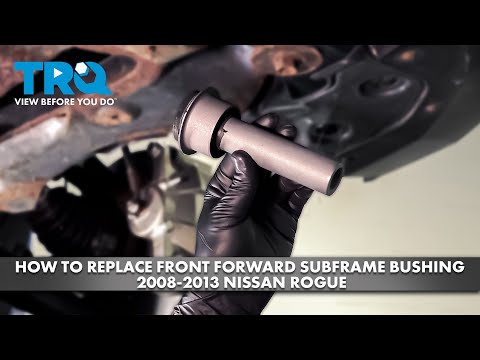
It depends on the vehicle and the tools available. Subframe bushings are often pressed into the subframe or the chassis, and replacement may require dropping the subframe. Some platforms allow replacement with the subframe in place using a bushing press tool; others do not. Check the service procedure for your specific platform before starting.
Do I need an alignment after replacing subframe bushings?
Yes. Any time the subframe is disturbed, alignment angles change. Get a four-wheel alignment after replacement, and recheck it after a few hundred miles to confirm it holds.