Suspension Motion Ratio: Measure the Curve, Not the Spec Sheet
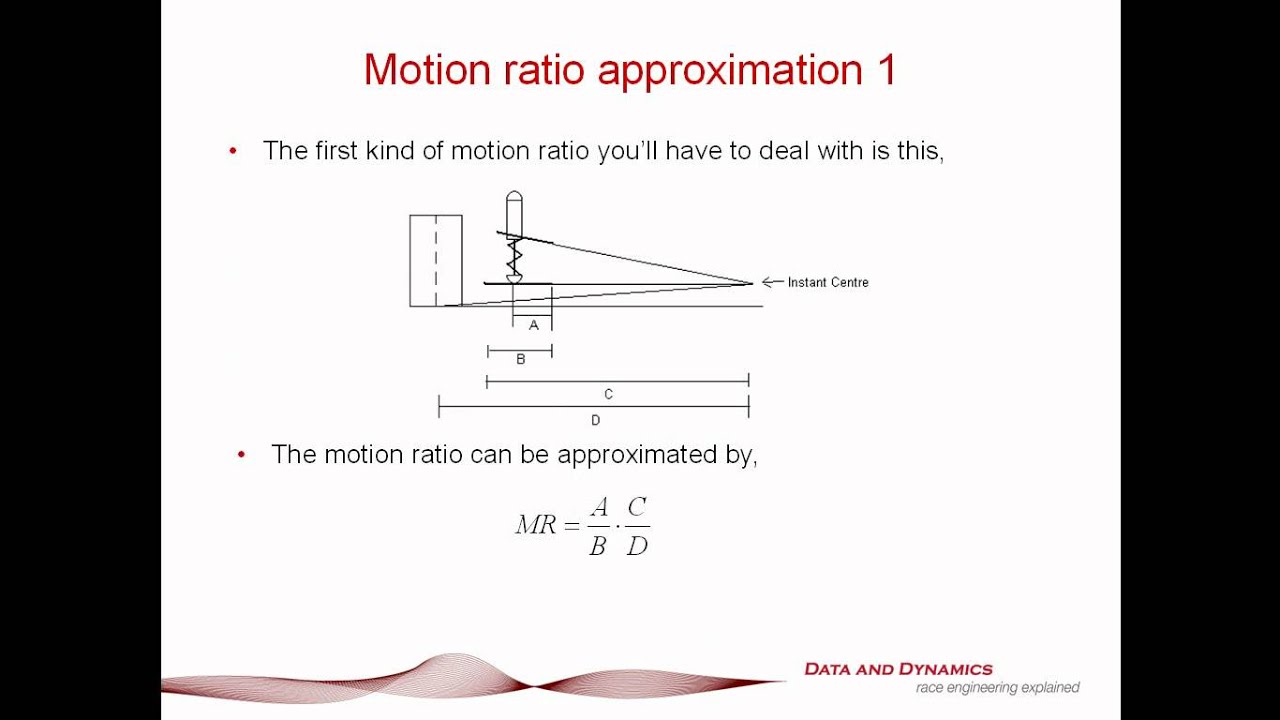
Suspension motion ratio (MR) is the ratio of spring or damper displacement to wheel displacement at a given point in suspension travel — and it changes as the suspension compresses and extends [SEARCH_EVIDENCE]. That single fact separates a car that works from one that fights you. Published single-value MR figures are approximations at one ride-height point; using them as constants is the most common reason DIY spring and damper choices miss the target [MODEL_ANALYSIS].
The practical consequence is immediate: two cars with the same spring rate but different MR curves will have different wheel rates and different ride behavior [MODEL_ANALYSIS]. A 500 lb/in spring in a car with MR = 0.5 delivers 125 lb/in at the wheel. The same spring in a car with MR = 0.9 delivers 405 lb/in. Same spring, wildly different car.
If you are buying coilovers, selecting spring rates, or trying to understand why your car feels stiff in one part of travel and soft in another, you need your car's MR curve — not a forum post quoting a single number.
The Motion Ratio Formula and a Worked Example You Can Check Against Your Own Car
MR = spring (or damper) displacement ÷ wheel displacement [SEARCH_EVIDENCE]. That is the entire formula. Everything else is measurement discipline.
Worked example: if the wheel moves 1.00 inch and the spring moves 0.70 inch, MR = 0.70 [SEARCH_EVIDENCE]. MR is dimensionless; a value below 1.0 means the spring moves less than the wheel, which is typical for most independent suspensions [MODEL_ANALYSIS]. A value above 1.0 means the spring moves more than the wheel — possible in some strut layouts and certain solid-axle configurations.
Check your own car: jack the suspension through a known wheel travel, measure spring or damper travel at the same time, divide. If your number is far from what a forum claims, trust your measurement. The forum number was probably taken at a different ride height.
Wheel Rate = Spring Rate × MR²: Why the Squared Term Changes Everything
Wheel rate = spring rate × MR² [SEARCH_EVIDENCE]. The square is not a rounding detail — it is the difference between a car that handles and a car that skips across bumps.
Numeric example: a 500 lb/in spring with MR = 0.70 gives a wheel rate of 500 × 0.49 = 245 lb/in — not 350 lb/in [MODEL_ANALYSIS]. If you skip the square and multiply 500 × 0.70, you get 350 lb/in, which is 43% higher than reality. You will buy a softer spring than you need, or you will wonder why the car understeers.
Because MR is squared, small errors in MR measurement produce large errors in wheel rate; a 10% MR error becomes roughly a 21% wheel rate error [MODEL_ANALYSIS]. Measure carefully. Measure at multiple points. The square punishes sloppy work.
How to Measure Motion Ratio on Your Actual Car: Tools, Method, and Recording
Tools: jack and jack stands or a lift, tape measure or calipers, a way to compress the suspension (jack under the lower control arm or a spring compressor depending on layout), and a notebook or phone for recording [MODEL_ANALYSIS]. A dial indicator helps if you want repeatable damper-travel numbers, but a tape measure and a steady hand will get you close enough to make better decisions than a published constant.
Method: disconnect or account for the spring and damper as needed, move the wheel through a known vertical travel, and record the corresponding spring or damper displacement at multiple points [MODEL_ANALYSIS]. If you cannot disconnect the spring, measure damper rod travel instead — it moves with the spring in most layouts.
Record spring travel vs. wheel travel at several increments (e.g., every 0.5 inch of wheel travel) to build a curve, not a single point [MODEL_ANALYSIS]. Start at full droop, work up to full bump, and note where the curve changes slope. That slope change is the geometry talking.
Why Motion Ratio Changes Through Travel — and What That Means for Spring and Damper Selection
Control arm geometry, spring mount location, and camber change all alter the effective lever arm between the wheel and the spring as the suspension moves [MODEL_ANALYSIS]. The spring does not see the wheel directly — it sees the control arm, and the control arm rotates. As it rotates, the perpendicular distance from the pivot to the spring force line changes. That distance is the lever arm. When the lever arm changes, MR changes.
A rising or falling MR curve means the wheel rate changes with compression, which affects ride frequency, roll stiffness, and damper force [MODEL_ANALYSIS]. If MR rises in bump, the car gets stiffer as it compresses — good for load transfer, potentially harsh over sharp bumps. If MR falls in bump, the car gets softer as it compresses — comfortable but potentially wallowy under load.
Selecting a spring rate from a single MR value ignores this variation and can produce a car that feels stiff in one part of travel and soft in another [MODEL_ANALYSIS]. That is not a damper problem. That is a motion ratio problem.
Motion Ratio by Suspension Type: MacPherson Strut, Double Wishbone, Multilink, and Solid Axle
MacPherson strut: MR typically in the 0.9–1.0 range at ride height because the strut acts close to the wheel, but the curve can change noticeably through travel [MODEL_ANALYSIS]. The strut is also the upper link, so camber change and MR change are linked.
Double wishbone: MR often in the 0.5–0.7 range depending on spring mounting location on the lower arm, with more design freedom to shape the curve [MODEL_ANALYSIS]. You can mount the spring inboard for packaging and tune the arm length to get the MR curve you want.
Multilink and solid axle: multilink MR varies by link geometry; solid axle MR is often closer to 1.0 for springs mounted on the axle, but can differ for offset mounts [MODEL_ANALYSIS]. A solid axle with springs on the axle tubes sees nearly direct wheel travel. A solid axle with springs on the trailing arms sees a ratio.
How Motion Ratio Drives Damper Valving and Why Aftermarket Coilovers Must Match Your Actual MR
Damping force at the wheel is damper force multiplied by MR (not MR²), so a change in MR changes the effective damping at the wheel [MODEL_ANALYSIS]. This is the critical difference: springs use MR², dampers use MR. If you change spring rate and damper valving together, you need both numbers.
Aftermarket coilovers valved for a different MR than the vehicle actually has will feel over- or under-damped regardless of adjustment range [MODEL_ANALYSIS]. A damper valved for MR = 0.7 installed on a car with MR = 0.5 will feel soft at the wheel even at full stiff. The adjuster cannot fix a geometry mismatch.
When buying coilovers or springs, ask the supplier how their rates and valving were specified for your suspension geometry — if they cannot explain it, that is a decision signal [MODEL_ANALYSIS]. A supplier who understands MR will ask you for your car's measurements or provide rates based on your specific suspension type and ride height.
Putting It Together: Using Your Measured MR Curve to Choose Springs and Dampers
Workflow: measure MR at multiple travel points → calculate wheel rate at each point → compare to target wheel rate for your use case → select spring rate and damper accordingly [MODEL_ANALYSIS]. Target wheel rate depends on use: a street car might want 150–250 lb/in at the wheel; a track car might want 400–800 lb/in. Your MR curve tells you what spring rate gets you there.
Do not trust a single published MR value, do not assume it is constant, and do not skip the MR² step when converting spring rate to wheel rate [MODEL_ANALYSIS]. These three mistakes account for most of the “my coilovers feel wrong” complaints on forums.
If you cannot measure MR yourself, choose a supplier who can explain how their spring rates were specified for your suspension geometry [MODEL_ANALYSIS]. Ask them: “What MR did you assume, and how does your valving change if my car's MR is different?” If they cannot answer, keep looking.
Motion ratio is not a spec-sheet number. It is a curve. Measure it, square it for springs, use it directly for dampers, and your suspension will finally do what you intended.
---
Related
- Large suspension bushing — 54584-2D000
- Large suspension bushing — 54584-3S100
- Large suspension bushing — 54584-BU000
FAQ
What is suspension motion ratio?
Suspension motion ratio (MR) is the ratio of spring or damper displacement to wheel displacement at a given point in suspension travel. It is dimensionless and changes as the suspension compresses and extends [SEARCH_EVIDENCE].
Why does motion ratio change through suspension travel?
Control arm geometry, spring mount location, and camber change alter the effective lever arm between the wheel and the spring as the suspension moves. When the lever arm changes, MR changes [MODEL_ANALYSIS].
How do I measure motion ratio on my car?
Jack the suspension through a known wheel travel, measure spring or damper travel at the same time, and divide. Record at multiple points to build a curve, not a single value [MODEL_ANALYSIS].
Why is wheel rate calculated with MR²?
Wheel rate = spring rate × MR². The square accounts for both the displacement ratio and the force ratio. Skipping the square overestimates wheel rate and leads to incorrect spring selection [SEARCH_EVIDENCE].
Do dampers use MR or MR²?
Damping force at the wheel is damper force multiplied by MR (not MR²). Springs use MR², dampers use MR. You need both numbers when changing spring rate and valving together [MODEL_ANALYSIS].
What if I can't measure motion ratio myself?
Choose a supplier who can explain how their spring rates were specified for your suspension geometry. Ask them: “What MR did you assume, and how does your valving change if my car's MR is different?” If they cannot answer, keep looking [MODEL_ANALYSIS].