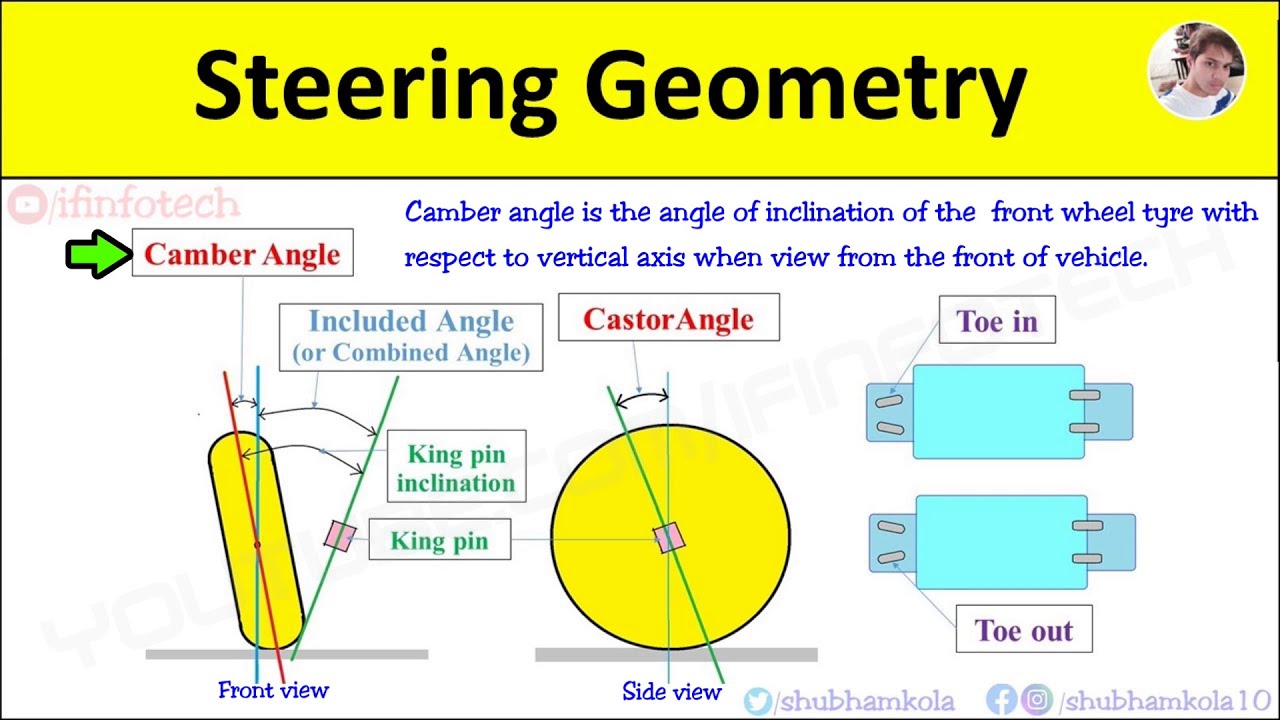
Kingpin Geometry Is a System Constraint, Not a Tuning Knob
Kingpin inclination (KPI) is the angle between the steering axis and vertical, viewed from the front. On a modern MacPherson strut, that axis is virtual—it runs through the lower ball joint and the upper strut mount. On a double-wishbone suspension, it runs through the upper and lower ball joints. The angle of that line relative to vertical is KPI. [SEARCH_EVIDENCE]
KPI is not a standalone number you can tune on most production cars. It is a system-level design constraint that works with scrub radius, caster, and camber to define how the tire contacts the road and how the steering system feels. If you're replacing a control arm, bushing, or strut mount without understanding how the new part shifts the steering axis, you're guessing at the system-level result. [MODEL_ANALYSIS]
KPI, Scrub Radius, Caster, and Camber: The Four Angles You Can't Tune in Isolation
Scrub radius is the distance between the tire contact patch center and the point where the steering axis meets the ground. KPI and wheel offset both influence it. Increase KPI—tilt the steering axis more—and the axis meets the ground closer to the tire center, reducing scrub radius for a given wheel offset. Decrease KPI and scrub radius grows. [SEARCH_EVIDENCE]
Caster and camber shift the contact patch and the steering axis too. Caster tilts the axis fore-and-aft, changing how the contact patch moves as the wheel steers. Camber tilts the wheel in or out, moving the contact patch laterally. Change one and the others move. On most production cars, these angles are set by hard points—the physical location of ball joints, strut towers, and control arm pivots. You can't adjust KPI independently with factory alignment cams. Aftermarket parts that change one angle will affect the others, often in ways the buyer didn't intend. [MODEL_ANALYSIS]
This is the core constraint: KPI, scrub radius, caster, and camber are a geometric system. Treating any one as a standalone tunable is a recipe for unpredictable steering feel and uneven tire wear.
What KPI and Scrub Radius Actually Do: Steering Effort, Self-Centering, and Tire Wear
KPI creates a self-centering moment because vehicle weight acts on the steering axis offset. When the wheel is turned, the weight of the car pushes down on the spindle, and because the steering axis is tilted, that force tries to return the wheel to straight ahead. More KPI generally means more self-centering—up to a point. Scrub radius affects steering effort and kickback. Positive scrub radius (axis meets ground inside the tire center) increases steering effort and transmits road irregularities back through the wheel. Negative scrub radius (axis meets ground outside the tire center) reduces kickback but can reduce self-centering. [SEARCH_EVIDENCE]
Excessive scrub radius can increase steering effort, cause tramlining on crowned roads, and produce uneven tire wear—typically cupping or feathering on the inner or outer shoulder depending on caster and camber. Too little scrub radius can reduce straight-line stability and make the steering feel vague. Tire wear patterns alone cannot diagnose KPI. You have to read them alongside scrub radius, caster, camber, and toe. A car with inner shoulder wear might have too much negative camber, too much toe-out, or a scrub radius problem—or all three. [MODEL_ANALYSIS]
For a parts buyer, this means: if you're replacing a control arm or bushing and the new part shifts the ball joint location, you're changing KPI and scrub radius. That can fix a tramlining complaint or create one.
Fixed by Hard Points: Why KPI Isn't a Tunable on Most Production Cars
On most production cars, KPI is determined by the lower ball joint position and the strut tower or upper control arm mounts. It is not adjustable with factory alignment cams. You can change camber and toe at the strut-to-knuckle bolts or tie rod ends, but KPI stays where the hard points put it. [MODEL_ANALYSIS]
Aftermarket parts can shift the steering axis on race cars. Offset bushings move the control arm pivot. Camber plates move the strut top. Modified spindles change the ball joint location. Each of these changes KPI, and each also changes scrub radius. A camber plate that adds negative camber by moving the strut top inboard also tilts the steering axis, which changes KPI and scrub radius. On a street car with electronic stability control (ESC) and electric power steering (EPAS), those changes can affect system behavior. ESC compares steering angle to yaw rate and wheel speeds. If the steering axis geometry changes, the relationship between steering wheel angle and actual tire slip angle shifts. EPAS assist curves are tuned to a specific steering effort profile—change scrub radius and you change the effort the driver feels, which can make the assist feel too light or too heavy. [MODEL_ANALYSIS]
Whether recalibration is required depends on the specific vehicle and the magnitude of the geometry change. There is no universal threshold. Consult OEM service data for your chassis to determine if a steering angle sensor reset or ESC calibration procedure applies. Do not assume recalibration is needed for every parts swap, and do not assume it is never needed. [MODEL_ANALYSIS]
OEMs treat KPI as a system constraint because it interacts with ESC and EPAS calibration. That's why you won't find a factory procedure for adjusting KPI. It's set at the design stage and validated as part of the steering system.
How to Measure KPI and Scrub Radius in Your Shop Before Buying Parts
You can measure KPI with a camber gauge and turn plates. Put the front wheels on turn plates on a level surface. Measure camber at 20 degrees left steer and 20 degrees right steer. The change in camber across that sweep is used to calculate KPI. [MODEL_ANALYSIS]
A standard method: record camber at 20° left steer and 20° right steer. The total camber change divided by the total steer angle (40°) gives the rate of camber change per degree of steer. KPI is then derived from that rate using the relationship between camber change and steering axis inclination. For example, if camber reads +0.5° at 20° left and -0.5° at 20° right, the total camber change is 1.0° over 40° of steer, or 0.025° per degree of steer. That rate is proportional to KPI. [MODEL_ANALYSIS]
This is a simplified model. The exact formula depends on your gauge and the suspension geometry. Use the procedure recommended by your alignment equipment manufacturer. The principle is: KPI causes camber to change as the wheel steers, and the rate of change tells you the angle. [MODEL_ANALYSIS]
To measure scrub radius, project the steering axis to the ground and compare it to the contact patch center. Use a plumb bob or laser level. Mark the point where the steering axis intersects the ground, then mark the tire contact patch center. The distance between them is scrub radius. Positive scrub radius means the axis meets the ground inboard of the contact patch center. Negative means outboard. [MODEL_ANALYSIS]
These measurements require a level surface. Record them before and after any parts change so you can quantify the shift. If you're replacing a control arm or bushing, measure first. If you don't have the tools, ask the supplier for steering-axis data—but be aware that many aftermarket suppliers don't publish it. [MODEL_ANALYSIS]
For Hyundai and Kia applications, control arm and bushing part numbers are tied to specific chassis codes. A Control Arm — 54500-2S000 for one platform won't have the same ball joint location as a Control Arm — 54500-3X000 for another. If you're swapping arms to change camber, you're also changing KPI and scrub radius. Measure before and after. [FACT_FROM_DATABASE]
Reading the Trade-Offs: How to Evaluate Aftermarket Parts That Shift KPI
Offset bushings, camber plates, and drop spindles can change KPI and scrub radius. The effect depends on the direction and magnitude of the shift. A drop spindle that lowers ride height without changing the ball joint location preserves KPI. A camber plate that moves the strut top inboard changes KPI and scrub radius together. An offset bushing that moves the lower control arm pivot changes the lower ball joint location, which changes KPI. [MODEL_ANALYSIS]
A part that changes KPI without addressing scrub radius can make steering worse—increased effort, tramlining, or reduced self-centering. If you increase KPI to reduce scrub radius, you may also increase steering effort because the steering axis is more tilted. If you decrease KPI to reduce effort, you may increase scrub radius and tramlining. There's no free lunch. [MODEL_ANALYSIS]
Use this decision matrix to evaluate common aftermarket parts before you buy:
| Part Type | Likely KPI Change | Likely Scrub Radius Change | Expected Steering Effect | Required Measurement / Recalibration |
|-----------|-------------------|----------------------------|--------------------------|--------------------------------------|
| Offset bushing (lower control arm pivot) | Shifts lower ball joint location; KPI changes | Changes with ball joint shift | Alters self-centering and effort; may increase tramlining | Measure KPI and scrub radius before/after; check ESC/EPAS per OEM data |
| Camber plate (strut top) | Moves upper steering axis point; KPI changes | Changes with strut top shift | Changes camber and KPI together; effort and self-centering shift | Measure KPI and scrub radius; verify ESC/EPAS calibration needs |
| Drop spindle | Preserves ball joint location if designed to; KPI unchanged | Unchanged if geometry preserved | Maintains factory steering feel; lowers ride height | Confirm ball joint location matches factory; measure to verify |
| Modified spindle (race) | Changes ball joint location; KPI changes | Changes with ball joint shift | Alters scrub radius and self-centering; may reduce effort on track | Measure KPI and scrub radius; re-measure after every geometry change |
[FACT_FROM_DATABASE] [MODEL_ANALYSIS]
Buyers should ask suppliers for steering-axis data or measure before and after installation. If a supplier can't tell you how their part changes KPI or scrub radius, assume it changes both and plan to measure. For Hyundai/Kia suspension bushings, the part number often indicates the platform. A Large suspension bushing — 54584-2D000 is not interchangeable with a Large suspension bushing — 54584-3S100 without verifying the control arm geometry. [FACT_FROM_DATABASE]
Common Misconceptions About KPI—and What They Cost You in Parts and Performance
Myth 1: KPI is irrelevant on strut cars. Reality: the virtual steering axis still defines scrub radius and self-centering. On a MacPherson strut, the axis runs through the lower ball joint and upper strut mount. If you change the strut mount position with a camber plate, you change KPI. If you change the lower ball joint location with a different control arm, you change KPI. The absence of a physical kingpin doesn't mean the angle is gone. [MODEL_ANALYSIS]
Myth 2: KPI is always non-adjustable. Reality: it is fixed on most production cars, but race cars can alter it with offset bushings, camber plates, or spindle modifications—with trade-offs. Adjusting KPI on a race car is a system-level change. You're not just changing one angle; you're changing scrub radius, caster, and camber at the same time. That's why race teams measure and re-measure after every geometry change. [MODEL_ANALYSIS]
Myth 3: More KPI is always better. Reality: increasing KPI reduces scrub radius but can also reduce self-centering and increase steering effort if not balanced with caster and wheel offset. There's an optimum for each application. A street car needs enough self-centering for stability and enough scrub radius for steering feel. A race car may trade self-centering for reduced scrub radius to minimize steering effort on track. More KPI is not universally better—it's a trade-off. [MODEL_ANALYSIS]
Putting It Together: A Decision Checklist for Specifying Suspension Parts with KPI in Mind
Step 1: Measure or obtain your vehicle's factory KPI and scrub radius before shopping. If you can't measure, look for factory service data or ask an alignment shop to record it. [MODEL_ANALYSIS]
Step 2: Ask whether the part changes the steering axis, and if so, how it affects scrub radius, caster, and camber. If the supplier doesn't know, assume it does and plan to measure. [MODEL_ANALYSIS]
Step 3: Consider ESC and EPAS interactions. If the part significantly shifts KPI, verify whether recalibration is needed. Consult OEM service data for your specific chassis—there is no universal rule. [MODEL_ANALYSIS]
Step 4: After installation, re-measure and test-drive to confirm steering feel and tire wear are acceptable. If steering effort increased, tramlining appeared, or self-centering decreased, the part shifted KPI or scrub radius in a way that doesn't match your application. [MODEL_ANALYSIS]
For Hyundai/Kia suspension work, control arm and bushing part numbers are platform-specific. A Control Arm — 54500-2S000 and a Control Arm — 54500-3X000 may look similar but have different ball joint locations. Always verify the part number against the chassis code and measure steering axis geometry before and after. [FACT_FROM_DATABASE]
FAQ
What is kingpin inclination (KPI)?
KPI is the angle between the steering axis and vertical, viewed from the front. On modern suspensions, the steering axis is virtual—defined by the lower ball joint and upper strut mount on a MacPherson strut, or by the upper and lower ball joints on a double-wishbone suspension. [SEARCH_EVIDENCE]
Can I adjust KPI on my car?
On most production cars, no. KPI is set by hard points—the physical location of ball joints, strut towers, and control arm pivots. It is not adjustable with factory alignment cams. Aftermarket parts like offset bushings, camber plates, or modified spindles can shift KPI, but they also change scrub radius and other angles. [MODEL_ANALYSIS]
How does KPI affect steering feel?
KPI creates a self-centering moment because vehicle weight acts on the steering axis offset. More KPI generally means more self-centering—up to a point. Scrub radius affects steering effort and kickback. Positive scrub radius increases steering effort and transmits road irregularities back through the wheel. Negative scrub radius reduces kickback but can reduce self-centering. [SEARCH_EVIDENCE]
Do I need to recalibrate ESC after changing suspension parts?
It depends on the vehicle and the magnitude of the geometry change. There is no universal threshold. Consult OEM service data for your specific chassis to determine if a steering angle sensor reset or ESC calibration procedure applies. [MODEL_ANALYSIS]
How do I measure KPI?
Use a camber gauge and turn plates on a level surface. Measure camber at 20 degrees left steer and 20 degrees right steer. The change in camber across that sweep is used to calculate KPI. The exact formula depends on your gauge—follow the procedure recommended by your alignment equipment manufacturer. [MODEL_ANALYSIS]
What happens if I change KPI without addressing scrub radius?
A part that changes KPI without addressing scrub radius can make steering worse—increased effort, tramlining, or reduced self-centering. If you increase KPI to reduce scrub radius, you may also increase steering effort. If you decrease KPI to reduce effort, you may increase scrub radius and tramlining. [MODEL_ANALYSIS]