Instant Center: How to Locate, Read, and Tune It Without Chasing a Magic Number
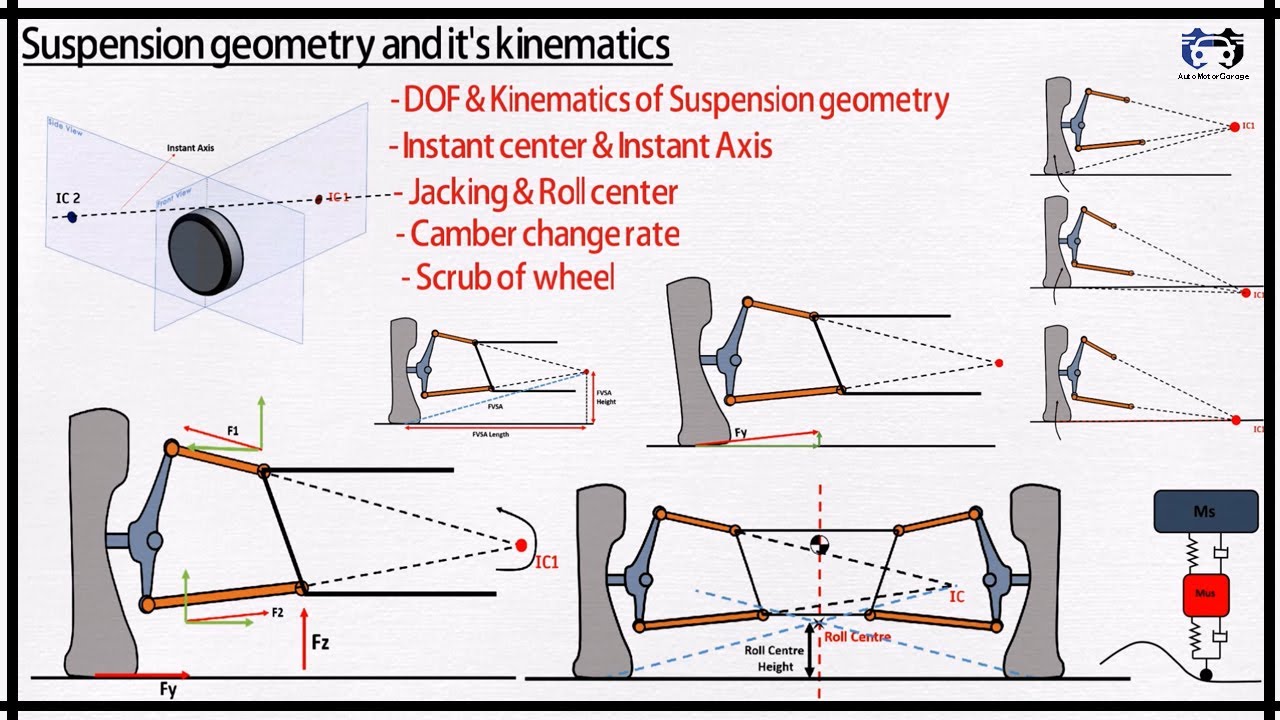
Instant center is the point where your suspension link lines intersect in side view. It is a diagnostic compass, not a magic number. Its location changes with ride height and suspension travel, so the value you measure in the shop is a snapshot. Use it to predict how the rear axle or tire contact patch will load under acceleration and cornering, then adjust it in balance with roll center, center of gravity (CG), and anti-squat.
Chasing a single "good" instant center height ignores those interactions. On a double wishbone car, the instant center moves as the suspension compresses. On a solid axle drag car, it moves as the trailing arm angle changes with ride height. The number is not a permanent characteristic. It tells you which direction the tire contact patch forces are pointing, but it does not tell you the whole story of grip.
How to Locate Instant Center on Double Wishbone, MacPherson Strut, and Solid Axle
Double Wishbone
Extend the upper and lower control arm lines in side view. Their intersection is the instant center. Mark the inner pivots and the ball joint centers on both arms, then extend those lines until they cross. Use a plumb bob, tape measure, and a large sheet of paper or digital angle finder to transfer points from the car to a side-view drawing.
MacPherson Strut
Draw a line perpendicular to the strut axis at the lower ball joint. Draw a line along the lower control arm. Their intersection is the instant center. The strut itself is a link—its axis is the upper line, and the lower control arm is the lower line. The perpendicular at the ball joint represents the strut's instantaneous force direction. This is the step most DIY tuners miss.
Solid Axle (Drag Racing)
Use the trailing arm or ladder bar lines in side view. The intersection of those lines is the instant center. If the arms are parallel, the instant center is at infinity, which means zero anti-squat from geometry alone. For a typical door-slammer with a 108-inch wheelbase, an instant center height of 6–8 inches above ground and 2–4 inches behind the rear axle is a common starting point, but the optimal range depends on the specific chassis and must be determined by testing. [MODEL_ANALYSIS]
Instant Center, Anti-Squat, and Weight Transfer: Reading the Effect on Traction
Anti-squat percentage is determined by instant center height relative to CG and wheelbase. A higher instant center generally increases anti-squat. More anti-squat reduces rear squat under acceleration, which can improve traction on launch but may cause the rear tires to unload on bumps or during corner exit. Instant center location also affects the direction of force applied to the tire contact patch, influencing forward bite and handling balance.
Think of anti-squat as the geometry's resistance to the rear end dropping under torque. If the instant center is above the CG, the suspension tries to lift the rear of the car, planting the tires. If it is below, the rear squats and the tires may lose load. But too much anti-squat can make the rear suspension rigid under acceleration, so bumps upset the car and corner exit becomes unpredictable. The goal is not maximum anti-squat; it is the right amount for your tire, power level, and track surface.
Worked Anti-Squat Example
Use the standard formula: Anti-squat % = (IC height / CG height) × (wheelbase / horizontal distance from rear axle to IC) × 100. [MODEL_ANALYSIS]
Example: 108-inch wheelbase, CG height 20 inches, IC height 7 inches, IC located 3 inches behind the rear axle. Horizontal distance from rear axle to IC = 3 inches. Anti-squat % = (7 / 20) × (108 / 3) × 100 = 0.35 × 36 × 100 = 1260%. That number is unrealistic because the formula assumes the IC is ahead of the rear axle. For a rear-axle IC behind the axle, the horizontal distance term changes sign or the formula must be adjusted for the actual geometry. [MODEL_ANALYSIS] This is why you cannot blindly plug numbers into a generic formula. Measure your actual link angles and use a suspension calculator that accounts for your layout.
Instant Center vs Roll Center: When to Prioritize Each
Instant center governs longitudinal (acceleration/braking) force geometry. Roll center governs lateral (cornering) force geometry. Changing instant center often changes roll center because they share suspension link geometry. Adjust one and re-check the other.
| Application | Priority | Why |
|-------------|----------|-----|
| Drag racing | Instant center and anti-squat | Maximize forward bite on launch |
| Road course | Roll center and camber control | Maintain cornering grip and tire contact |
| Street | Balance both | Avoid harsh ride or unpredictable behavior |
On a double wishbone, moving the inner pivot of the upper arm changes both instant center and roll center. On a MacPherson strut, lowering the car changes the lower control arm angle, which moves both. That is why you cannot tune one in isolation. If you raise the instant center for launch, you may also raise the roll center, which can cause jacking or excessive camber change in corners. Always measure both after any adjustment.
Instant Center and Anti-Dive: The Braking Trade-Off
Instant center also affects anti-dive percentage under braking. Anti-dive geometry uses the front suspension link angles to resist nose dive. A higher front instant center generally increases anti-dive, which can stabilize the car under braking but may reduce compliance over bumps. For drag racing, you may prioritize rear anti-squat and accept less front anti-dive. For road course, you need a balance: enough anti-dive to keep the front tires loaded under braking, but not so much that the suspension becomes rigid over curbs. [MODEL_ANALYSIS]
Step-by-Step: Measuring and Adjusting Instant Center Without Expensive Tools
- Measure ride height. Park the car on a level surface. Measure from the ground to a fixed reference point on the chassis (e.g., the bottom of the rocker panel) at all four corners. Record these numbers.
- Mark pivot points. Use a plumb bob to mark the ground directly below each suspension pivot point. Measure the vertical and horizontal distances from a reference line (e.g., the centerline of the car) to each mark.
- Transfer to a side-view drawing. Plot the points on a large sheet of paper or in a digital drawing. Extend the link lines until they intersect. That intersection is your instant center.
- Account for suspension travel. The instant center moves as the suspension compresses or extends. Measure at static ride height, then repeat at 1 inch compression and 1 inch extension to see the trend. If the instant center moves dramatically, your geometry may need adjustment.
- Record before/after coordinates. Use a simple table:
| Condition | IC Height (in) | IC Horizontal (in from rear axle) | Anti-Squat % |
|-----------|----------------|-----------------------------------|--------------|
| Before | | | |
| After | | | |
- Verify with a second method. Use a digital angle finder to measure link angles directly, then compare with your plumb-bob drawing. If the two methods disagree by more than 0.5 inch, re-check your measurements.
- Adjust one variable at a time. Change link lengths, mounting points, or ride height. Re-measure after each change. Test at low speed first, then incrementally increase load.
Avoid common mistakes: not accounting for suspension travel, measuring on uneven ground, or ignoring roll center changes.
Tuning Instant Center for Drag, Road Course, and Street
Drag Racing
Aim for higher instant center to increase anti-squat and plant the rear tires on launch. For a typical door-slammer with a 108-inch wheelbase, an instant center height of 6–8 inches above ground and 2–4 inches behind the rear axle is a common starting point, but the optimal range depends on the specific chassis and must be determined by testing. [MODEL_ANALYSIS] If the car wheel-hops or feels unstable, lower the instant center or soften the shocks.
Road Course
Prioritize roll center and camber. Use instant center to fine-tune corner exit traction without causing snap oversteer. Keep the instant center moderate and focus on roll center and camber curves.
Street
Balance comfort and handling. Stay close to factory geometry unless you have adjustable arms and a clear goal. Avoid extreme instant center heights that cause harsh ride or unpredictable behavior. Changing instant center without adjusting springs and shocks often makes the car worse.
Always adjust in harmony with spring rates, shocks, and tire pressures. Instant center is one part of the system.
Myth-Busting: Why Higher Instant Center Is Not Always Better
Too much anti-squat from a high instant center can cause the rear tires to unload on bumps, reducing traction on uneven surfaces. Instant center does not account for dynamic changes during suspension travel; what works static may not work in motion. Instant center cannot fix poor weight distribution, inadequate tires, or bad shock tuning; it is one variable among many.
A high instant center can make the car feel planted on a smooth track, but on the street or a bumpy autocross course, it can cause the rear to skip. That is because the geometry is trying to lift the car, and when a bump interrupts that, the tire loses load. Also, instant center is a static measurement. As the suspension compresses or extends, the instant center moves—sometimes dramatically. That is why you must test in motion, not just in the shop.
Putting It to Work: A Measured Approach to Instant Center Tuning
Start by measuring your current instant center and roll center. Understand your baseline before making changes. Adjust one variable at a time and test. Keep a log of changes and results.
If you are replacing worn suspension bushings, choose parts that maintain or allow you to adjust geometry. After replacing bushings, verify that the suspension pivot points remain in the same location. Worn bushings can allow deflection that changes instant center under load. New bushings with stiffer material may reduce that deflection, but you must re-measure to confirm the geometry is unchanged. [MODEL_ANALYSIS]
Consult a chassis shop if: you are changing suspension mounting points, you cannot achieve consistent measurements, you are building a dedicated race car, or you need to certify the car for competition. For routine adjustments on a street car, you can measure and tune yourself with the steps above.
Instant center tuning is iterative. Measure, adjust, test, and repeat. Keep notes on ride height, instant center location, and handling changes. That log becomes your compass for future modifications.
---
Related
---
Related