Anti-Dive Suspension Geometry: How Much Is Right for Your Car?

Anti-dive geometry reduces brake dive by redirecting braking forces through the suspension links—but every percentage point you add also reduces vertical compliance, hurting ride quality, tire contact, and wear. The right amount depends on your car's use case, not on maximizing the number. For street cars, 5–15% anti-dive is a realistic target. Race cars can use 20–30% or more because compliance is already sacrificed. This article gives you the calculation, the trade-offs, and a decision framework to evaluate suspension components and tuning choices.
How Braking Forces Create Dive and What Anti-Dive Geometry Actually Changes
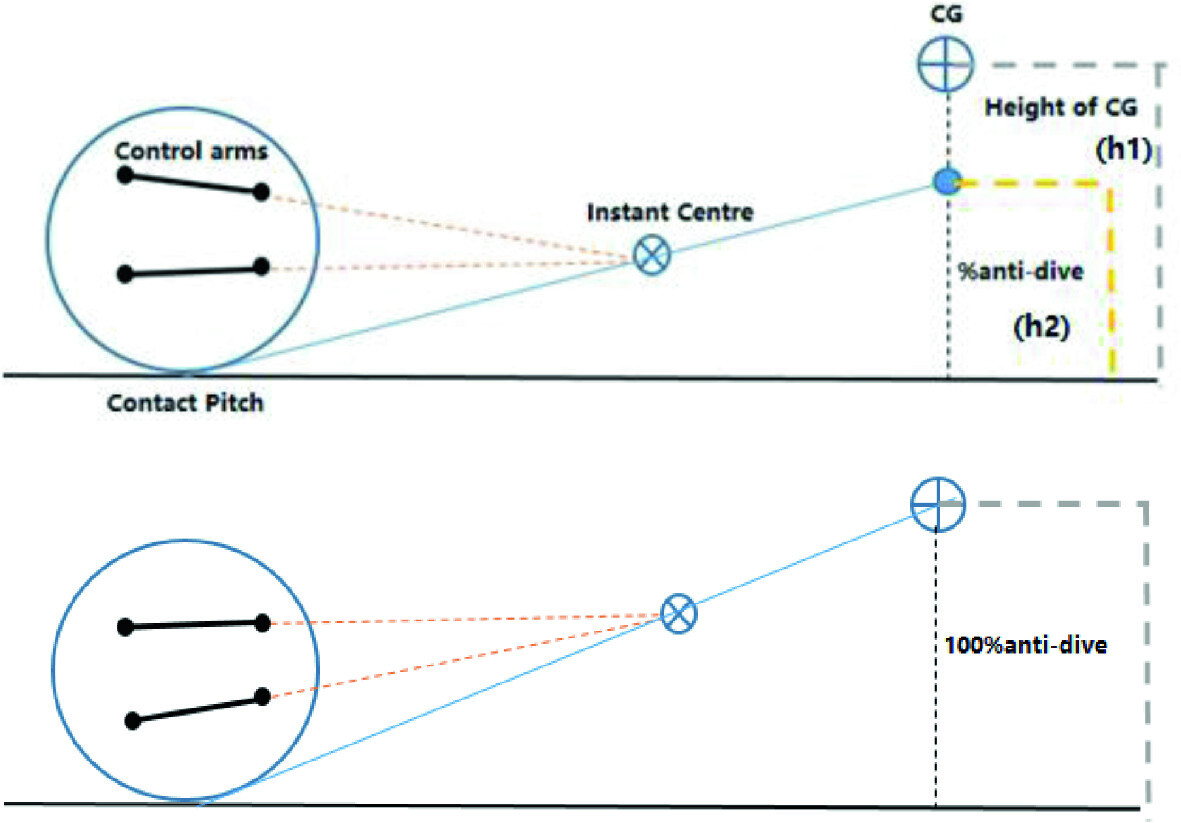
Under braking, weight transfers forward, compressing the front springs and dropping the nose—that is brake dive. Anti-dive geometry uses the suspension pivot points and the side-view instant center to create a force path that opposes dive. The anti-dive line runs from the tire contact patch through the side-view instant center; its angle relative to the ground determines the anti-dive percentage. Anti-dive does not eliminate weight transfer—it changes how much of that transfer is carried by the springs versus the suspension links.
When you brake, the front tires generate a rearward force at the contact patch. That force acts on the suspension links. If the links are angled so the force vector points upward relative to the chassis, the links push the chassis up, counteracting dive. The side-view instant center is where the upper and lower control arm lines intersect in side view. A steeper anti-dive line means more anti-dive—but also less vertical compliance, because the links resist bump travel as well as dive.
Calculating Anti-Dive Percentage: A Step-by-Step Worked Example
Anti-dive percentage is calculated from the angle of the anti-dive line:
% anti-dive = (tan θ × wheelbase / CG height) × 100
Where θ is the angle of the line from the contact patch to the side-view instant center.
Worked example: 100-inch wheelbase, 20-inch CG height, anti-dive line angle of 5 degrees.
% anti-dive = (tan 5° × 100 / 20) × 100 ≈ 12.5%
To find the side-view instant center, draw the upper and lower control arm pivot axes in side view. Extend them until they intersect. Draw a line from the tire contact patch to that point. Measure the angle relative to the ground. If you cannot measure the instant center directly, ask your suspension supplier for pickup point coordinates or use suspension analysis software. Without this data, any anti-dive percentage is a guess.
Realistic anti-dive percentages range from near 0% on comfort-oriented cars to 30% or more on race cars. The calculation alone does not tell you whether that value is appropriate for your use.
Anti-Dive and Anti-Squat: How They Interact and Affect Vehicle Balance
Anti-squat resists rear squat under acceleration; anti-dive resists front dive under braking. Both are determined by the side-view instant center location, so changing the instant center to increase anti-dive often changes anti-squat as well. Excessive anti-squat can cause the rear suspension to bind or lose compliance, just as excessive anti-dive does at the front. Vehicle balance under braking and acceleration depends on the combined effect of anti-dive and anti-squat, not on either alone.
On many cars, front and rear suspensions share design constraints. Raising the front instant center to increase anti-dive may also raise the rear instant center if the platform uses similar geometry. That can increase anti-squat, reducing rear compliance and causing the rear tires to lose contact under acceleration. The result is a car that feels nervous and unpredictable. Tuning anti-dive without considering anti-squat is like adjusting front camber without checking rear toe—you solve one problem and create another.
The Real Costs of Anti-Dive: Ride, Compliance, Tire Wear, and Braking Stability
Higher anti-dive reduces suspension compliance, making the ride harsher and reducing the tire's ability to follow road irregularities under braking. Reduced compliance can lead to uneven tire wear, especially on the front axle, because the tire is not maintaining consistent contact with the road. On race cars, some loss of compliance is acceptable for braking stability and reduced dive. On street cars, the same trade-off often makes the car unpleasant and less safe on rough roads.
Braking stability can improve with moderate anti-dive because the car's attitude changes less. But excessive anti-dive can cause the front tires to lock more easily or reduce steering feel. Compliance is the suspension's ability to absorb bumps without transferring force to the chassis. Increasing anti-dive effectively stiffens the front suspension in the vertical direction under braking. That stiffness helps keep the chassis flat, but it also means the tire cannot follow the road surface as well. On a smooth track, that is a net gain. On a potholed street, it is a net loss. Tire wear follows the same logic: a tire that skips over bumps will wear unevenly, often with flat spots or cupping. If you drive on rough roads, keep anti-dive modest.
Anti-Dive Across Suspension Types: MacPherson Strut, Double Wishbone, and Multilink
MacPherson strut suspensions have limited anti-dive adjustability because the lower control arm and strut rod define the side-view instant center; changing it often requires altering pickup points or using offset bushings. Double wishbone suspensions offer more anti-dive tuning potential because the upper and lower control arm angles can be adjusted independently. Multilink suspensions can be designed with specific anti-dive characteristics, but aftermarket adjustment is often limited to replacing bushings or arms with altered geometry. The suspension type determines how much anti-dive is realistically achievable without major fabrication.
If you are buying suspension parts, know your suspension type. For a MacPherson strut car, you cannot easily change anti-dive without modifying the strut tower or lower control arm mounting points. Offset bushings can help, but they are a compromise. For a double wishbone car, adjustable upper control arms or shims at the pivot points can change the instant center. For a multilink car, the rear suspension often has more adjustment than the front. In all cases, the limiting factor is the chassis pickup points. If you cannot change those, your anti-dive range is fixed.
Practical Limits and Tuning Guidance: What a Street Car Can Realistically Use
For street cars, modest anti-dive in the 5–15% range can improve braking stability without ruining ride quality. Higher percentages are usually not worth the comfort and tire wear penalties. Race cars can benefit from higher anti-dive (20–30% or more) because compliance is already sacrificed for grip and the driver can tolerate a harsher ride. EVs, with their low center of gravity and heavy battery mass, may have different anti-dive needs; the calculation still applies, but the target percentage may shift.
Before adjusting anti-dive, ensure the basics are correct: proper alignment, quality dampers, and correct spring rates. Anti-dive is a fine-tuning tool, not a fix for worn components. If you cannot measure or calculate your current anti-dive, changing parts blindly is more likely to hurt than help.
Start with a baseline. Measure your current anti-dive percentage if possible. If it is already above 15% and you drive on the street, do not increase it. If it is near 0% and you want better braking stability, a small increase may help. But always address worn bushings, dampers, and alignment first. A car with fresh bushings and a good alignment will outperform a car with aggressive anti-dive and worn components. Anti-dive is the last 5% of the setup, not the first 50%.
Putting It Into Practice: How to Evaluate Anti-Dive Before You Buy Suspension Parts
Ask suppliers for side-view instant center data or anti-dive percentage if available. If not, use the calculation method to estimate from known pickup points. Prioritize correct geometry and quality components (dampers, bushings, arms) over chasing a specific anti-dive number. A well-sorted suspension with moderate anti-dive will outperform a poorly executed high-anti-dive setup. For street cars, avoid suspension kits that promise aggressive anti-dive without addressing compliance. For race cars, consider adjustable arms or custom pickup points if the rules allow. Test changes incrementally: adjust one parameter at a time and evaluate on the same road or track section to isolate the effect of anti-dive.
When you evaluate suspension parts, look for components that allow geometry adjustment. Adjustable control arms or offset bushings can change the instant center. If you are replacing worn bushings, consider whether a stiffer bushing will change compliance and thus the effective anti-dive. A stiffer bushing reduces compliance, which can make anti-dive feel more aggressive even if the geometry is unchanged. So if you are upgrading bushings, do not also increase anti-dive without testing. One change at a time.
For Hyundai and Kia models, we stock a range of suspension bushings and control arms that can affect anti-dive geometry. For instance, the Large suspension bushing — 54584-2D000 and Large suspension bushing — 54584-3S100 are original-equipment replacements that restore factory compliance. If you are changing control arms, the Control Arm — 54500-S1AA0 and Control Arm — 54500-CG000 are direct-fit options. Always verify fitment by OEM number before ordering.
Frequently Asked Questions
Q: Can I adjust anti-dive on my MacPherson strut car?
A: Limited adjustment is possible with offset bushings or slotted strut mounts, but significant changes require modifying pickup points. For most street cars, it is not worth the effort.
Q: Does anti-dive reduce braking distance?
A: Not directly. Anti-dive changes chassis attitude under braking, which can improve stability and tire contact, but braking distance is primarily determined by tires, brakes, and weight transfer. Anti-dive is a fine-tuning tool.
Q: What is a good anti-dive percentage for a daily driver?
A: 5–15% is a reasonable target. Higher percentages may improve braking feel but often degrade ride quality and tire wear on rough roads.
Q: How does anti-dive affect tire wear?
A: Excessive anti-dive reduces compliance, causing the tire to skip over bumps and wear unevenly. Modest anti-dive has minimal effect on tire wear.
Q: Can I calculate anti-dive without a suspension program?
A: Yes, if you can measure the side-view instant center. Draw the control arm lines in side view, find the intersection, measure the angle, and use the formula. It requires patience and accurate measurements.
Conclusion
Anti-dive is a trade-off. The right amount depends on your car's use case. Calculate your current percentage, understand the interaction with anti-squat, and prioritize compliance for street cars. For race cars, higher anti-dive can be beneficial, but always test incrementally. Before buying suspension parts, ask for geometry data and choose quality components over aggressive numbers. Anti-dive is a fine-tuning tool, not a magic bullet.