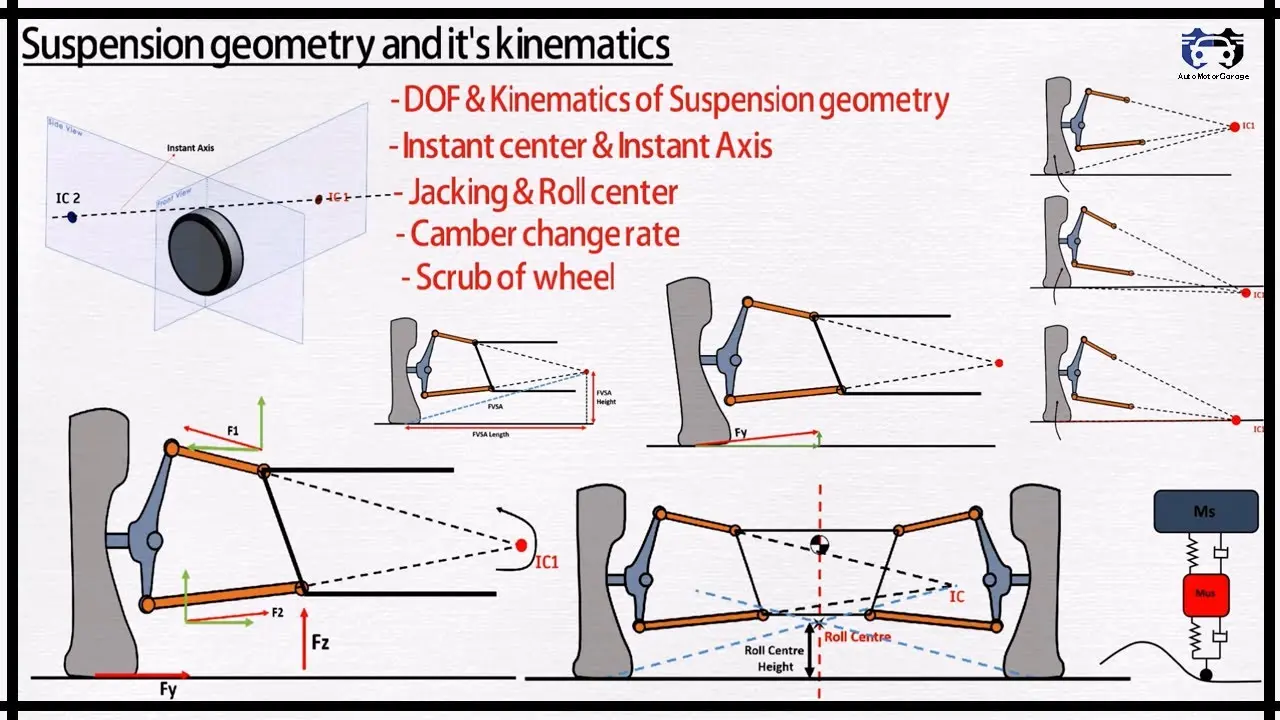
Suspension Design Optimization: Balancing Performance, Cost, and Real-World Constraints

Suspension design optimization is the process of making informed trade-offs to achieve the best balance of handling, ride comfort, and durability within manufacturing and cost limits. It’s not about chasing extreme metrics but aligning the suspension with the vehicle’s intended use and the user’s budget.
Fundamentals of Suspension Geometry and Their Impact on Handling
Suspension geometry—camber, caster, toe, roll center, and scrub radius—directly affects tire contact, stability, and cornering behavior. Understanding these parameters is essential before making any changes.
- Camber: Negative camber (top tilted inward) improves cornering grip but can reduce straight-line braking and cause inner-edge tire wear if excessive.
- Caster: Positive caster provides straight-line stability and steering return, but too much can make steering heavy.
- Toe: Toe-in (front of wheels closer) enhances stability; toe-out improves turn-in response.
- Roll Center: The point around which the body rolls during cornering. A lower roll center increases body roll; a higher one reduces it but can cause jacking.
- Scrub Radius: The distance between the tire contact patch center and the steering axis intersection with the ground. It affects steering effort and kickback.
These parameters influence understeer and oversteer. For example, increasing negative camber on the front can reduce understeer, but excessive negative camber on the rear may cause oversteer. Ride quality also suffers with too much negative camber, leading to vibration and harshness on rough roads.
Optimization Methods: Simulation, DOE, and Genetic Algorithms
Different optimization methods vary in cost and expertise required.
Simulation-based optimization uses multibody dynamics software (e.g., Adams, CarSim) to model and test virtual prototypes. It allows rapid evaluation of many design variations without physical prototypes, but requires specialized software and expertise, making it suitable for OEMs and large manufacturers.
Design of Experiments (DOE) is a statistical method to systematically test multiple variables and their interactions. By planning experiments, engineers can identify which factors have the most significant impact. DOE is cost-effective and can be used by smaller teams, but may miss non-linear interactions if the design space is not well explored.
Genetic algorithms are heuristic optimization techniques inspired by natural selection. They explore large design spaces by evolving a population of designs, selecting the best based on fitness criteria (e.g., minimizing lap time while maximizing ride comfort). They can find global optima but require many evaluations, often needing simulation or surrogate models. They are powerful but computationally intensive.
For aftermarket or DIY projects, simulation and DOE are rarely practical. Instead, start with a known good baseline (e.g., OEM specs), make one change at a time, and test. This is essentially manual DOE. For complex multi-variable optimization, consider consulting an engineer with simulation tools.
Comfort vs. Handling: Trade-offs for Different Vehicle Types
The inherent conflict between ride comfort and handling is fundamental. Comfort demands soft springs and damping to absorb road imperfections, while handling requires stiffer springs and controlled damping to minimize body roll and maintain tire contact.
Vehicle type dictates the balance:
- Luxury sedans prioritize comfort: low spring rates (e.g., 2-3 N/mm) and soft damping to isolate occupants.
- Sports cars prioritize handling: high spring rates (e.g., 6-10 N/mm) and firm damping to reduce body roll and improve steering response.
- Trucks and SUVs need load capacity and off-road articulation: spring rates vary widely, often using progressive springs to handle both light and heavy loads.
Typical damping ratios (actual damping coefficient / critical damping) range from 0.2-0.4 for comfort to 0.5-0.8 for performance.
Optimization must align with the vehicle’s intended use. A sports car optimized for track days will be harsh on daily commutes; a luxury SUV optimized for comfort will have poor handling in emergency maneuvers.
Real-World Constraints: Manufacturing Tolerances, Cost, and Durability
Manufacturing tolerances affect suspension component consistency. For example, a bushing with a tolerance of ±0.5 mm can change alignment angles by several tenths of a degree, affecting handling. Tight tolerances increase cost, so engineers must balance performance with manufacturability.
Cost constraints are significant. High-performance materials (e.g., forged aluminum, polyurethane bushings) and precision manufacturing raise costs. For aftermarket parts, buyers must weigh performance gains against price.
Durability is another trade-off. Optimizing for performance often reduces component life. Stiffer bushings transmit more shock to the chassis, leading to faster wear of adjacent parts. Softer bushings may last longer but compromise handling.
For production vehicles, optimization must consider these constraints to be viable. For aftermarket, the same applies: a part that fails prematurely is not a good value.
Practical Guide: Adjusting Suspension on Lowered Vehicles
Lowering a vehicle without proper adjustments can degrade handling and ride. Common issues include:
- Altered roll center: Lowering drops the roll center, increasing body roll.
- Bump steer: The tie rods may not be parallel to the control arms, causing toe changes during suspension travel.
- Reduced travel: Springs may bottom out, causing harshness.
- Alignment changes: Camber and toe often go out of spec.
To correct these:
- Install adjustable control arms to restore roll center and camber. For example, adjustable rear trailing arms allow you to set camber and toe correctly.
- Use camber plates on strut-type suspensions to adjust camber without affecting caster.
- Adjust tie rod ends to eliminate bump steer. Ideally, the tie rod should be parallel to the lower control arm.
- Perform a proper alignment after any suspension change.
- Choose the right spring rate and damping for the new ride height. Lowering typically requires slightly stiffer springs to avoid bottoming out, but not so stiff that ride quality suffers.
- Check clearance for tires and suspension components, and ensure bump stops are engaged to prevent metal-on-metal contact.
Always test the vehicle after adjustments. Start with moderate settings and fine-tune based on feel.
Passive vs. Active Suspension Systems: Which to Choose?
Passive suspension uses fixed-rate springs and dampers. It is simple, reliable, and cost-effective. Active suspension uses electronically controlled dampers or actuators that adapt to road conditions and driving style, offering better ride and handling.
Passive systems are the standard for most vehicles. They are cheaper to manufacture and maintain, and their behavior is predictable. However, they are a compromise: you cannot have both a soft ride and firm handling simultaneously.
Active systems (e.g., adaptive dampers, air suspension) can adjust damping in real-time. They provide a comfortable ride on highways and firm handling on twisty roads. However, they are more complex, expensive, and can fail. Repair costs are higher.
When to choose active:
- High-end vehicles where ride comfort and handling are both critical.
- Performance cars that need track capability and daily drivability.
- Heavy vehicles that need load-leveling (air suspension).
For most buyers, passive suspension is sufficient. If you are considering an active system, weigh the initial cost and potential repair bills. For DIYers, passive systems are easier to modify and maintain.
Conclusion
Suspension design optimization is a balancing act. Understanding the fundamentals of geometry, the trade-offs between comfort and handling, and the real-world constraints of manufacturing and cost will help you make informed decisions. Whether you are buying replacement parts or modifying your vehicle, always consider the intended use and the compromises you are willing to make.
For high-quality suspension components that meet OEM specifications, explore our automotive suspension components. We offer a range of Large suspension bushings and control arms designed for durability and performance.