Suspension Compliance: What It Is and How to Choose the Right Bushings and Links

Suspension compliance is the controlled deflection of suspension components under load, allowing wheels to move slightly in response to forces while maintaining alignment. It is not a defect but a tuned characteristic that balances ride comfort, tire grip, and handling precision. Compliance is primarily engineered into bushings, links, and mounts, which act as springs and dampers for suspension geometry. Understanding compliance helps buyers choose parts that match their driving needs, whether for daily comfort or performance handling.
When a car corners, brakes, or hits a bump, forces act on the suspension. If every component were perfectly rigid, those forces would transmit directly to the tires, causing them to lose grip and the ride to be harsh. Compliance allows controlled movement—typically a few millimeters—so the tire maintains optimal contact with the road. This movement is not random; it is carefully tuned by engineers to achieve specific handling characteristics.
For example, a luxury sedan might have softer bushings that allow more deflection, smoothing out road imperfections. A sports car, on the other hand, uses stiffer bushings to minimize deflection, providing sharper steering response. The same principle applies to links and mounts. Each component contributes to the overall compliance of the suspension system.
As a parts manufacturer, we see compliance as a design feature, not a flaw. When selecting aftermarket bushings or links, you are essentially choosing how much compliance you want. This article will explain how compliance is measured, its role in key components, and how to make informed decisions when upgrading your suspension.
How Is Suspension Compliance Measured? Kinematics & Compliance (K&C) Testing Explained
K&C testing measures how suspension geometry changes under vertical load (kinematics) and lateral/longitudinal forces (compliance). Key metrics include toe change, camber gain, and deflection under load, which indicate how much the wheel moves relative to the chassis. Manufacturers use K&C rigs to tune compliance targets for ride comfort and handling balance. For aftermarket parts, K&C data helps predict how changes in bushing stiffness alter compliance and vehicle behavior.
Kinematics and Compliance (K&C) testing is the standard method used by vehicle manufacturers and suspension engineers. A K&C rig holds the vehicle body fixed while applying controlled forces to the tires. Sensors measure the resulting changes in wheel position and orientation. Kinematics refers to the geometric motion of the suspension as it travels vertically (jounce and rebound). Compliance measures the deflection of bushings and links when lateral or longitudinal forces are applied.
The results are plotted as curves showing, for example, how toe angle changes with lateral force. These curves reveal the suspension's compliance characteristics. A steeper curve indicates more deflection for a given force, meaning higher compliance. Engineers use this data to set targets for bushing stiffness and geometry.
For aftermarket parts, K&C data is invaluable. If you replace a rubber bushing with a polyurethane one, you are increasing stiffness, which reduces compliance. K&C testing can predict how that change will affect toe and camber under load, helping you anticipate changes in handling. While you may not have access to a K&C rig, understanding the principles helps you make better part selections.
The Role of Bushings and Links in Suspension Compliance
Bushings are the primary compliance elements, allowing controlled movement between suspension arms and the chassis. Links (e.g., sway bar links, control arms) also flex under load, contributing to compliance. Bushing stiffness and durometer (hardness) determine the amount of compliance: softer for comfort, harder for precision. Aftermarket bushings (e.g., polyurethane, solid) reduce compliance, improving handling but increasing NVH (noise, vibration, harshness).
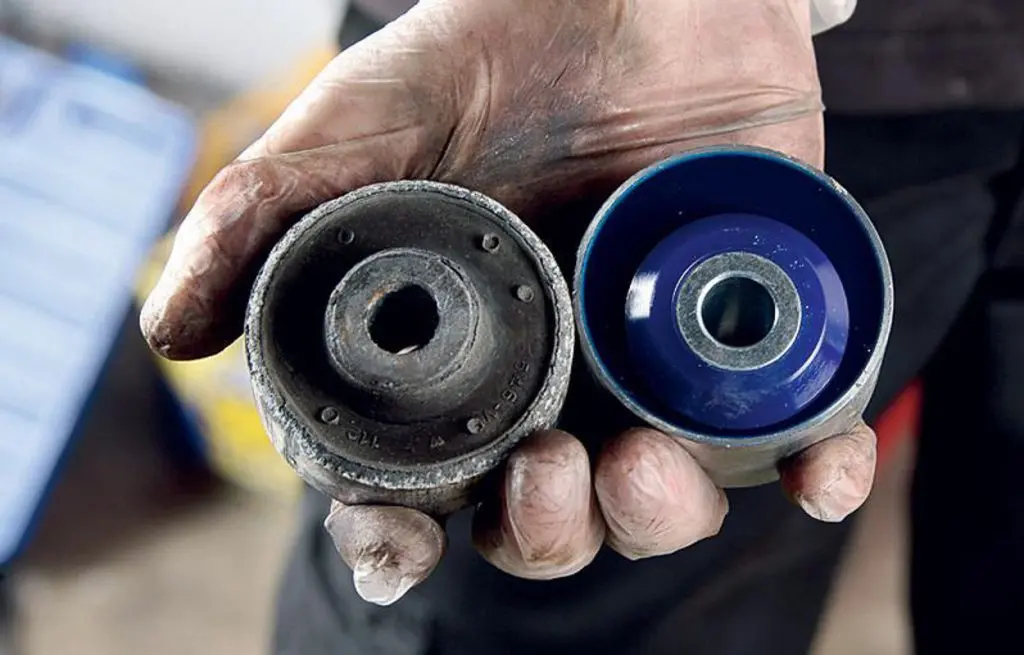
Bushings are typically made of rubber or polyurethane and are inserted between the suspension arm and the mounting point on the chassis or subframe. They allow the arm to pivot while absorbing small vibrations and shocks. The rubber's elasticity provides compliance, allowing the wheel to move slightly without transmitting harsh impacts to the cabin.
Links, such as control arms and sway bar links, also flex under load. While they are designed to be rigid, the bushings at their attachment points introduce compliance. The combination of all these flex points determines the overall suspension compliance.
When choosing aftermarket bushings, you are essentially adjusting this compliance. Softer rubber bushings (OEM) offer maximum comfort but can feel vague. Polyurethane bushings are stiffer, reducing deflection and improving steering response, but they transmit more road noise and vibration. Solid metal bushings (spherical bearings) offer minimal compliance, ideal for track use but too harsh for daily driving.
For Hyundai and KIA vehicles, we manufacture replacement bushings that match OEM specifications. For example, our Large suspension bushing and Large suspension bushing are designed to restore original compliance, ensuring your vehicle handles as intended.
Compliance vs. Handling: The Trade-Off You Need to Understand
Higher compliance improves ride comfort by absorbing road imperfections and reducing harshness. Excessive compliance can cause vague steering, delayed response, and uneven tire wear. Lower compliance (stiffer bushings) improves handling precision, steering feel, and cornering stability but increases NVH. Suspension geometry (e.g., MacPherson strut vs. double wishbone) influences how compliance affects alignment and tire contact.
The trade-off between compliance and handling is fundamental. A suspension with high compliance will soak up bumps and provide a smooth ride, but it may feel floaty and unresponsive during aggressive driving. The tires may not maintain optimal contact patch under hard cornering, leading to reduced grip. Conversely, a suspension with low compliance offers immediate response and precise control, but every road imperfection is felt in the cabin.
Suspension type also plays a role. MacPherson strut suspensions, common on front-wheel-drive cars, have a single lower control arm and a strut that acts as both shock absorber and structural member. Compliance in the lower arm's bushing significantly affects toe and camber under load. Double wishbone suspensions, often found on performance cars, have two control arms, allowing more precise control of geometry. Compliance in these arms can be tuned independently for better handling.
For most drivers, the ideal is a balance. OEM engineers spend thousands of hours tuning compliance to match the vehicle's intended use. When you modify your suspension, you are shifting that balance. If you prioritize comfort, stick with OEM or high-quality rubber bushings. If you want sharper handling, consider polyurethane bushings, but be prepared for increased NVH.
Signs of Excessive Compliance and How to Diagnose Compliance Issues
Symptoms of excessive compliance: vague steering, wandering, uneven tire wear, clunking noises, and poor alignment stability. Common causes: worn or deteriorated bushings, damaged links, or improperly torqued bolts. Diagnosis: visual inspection for cracks, play, or fluid leaks; use of pry bar to check bushing movement; alignment check. Replacement guidance: choose OEM or high-quality aftermarket parts that match the vehicle's design intent unless you intentionally want to alter compliance.
Over time, rubber bushings degrade due to heat, oil, and road contaminants. They may crack, tear, or become permanently deformed. When this happens, compliance increases beyond design limits, leading to a host of problems.
Vague steering: The steering wheel may feel loose, with a dead spot in the center. The car may not track straight, requiring constant correction.
Wandering: The vehicle may drift to one side or feel unstable at highway speeds, especially under braking or acceleration.
Uneven tire wear: Excessive compliance can cause the wheels to toe-in or toe-out under load, scrubbing the tires and causing premature wear on the inner or outer edges.
Clunking noises: Worn bushings allow metal-to-metal contact, producing clunks or squeaks over bumps.
Poor alignment stability: The alignment may change as you drive, causing the car to pull or handle inconsistently.
To diagnose, start with a visual inspection. Look for cracked, torn, or oil-soaked bushings. Use a pry bar to gently move the suspension arm; excessive movement indicates a worn bushing. Check for play in ball joints and tie rod ends. Finally, have the alignment checked; if the settings are correct but the car still exhibits symptoms, compliance is likely the culprit.
When replacing, decide whether you want to maintain OEM compliance or alter it. For most daily drivers, OEM or high-quality aftermarket rubber bushings are the best choice. If you are upgrading for performance, polyurethane bushings offer a good balance. Our range of automotive suspension components includes bushings that meet OEM specifications for Hyundai and KIA vehicles.
Manufacturer's Perspective: How We Tune Compliance for Real-World Driving
Compliance targets are set based on vehicle's intended use (e.g., luxury sedan vs. sports car). Engineers use K&C testing and subjective ride/handling evaluations to fine-tune bushing stiffness and geometry. Aftermarket parts that alter compliance can disrupt the engineered balance, sometimes with unintended consequences. For most drivers, OEM or high-quality aftermarket parts that match the vehicle's design intent offer the best overall performance.
As a manufacturer of suspension components, we understand the importance of compliance. When designing a new vehicle, automakers define a target balance between ride comfort and handling. They use K&C testing to measure prototype suspensions and adjust bushing stiffness until the desired characteristics are achieved. Subjective evaluations by test drivers provide final feedback.
For example, a luxury sedan like a Genesis G80 will have softer bushings to isolate road noise and vibration. A sporty model like a Hyundai N car will use stiffer bushings for sharper response. The same platform can have different compliance targets depending on trim level.
When you replace a bushing with an aftermarket part, you are changing that engineered balance. A stiffer bushing may improve handling but could introduce harshness or even cause unexpected alignment changes. Conversely, a softer bushing might improve ride but make the car feel vague.
Our advice: unless you have a specific performance goal, choose parts that match the original specifications. Our quality control ensures that our bushings meet OEM tolerances, so you can restore your vehicle's intended compliance. If you do want to alter compliance, consult with a suspension specialist to understand the trade-offs.
Choosing the Right Bushings and Links: A Buyer's Guide
Assess your driving needs: daily driver, spirited driving, track use, or towing. Understand bushing materials: rubber (OEM comfort), polyurethane (reduced compliance, increased NVH), solid (minimal compliance, harsh). Consider adjustable links for fine-tuning alignment and compliance. Check for quality certifications and compatibility with your vehicle's suspension design.
Selecting the right bushings and links is crucial for achieving your desired balance of comfort and performance. Here’s a step-by-step guide:
1. Define your priorities.
- Daily driver: Prioritize comfort and low NVH. Stick with rubber bushings that match OEM specs.
- Spirited driving: You want improved response without sacrificing too much comfort. Polyurethane bushings are a good middle ground.
- Track use: Maximum precision is key. Solid or spherical bushings minimize compliance but are harsh for street use.
- Towing or heavy loads: Consider stiffer bushings to reduce deflection under load, but be aware of increased NVH.
2. Understand bushing materials.
- Rubber: OEM standard. Provides good compliance, absorbs vibration, and is durable. Softer durometer means more comfort.
- Polyurethane: Stiffer than rubber, reduces compliance, improves handling, but transmits more road noise and harshness. Available in various durometers.
- Solid (Delrin, aluminum, spherical): Minimal compliance, best for track use. Very harsh for daily driving and can increase stress on other components.
3. Consider adjustable links.
Adjustable control arms or toe links allow you to fine-tune alignment settings, compensating for changes in ride height or compliance. They are useful for performance builds but require proper setup.
4. Check compatibility and quality.
Ensure the parts are designed for your specific vehicle model and year. Look for reputable manufacturers that provide clear specifications. Our about our company page details our manufacturing process and commitment to quality. We offer a range of automotive suspension components for Hyundai and KIA vehicles, including control arms and bushings that meet or exceed OEM standards.
By understanding your needs and the trade-offs, you can make an informed decision that enhances your driving experience without compromising safety or comfort.
FAQ
Q: What is suspension compliance?
A: Suspension compliance is the controlled deflection of suspension components under load, allowing wheels to move slightly while maintaining alignment. It balances ride comfort and handling precision.
Q: Why does suspension compliance matter?
A: It affects ride quality, tire grip, and handling. Too much compliance can cause vague steering and uneven tire wear; too little can make the ride harsh and reduce traction on rough roads.
Q: How do bushings affect compliance?
A: Bushings are the primary compliance elements. Softer bushings allow more deflection (more compliance), while stiffer bushings reduce deflection (less compliance).
Q: What are the signs of worn bushings?
A: Symptoms include vague steering, wandering, clunking noises, uneven tire wear, and poor alignment stability.
Q: Should I replace rubber bushings with polyurethane?
A: It depends on your priorities. Polyurethane reduces compliance, improving handling but increasing NVH. For daily driving, OEM rubber is often best. For performance, polyurethane can be a good upgrade.
Q: How do I choose the right bushings for my vehicle?
A: Consider your driving needs, understand bushing materials, and ensure compatibility with your vehicle. For most drivers, OEM or high-quality aftermarket parts that match the original specifications are recommended.
Q: What is K&C testing?
A: Kinematics and Compliance (K&C) testing measures how suspension geometry changes under load. It helps engineers tune compliance and can predict how aftermarket parts affect handling.
Q: Can I adjust compliance with aftermarket parts?
A: Yes, by choosing bushings with different stiffness or using adjustable links. However, altering compliance can affect ride comfort and handling balance, so it's important to understand the trade-offs.
Q: Are your bushings OEM quality?
A: Yes, our bushings are manufactured to meet OEM specifications for Hyundai and KIA vehicles. We ensure quality control to restore your vehicle's intended compliance.
Q: Where can I find the right bushings for my car?
A: Visit our products page to browse our range of suspension components, including bushings and links for Hyundai and KIA models.