Suspension Camber Curve: How to Measure, Read, and Tune It for Grip and Tire Wear
Camber curve is the change in camber angle across suspension travel, and it is a tunable characteristic—not a fixed spec. Understanding it is the difference between buying the right aftermarket part and buying the wrong one. A car can show "perfect" static alignment and still chew inner shoulders or lose grip mid-corner, because the number on the alignment sheet is not the number the tire sees under load.
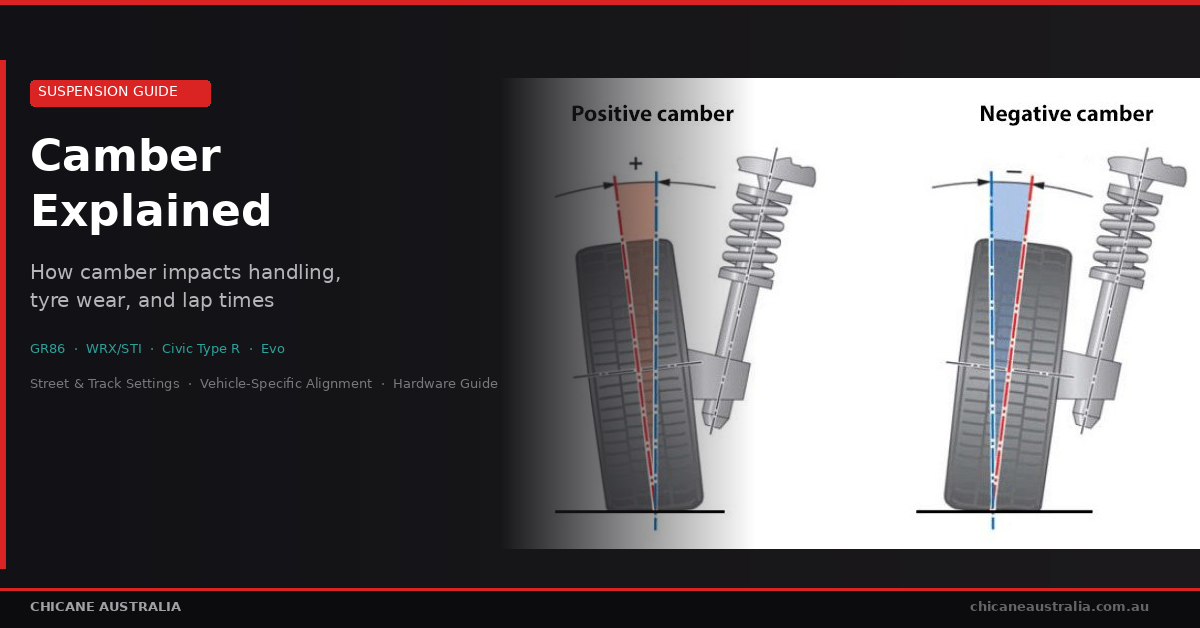
Camber angle is the tilt of the wheel relative to vertical. Negative camber tilts the top of the wheel inward; positive tilts it outward. Camber gain is the change in camber per unit of suspension travel, usually expressed in degrees per inch of compression or rebound. The camber curve is the plot of camber angle across the full range of travel.
This matters because cornering loads compress the outside suspension. If the curve adds negative camber as the suspension compresses, the tire stays flatter against the road. If it doesn't, the tire rolls onto its outer shoulder and grip drops.
Before buying any camber correction part, identify which problem you have: too little static camber, too little camber gain, or both. They require different solutions.
What a "Good" Camber Curve Actually Looks Like
This is the decision most readers came for. Camber gain is not one universal number—it depends on suspension architecture. The ranges below are typical design targets, not measured test data from a specific car. Use them as a sanity check when you plot your own curve.
| Suspension type | Typical camber gain (compression) | What "good" looks like | What "bad" looks like |
|---|---|---|---|
| McPherson strut | ~0.2–0.5°/in | Curve goes slightly more negative through compression; usable with moderate static camber | Flat or positive-going curve; tire rolls onto outer shoulder under load |
| Double wishbone | ~0.6–1.2°/in | Progressive negative gain; contact patch stays flat through roll | Excessive gain causing inner-edge loading, or flat curve from poor pivot heights |
| Multilink | Varies; often between strut and wishbone | Smooth, monotonic negative gain; toe stays controlled | Non-monotonic curve (camber reverses direction mid-travel) from worn or mismatched links |
On a plotted curve—camber on the vertical axis, suspension travel on the horizontal—a good curve moves steadily more negative in compression and returns predictably in rebound. A bad curve flattens, reverses, or jumps. If your curve goes positive in compression, you have insufficient camber gain, and no amount of static camber will fully compensate.
How Suspension Geometry Creates Camber Gain
Camber gain is a geometric byproduct, not a tunable setting on most factory suspensions. Unequal-length control arms create camber gain because the shorter upper arm pulls the top of the knuckle inward as the suspension compresses. The longer lower arm swings through a wider arc, and the difference in arc length tilts the knuckle.
Three variables define the curve:
- Arm length ratio — how long the upper arm is relative to the lower.
- Inner pivot heights — where the arm pivots sit vertically on the subframe.
- Knuckle geometry — spindle height and steering arm location, which also affect bump steer.
Raise the inner pivot of the upper arm and you change how aggressively camber goes negative in compression. Lower it and the curve flattens. Swapping knuckles from another trim level can shift both camber and bump steer, which is why knuckle swaps are rarely a bolt-on win.
McPherson struts typically have less camber gain than double wishbone suspensions because the strut itself is the upper locating member. The camber curve is largely fixed by the lower control arm and strut top position. This is why strut cars often need more static camber to compensate for weak dynamic camber gain.
Camber Curves by Suspension Type
McPherson Strut
Relatively flat curve with limited camber gain, especially in compression. Camber change comes almost entirely from lower control arm geometry. On many strut front ends, camber gain is modest—often in the range of a few tenths of a degree per inch of compression—which is why track-focused strut cars run significant static negative camber.
Double Wishbone
Can be designed with more aggressive camber gain, keeping the tire flatter during cornering. Engineers tune upper and lower arm lengths independently, so the curve can be shaped for a specific ride height and roll angle. This is why double wishbone cars often run less static camber than strut cars and still maintain good contact patch control.
Multilink
More tuning flexibility, more complexity. Each link can influence camber, toe, and caster simultaneously, so changing one arm affects multiple alignment angles. That complexity benefits OEMs optimizing ride and handling, but it makes aftermarket tuning harder without proper measurement.
Front and rear camber curves serve different purposes. Front camber curve is primarily about turn-in grip and mid-corner contact patch. Rear camber curve is about stability and traction under power. A car with aggressive front camber gain and flat rear camber gain will rotate well but may struggle to put power down. The opposite setup feels stable but understeers.
How Camber Curve Affects Tire Wear and Cornering Grip
Excessive negative camber at static ride height causes inner tire wear. A good camber curve can reduce wear by keeping the contact patch flat under load—but only if static camber is matched to the camber gain the suspension actually provides. If the curve adds negative camber in compression, you need less static camber to achieve the same cornering contact patch.
Insufficient camber gain leads to positive camber in compression, reducing cornering grip and causing outer shoulder wear. This is the classic strut-car problem: the suspension compresses in a corner, camber goes positive, and the tire rolls onto its outer edge. Drivers add static negative camber to compensate, which fixes cornering grip but accelerates inner wear on the street.
Tire wear patterns are diagnostic:
- Inner shoulder wear — too much static negative camber for the camber curve, or too much toe-in.
- Outer shoulder wear — too little camber gain or too little static camber.
- Even wear across the tread — camber curve and static setting are matched to the driving conditions.
Adjust camber curve in conjunction with toe and caster. Adding negative camber without adjusting toe increases straight-line instability and inner wear. Increasing caster on a strut car adds negative camber with steering angle, which changes the effective camber curve in corners. Treat camber, toe, and caster as a system.
Step-by-Step: Measuring Your Camber Curve with Basic Tools
You need a camber gauge, jack stands, a measuring tape, and a way to compress the suspension—typically a jack under the control arm. Work on a level surface with tire pressures set to spec.
Before you start
- Gauge type: A digital camber gauge is faster and more repeatable for plotting a curve. A bubble gauge works if you are consistent, but expect more scatter between data points.
- Data points: Five to seven points across the travel range you care about (roughly static, plus one to three inches of compression, plus rebound if the suspension allows droop) is the minimum for a usable curve. Three points is a straight line, not a curve.
- Motion ratio: If you compress at the control arm rather than at the wheel, the wheel travel is not the same as the jack travel. Multiply jack travel by the motion ratio to get wheel travel. If you don't know the motion ratio, compress at the wheel (using a jack under the hub or a load-bearing plate) so the numbers you record are actual wheel travel.
- Keep the car level: Compressing one corner changes ride height at the others. Use jack stands under the chassis at ride height, and re-check that the car stays level as you compress. A tilted chassis corrupts the camber reading.
Procedure
- Start at static ride height. Measure camber on both sides and record the values.
- Compress the suspension in one-inch wheel-travel increments, measuring camber at each step.
- Repeat for rebound if your suspension allows droop. Record every value.
- Plot the data: camber on the vertical axis, suspension travel on the horizontal axis. A curve that goes more negative in compression indicates camber gain. A curve that goes positive indicates camber loss.
- Compare before and after modifications to quantify changes.
Small ride height changes alter the camber curve, so measure at the ride height you actually drive. If you change springs or ride height, re-measure—the curve will shift.
This measurement process gives you a baseline. Without it, you're guessing whether a new part improved the camber curve or just changed static camber.
Choosing the Right Part: A Decision Matrix
Match the part to the problem. Buying camber plates when you need adjustable arms wastes money and leaves the curve unchanged.
| Your symptom / goal | Likely fix | Why |
|---|---|---|
| Strut car needs more static camber; curve is otherwise acceptable | Camber plates | Adjusts static camber and strut top position; effect on camber gain is modest |
| Curve is flat or goes positive in compression; need to change curve shape | Adjustable control arms (upper or lower) | Changes arm length and mounting points, directly reshaping the curve |
| Car is lowered and roll center / bump steer is off | Roll center correction kit + bump steer kit | Restores geometry that lowering disturbed; must be considered with camber curve |
| Inner shoulder wear with aggressive static camber and weak gain | Adjustable arms to increase gain, then reduce static camber | Fixes the root cause instead of masking it with more static camber |
| Vague handling, wandering, uneven wear on a high-mileage car | Inspect and replace worn bushings first | Worn bushings let geometry move under load; restore the baseline before tuning |
Camber Plates
Allow static camber adjustment and can slightly alter camber gain by changing strut top position. Moving the strut top inboard adds static negative camber and can change the curve shape, but the effect on camber gain is usually modest. Camber plates are the first step for strut cars that need more static camber without changing control arms.
Adjustable Control Arms
Upper or lower adjustable arms change arm length and mounting points, directly affecting camber curve shape. Lengthening the lower arm or shortening the upper arm increases camber gain. Adjustable arms also let you correct camber after lowering, which is critical because lowering a strut car often reduces camber gain.
Roll Center and Bump Steer Kits
These influence camber curve and should be considered together with camber correction. Lowering a car changes roll center height and bump steer characteristics. Correcting those without addressing camber curve leaves the suspension unbalanced.
Bushings: Restore the Baseline Before You Tune
Worn suspension bushings can contribute to uncontrolled geometry changes under load, which can shift the effective camber curve. They are not a camber-curve tuning part—they are a prerequisite. Before you spend on adjustable arms, check bushings with a pry bar for excessive movement, look for visible cracking or separation, and consider mileage (many rubber bushings are past their best by 80,000–100,000 miles, though this varies by platform and use). If a bushing is worn, replacing it with a factory-spec part restores the original geometry so your camber curve measurements mean something. For Hyundai and Kia platforms, common factory replacement bushings include Large suspension bushing — 54584-2D000, Large suspension bushing — 54584-3S100, Large suspension bushing — 54584-BU000, and Large suspension bushing — 54584-F9000.
Alignment settings must be adjusted in tandem. Adding camber gain without adjusting toe can create bump steer. Increasing caster on a strut car adds camber with steering angle, which changes the effective camber curve in corners. Plan the full alignment after any camber curve change.
Illustrative Scenarios: What Changes When You Tune the Curve
The three scenarios below are illustrative examples of the decision logic, not measured test data from a specific vehicle. Use them to understand the direction of change, not as expected numbers for your car.
Scenario 1: McPherson Strut Car for Autocross
Factory curve is flat, so the car rolls onto the outer shoulder in corners. Adding camber plates and stiffer springs increases camber gain by reducing body roll and allowing more static camber. Directionally: static camber becomes more negative, camber gain increases modestly, turn-in sharpens, and tire wear evens out.
Scenario 2: Double Wishbone Car for Track
Factory curve is already good, but sticky tires need more contact patch. Adjusting control arm lengths to optimize the curve for sticky tires means increasing camber gain slightly and running less static camber. Directionally: the car maintains contact patch under high cornering loads without adding excessive static camber.
Scenario 3: Daily-Driven Car with Uneven Tire Wear
Inner shoulders wear prematurely because static camber is aggressive but camber gain is weak. Correcting the curve with adjustable arms to reduce inner wear means reducing static camber and increasing camber gain. Directionally: inner wear decreases and cornering grip improves.
The pattern is consistent: match static camber to camber gain, and adjust both for the driving conditions.
Integrating Camber Curve with Toe, Caster, and Tire Pressures
Toe changes dynamically with suspension travel, and camber curve adjustments can alter bump steer characteristics. If you increase camber gain by changing control arm geometry, you may also change toe change in bump. That's why bump steer kits are often installed alongside camber correction parts.
Caster affects camber gain on McPherson struts; increasing caster can increase negative camber gain with steering angle. This is a useful tuning tool for strut cars: more caster adds camber in corners without changing static camber. But too much caster increases steering effort and can cause tire rub.
Tire pressures and compounds influence contact patch and should be tuned alongside camber curve. A tire with a stiff sidewall needs less camber gain than a soft-sidewall tire. R-compound tires often need more static camber because they generate higher cornering loads and compress the suspension more.
A holistic alignment approach is necessary; changing camber curve alone can lead to instability. Set camber curve first, then adjust static camber, then toe, then caster. Re-measure after each change. The goal is a balanced setup where the tire maintains contact patch under load without excessive wear on the street.
Shop-Floor Note
One of the most common alignment-shop mistakes on strut cars is setting static camber to a "factory spec" that assumes a stock ride height and stock camber curve. Once the car is lowered or fitted with camber plates, that spec is meaningless—the curve has moved. If your shop hands you a printout that matches the door-jamb sticker but the car still wears tires unevenly, the problem is almost certainly the curve, not the static number. Ask for a before/after camber sweep, not just a static alignment sheet.
FAQ
What is camber gain?
Camber gain is the change in camber angle per unit of suspension travel, typically measured in degrees per inch of compression or rebound.
How do I know if my camber curve is bad?
Measure camber at static ride height and at one-inch compression increments. If camber goes positive in compression, you have insufficient camber gain. Plot the curve—a flat or reversing curve is the tell.
What camber gain should I aim for?
It depends on suspension type. Typical design targets are roughly 0.2–0.5°/in for McPherson strut and 0.6–1.2°/in for double wishbone. Multilink varies. These are starting points, not universal specs—measure your own curve.
Can I adjust camber curve with camber plates?
Camber plates primarily adjust static camber. They can slightly alter camber gain by changing strut top position, but the effect is modest. If you need to change curve shape, adjustable control arms are the more direct solution.
What causes inner tire wear?
Excessive static negative camber for the camber curve, or too much toe-in, causes inner tire wear. Measure both before adjusting.
Do I need adjustable control arms?
If you need to change camber curve shape—not just static camber—adjustable control arms are the most direct solution. They allow changes to arm length and mounting points.
Do worn bushings change my camber curve?
They can contribute to uncontrolled geometry changes under load, which can shift the effective curve. Inspect bushings with a pry bar and look for cracking before tuning. Restore the baseline first, then tune.