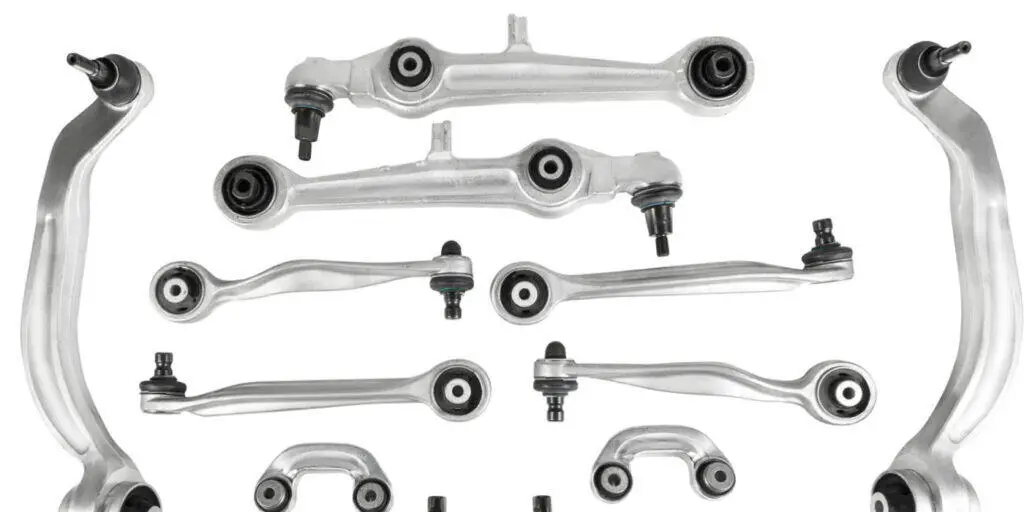
Suspension Bushing Replacement: Press New Bushings or Replace the Control Arm?
The press-versus-replace decision is determined by three factors: whether the bushing is sold as a standalone part number, whether the arm is structurally sound, and whether you have the tooling and skill to press without deforming the arm. Symptom severity tells you the bushing is worn; it does not tell you which replacement path is correct. A clunking noise confirms a problem, not a repair strategy.
Getting the call wrong costs more in labor and damaged arms than the parts saved. A failed press on a non-serviceable arm can turn a modest bushing job into a complete arm replacement, plus the labor already spent attempting the press. That is the core risk this framework eliminates.
This article is written for parts buyers, independent mechanics, and informed DIY users who already suspect worn bushings and now need to decide between pressing bushings and replacing the full control arm. Wholesale and import distributors evaluating how to advise their own customers will find the same logic applies.
Symptom and Inspection Checklist: Confirming the Bushing Is Actually the Problem
Clunking over bumps, steering wander, vague on-center feel, uneven or feathered tire wear, and visible bushing cracks or separation are the primary indicators of worn bushings. Confirm these before pricing any parts, because worn ball joints, tie rods, and strut mounts produce overlapping symptoms and change the repair scope entirely.
A pry-bar or large channel-lock play check on the arm while the vehicle is raised reveals excessive bushing deflection that static inspection may miss. Rubber that looks intact can still be soft enough to allow several millimeters of movement under load. Load the arm in multiple directions — vertical, lateral, and fore-aft — because different bushing designs fail in different axes.
The practical sequence: raise and support the vehicle safely, grab the arm near the bushing and attempt to move it by hand, then apply leverage with a pry bar between the arm and the subframe or cradle. Any movement beyond slight rubber compliance indicates a worn bushing. If the arm moves but the bushing looks fine, check the ball joint and tie rod before committing to a bushing repair.
Bushing Serviceability: Why Some Bushings Can Be Pressed and Others Cannot
Bushings are serviceable separately only when the arm is designed with a replaceable bushing shell and the bushing is cataloged as a standalone part number. Many modern control arms use bonded, staked, or hydraulically crimped bushings that cannot be pressed out without deforming the arm — these are sold only as complete arm assemblies.
Hydraulic bushings (fluid-filled) and bushings integrated into aluminum or stamped arms frequently fall into the non-serviceable category. The bushing shell is bonded to the arm during manufacturing, and the force required to remove it exceeds what the arm structure can withstand. Attempting the press anyway risks cracking the arm or ovalizing the bore.
The parts catalog is the authority. If the bushing has no standalone part number for that specific arm, the arm must be replaced. For Hyundai and KIA applications, our catalog lists rear trailing arm bushings and large/small suspension bushings as standalone parts for many platforms — for example, the Rear Trailing Arm Bushing — 55274-D3000 and Rear Trailing Arm Bushing — 55274-2W000 are cataloged separately, which means the corresponding arms are designed for bushing service. Where no standalone number exists, the complete arm is the only correct path.
Tools, Equipment, and the Real Risk of Damaging the Arm
A hydraulic press or a dedicated bushing press kit with correctly sized receiver cups is the minimum requirement. Hammer-and-socket methods frequently bend arm ears or tear the new bushing during installation. There is no reliable shortcut.
Pressing on the arm rather than the bushing shell, or using an undersized receiver, is the most common cause of bent or cracked arms. The receiver must support the arm bore evenly around its circumference. If the receiver contacts the arm instead of the bushing edge, the force path goes through the casting or stamping, not the bushing.
Aluminum arms, thin stamped arms, and arms with bonded bushings carry the highest risk of damage during pressing. If the arm is damaged during a failed press, the total cost exceeds simply buying the complete arm from the start — you pay for the bushing, the labor, and then the arm, plus the downtime of a second repair.
Self-assessment question: do you have a press with the correct receiver cups, or access to a shop that does? If not, the arm replacement is the lower-risk path regardless of parts cost.
Cost Comparison: Pressing Bushings vs Replacing the Complete Arm
Parts cost: standalone bushings are typically a fraction of a complete arm, but only when the bushing is serviceable separately. If the bushing is not sold alone, the parts comparison is moot — the arm is the only option.
Labor cost: pressing bushings carries higher labor hours than a bolt-on arm swap because of press setup, bushing removal, cleanup, and the risk of a second attempt if the first press goes wrong. A complete arm swap is remove-and-replace with basic hand tools and a torque wrench.
Regional labor rate variation can flip the math. At high labor rates, the lower-labor arm replacement often wins even when bushings are cheaper in parts. At low labor rates, pressing bushings can be the economical choice — but only if the arm is serviceable and the press succeeds on the first attempt.
Hidden costs apply to both paths: alignment after either repair, potential arm replacement if the press fails, and downtime if a pressed bushing is installed incorrectly and must be redone. Build the comparison with your own local parts pricing and labor rate rather than relying on generic estimates.
Rubber vs Polyurethane Bushing Selection by Driving Use Case
Rubber bushings prioritize NVH isolation and are the correct choice for daily-driven street vehicles. They absorb road noise and vibration, flex progressively under load, and deliver the ride quality the vehicle was designed around.
Polyurethane bushings trade NVH for reduced deflection and longer service life under load — appropriate for performance, track, or heavy-duty applications. They hold alignment geometry more consistently under cornering and braking forces, but transmit more road noise and require periodic re-greasing depending on design.
Polyurethane is more commonly available as a standalone press-in part, which can make pressing viable on arms where the OEM rubber bushing is only sold with the arm. This is a legitimate path for enthusiasts, but it does not change the arm's structural serviceability — if the arm cannot accept a pressed bushing without damage, polyurethane availability does not help.
Material choice does not override serviceability. A non-serviceable arm remains non-serviceable regardless of bushing material. Select material second, after confirming the arm can be serviced.
The Decision Framework: Press vs Replace in Five Questions
Work through these in order. The first "no" answer resolves the decision.
Question 1: Is the bushing sold as a standalone part number for this arm? If no, replace the arm. Check the parts catalog for your specific platform — if only the complete arm is listed, that is the answer.
Question 2: Is the arm free of corrosion, cracks, or prior damage? If no, replace the arm. A compromised arm cannot safely accept a pressed bushing, and the new bushing will not restore structural integrity.
Question 3: Do you have a hydraulic press or bushing press kit with correct receiver cups, or access to a shop that does? If no, replace the arm. The tooling requirement is not negotiable for a safe press.
Question 4: Does the total cost — parts, labor at your local rate, alignment, and failed-press risk — favor pressing? If no, replace the arm. Run the numbers with your actual local pricing, not national averages.
Question 5: Does the bushing material you want exist as a standalone part? If no, replace the arm. If you want polyurethane and only rubber is sold separately, the arm is the path.
Extending Bushing Life and Knowing When to Re-Inspect
Avoid harsh impacts, keep the undercarriage free of oil and solvent contamination, and address alignment issues promptly — all extend rubber bushing life. Oil and solvent degrade rubber over time, and a misaligned suspension loads bushings unevenly, accelerating wear on one side.
Polyurethane bushings typically require periodic re-greasing depending on design and use. Follow the manufacturer's interval for your specific bushing, and re-grease more frequently in dusty or wet environments.
Re-inspect bushings at every alignment service or tire rotation once the vehicle passes the mileage range where the original bushings typically begin to degrade. Early detection keeps the repair in the bushing-only category rather than escalating to arm replacement.
If the arm was replaced as a complete assembly, the new arm's bushings reset the inspection clock. Treat the replacement date as the new baseline and inspect on the same cadence going forward.
For buyers sourcing suspension components in volume, our automotive suspension components catalog lists bushing and control arm part numbers by platform, and our quality control process covers dimensional verification for press-fit applications. Distributors advising customers on press-versus-replace can use the same five-question framework to guide their recommendations.
FAQ
Can I press new bushings into any control arm?
No. Only arms designed with a replaceable bushing shell and a standalone bushing part number can be serviced. Bonded, staked, or crimped bushings require complete arm replacement.
What happens if I try to press a non-serviceable bushing?
The force required to remove the bonded shell can crack the arm or ovalize the bore. You then pay for the bushing, the labor, and the arm — plus a second repair.
Is pressing bushings cheaper than replacing the arm?
Only if the bushing is serviceable, the arm is sound, and you have the correct tooling. At high labor rates, the lower-labor arm replacement often wins even when bushings are cheaper in parts.
Do polyurethane bushings change the press-versus-replace decision?
No. Polyurethane availability does not make a non-serviceable arm serviceable. Material choice comes after confirming the arm can accept a pressed bushing.
How do I know if my arm is serviceable?
Check the parts catalog for a standalone bushing part number for your specific platform. If only the complete arm is listed, the arm is the only correct path.