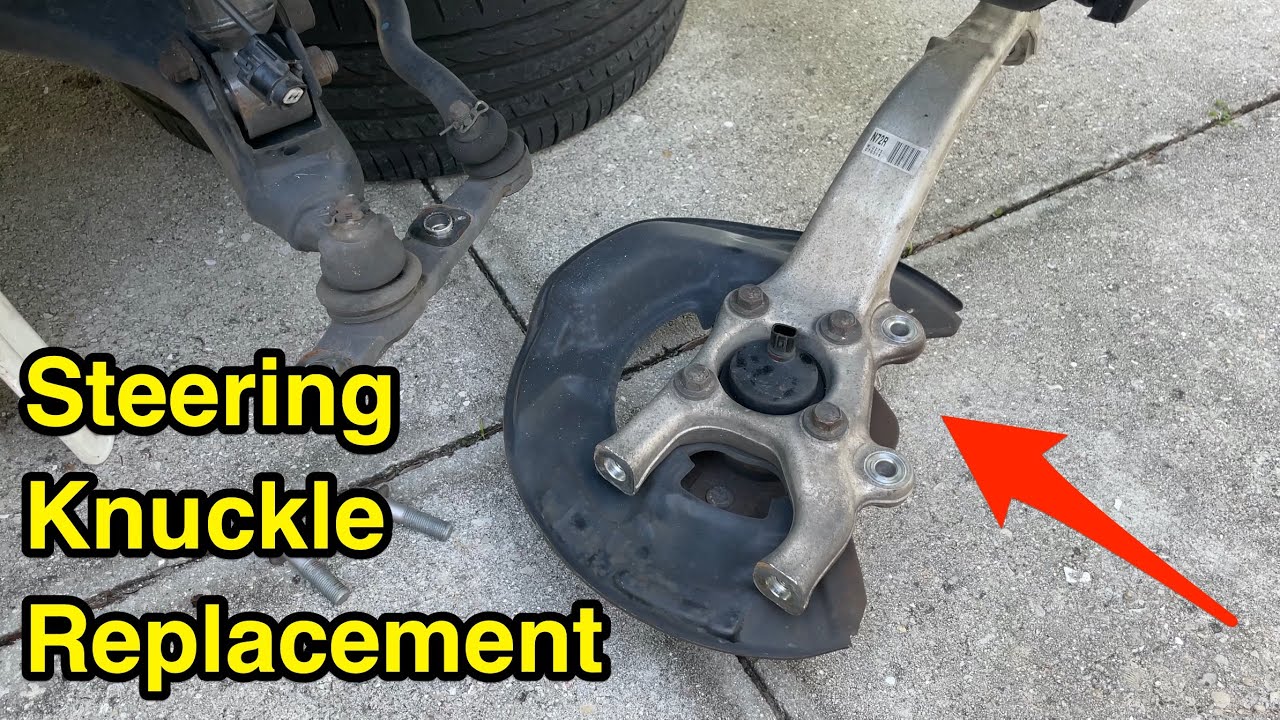
Steering Knuckle Suspension: Diagnose Before You Condemn, Replace by Material and Damage Type
Condemn a steering knuckle only after a structured diagnostic rules out the ball joint, tie rod end, and wheel bearing — and once condemned, choose between bearing-race service and full knuckle replacement based on material and damage type, not mileage or noise alone. A knuckle that is blamed too early wastes money; a knuckle that is welded or straightened creates a wheel-separation risk. [MODEL_ANALYSIS]
Is It the Knuckle? A Diagnostic Flowchart to Isolate Knuckle Faults from Ball Joints, Tie Rods, and Wheel Bearings
Put the vehicle on a lift, remove the wheels, and compare the suspect knuckle side-to-side. Then run the play tests below in order. Each branch ends in a decision. [MODEL_ANALYSIS]
Step 1 — Visual inspection (cracks, rust jacking, witness marks)
Inspect the strut mounting ears, the ball joint taper hole, and the bearing bore on both sides. Look for:
- Cracks at the strut ears, taper hole, or bearing bore → condemn the knuckle.
- Rust jacking (corrosion expanding between the bearing race and the knuckle bore, distorting the bore) → condemn the knuckle.
- Witness marks around the bearing bore indicating a spinning race → condemn the knuckle.
- Elongated ball joint taper hole (wallowed out by a loose stud) → condemn the knuckle.
- No visible damage → proceed to Step 2. [MODEL_ANALYSIS]
Step 2 — Three-point play test with a pry bar and dial indicator
Mount the dial indicator against the wheel rim or hub face. Apply force with the pry bar under the tire, then at the top and bottom of the tire. Read the indicator and locate the origin of the movement. [MODEL_ANALYSIS]
Representative pass/fail thresholds vary by platform — verify against OEM service data for the specific application. As a working reference, typical ball joint axial play limits and wheel bearing endplay limits are small (often measured in thousandths of an inch); any play that exceeds the OEM limit is a fail. Do not substitute a generic number for the platform-specific spec. [MODEL_ANALYSIS]
Step 3 — Branch the diagnosis
- Play at the ball joint stud-to-knuckle interface → suspect an elongated taper → replace the knuckle (a new ball joint in a worn taper will not restore a tight fit and will fail again).
- Play at the tie rod end → replace the tie rod end, not the knuckle.
- Play at the wheel bearing race → replace the bearing/race if the bore is clean; replace the knuckle if the bore is scored, out-of-round, or shows spinning-race damage.
- No play at any of the three points → the knuckle is not the source; continue with a loaded road test. [MODEL_ANALYSIS]
Step 4 — Loaded road test to confirm bearing noise
Load and unload the suspect side during a test drive.
- Noise changes pitch with cornering load → bearing or race, not the knuckle casting.
- Noise remains constant regardless of load → the knuckle itself is less likely to be the source. [MODEL_ANALYSIS]
For matching catalog pages, see the ball joint and wheel bearing listings. [FACT_FROM_DATABASE]
Material Matters: Cast Iron vs. Forged Steel vs. Aluminum Knuckles
Material dictates whether a repair is even possible. Any crack, bend, or elongated ball joint taper is a condemnation criterion in all three materials. Material changes how likely that damage is — not whether repair is acceptable. [MODEL_ANALYSIS]
| Material | Typical use | Repairability | Replacement decision |
|---|---|---|---|
| Cast iron | Heavy-duty and older platforms | Not weldable; not straightenable | Replace if cracked, bent, or taper is elongated |
| Forged steel | Trucks and performance applications | Not weldable; not straightenable | Replace if cracked or bent; resists bending better than cast iron |
| Aluminum | Weight-saving applications | Not weldable; not straightenable; more prone to bore distortion and galling | Replace once the bore is compromised; also replace on any crack at bearing bore or ball joint taper |
[MODEL_ANALYSIS]
Bearing Race Replacement vs. Full Knuckle Replacement: When Each Is Appropriate
- Bore undamaged, race is the only worn component → bearing and race replacement is appropriate and cost-effective.
- Bore scored, out-of-round, or shows spinning-race damage → replace the knuckle. Pressing a new race into a damaged bore will not restore proper bearing preload or fit.
- Aluminum knuckle with a compromised bore → replacement is the only reliable option.
- Sealed bearing-hub assembly (race integrated into the hub) → the race cannot be serviced separately; the knuckle may still be reusable if the bore is clean. [MODEL_ANALYSIS]
See the steering knuckle catalog page for matching applications. [FACT_FROM_DATABASE]
Why Welding or Straightening a Steering Knuckle Is Never Acceptable
Welding introduces heat-affected zones that can embrittle the surrounding metal, creating a new crack initiation site under cyclic suspension loads. Straightening cold-works the material, reducing fatigue life and potentially causing a sudden fracture under load. A cracked or bent knuckle compromises wheel location, steering geometry, and load path integrity — failure can result in wheel separation. No OEM or aftermarket manufacturer endorses welding or straightening a knuckle; the only safe repair is replacement. [MODEL_ANALYSIS]
Torque Specifications and Tightening Sequence for Knuckle-to-Strut and Knuckle-to-Ball-Joint Fasteners
Use the numbers below as a working reference only. Verify against OEM service data for the specific application — values vary by platform, fastener class, and whether the fastener is torque-to-yield (TTY). [MODEL_ANALYSIS]
| Fastener | Representative torque | Sequence / notes |
|---|---|---|
| Knuckle-to-strut | ~150 ft-lb (≈203 Nm) | Tighten at ride height to avoid bushing preload; multi-bolt strut flanges use a star pattern |
| Knuckle-to-ball-joint stud nut | ~45 ft-lb (≈61 Nm) | Tapered fit — do not over-tighten; over-torque can elongate the taper or strip threads |
| TTY / single-use fasteners | Per OEM spec | Replace, do not reuse |
[MODEL_ANALYSIS]
Do not guess or substitute generic values. If the OEM spec is not available, stop and obtain it before tightening. [MODEL_ANALYSIS]
After Replacement: Alignment Requirements and ADAS Sensor Recalibration
Any knuckle replacement alters suspension geometry and requires a professional wheel alignment to restore camber, caster, and toe. ADAS features such as lane-keeping assist, adaptive cruise control, and automatic emergency braking rely on sensors mounted to the steering and suspension; a changed thrust angle can misaim them. Many OEMs require recalibration of the forward-facing camera and radar after suspension work that affects ride height or steering angle. Skipping alignment or recalibration can cause poor handling, uneven tire wear, and ADAS malfunctions. [MODEL_ANALYSIS]
Aftermarket vs. OEM Knuckles: Fitment, Material, and Quality Considerations for Buyers and Installers
Aftermarket knuckles may differ in material grade, machining tolerances, and surface finish. Verify that the part meets or exceeds OEM specifications for the application. Concrete inspection points to check before installation:
- Ball joint taper angle — must match the OEM taper; a mismatched angle will not seat the stud correctly.
- Bearing bore diameter — must match the OEM bore; an out-of-spec bore will not hold bearing preload.
- Strut mounting hole spacing — must match the OEM strut flange pattern.
For high-volume or performance applications, forged or billet aftermarket knuckles may offer strength advantages, but only if properly engineered and documented. Wholesale buyers should request material certifications, dimensional inspection reports, and warranty terms before committing to a supplier. [MODEL_ANALYSIS]
Related suspension components that work with the knuckle to maintain geometry include Large suspension bushing — 54584-2D000, Large suspension bushing — 54584-3S100, Control Arm — 54500-S1AA0, and Control Arm — 54500-2D000. [FACT_FROM_DATABASE]
FAQ
Can I replace just the wheel bearing and keep my knuckle?
Yes, if the knuckle bore is undamaged and the bearing race is the only worn component. If the bore is scored, out-of-round, or shows spinning-race damage, the knuckle must be replaced. See the bearing-race vs. full-knuckle section above. [MODEL_ANALYSIS]
How do I know if my ball joint taper hole is elongated?
If play exists at the ball joint stud-to-knuckle interface during the three-point play test, the taper may be elongated. A new ball joint installed into a worn taper will not restore a tight fit and will fail again. See the diagnostic flowchart above. [MODEL_ANALYSIS]
Can a steering knuckle be welded or straightened?
No. Welding introduces heat-affected zones that can embrittle the metal, and straightening cold-works the material, reducing fatigue life. The only safe repair is replacement. See the welding/straightening section above. [MODEL_ANALYSIS]
Do I need an alignment after replacing a steering knuckle?
Yes. Any knuckle replacement alters suspension geometry and requires a professional wheel alignment to restore camber, caster, and toe. See the alignment/ADAS section above. [MODEL_ANALYSIS]
Does ADAS need recalibration after knuckle replacement?
Many OEMs require recalibration of the forward-facing camera and radar after suspension work that affects ride height or steering angle. Skipping it can cause ADAS malfunctions. See the alignment/ADAS section above. [MODEL_ANALYSIS]