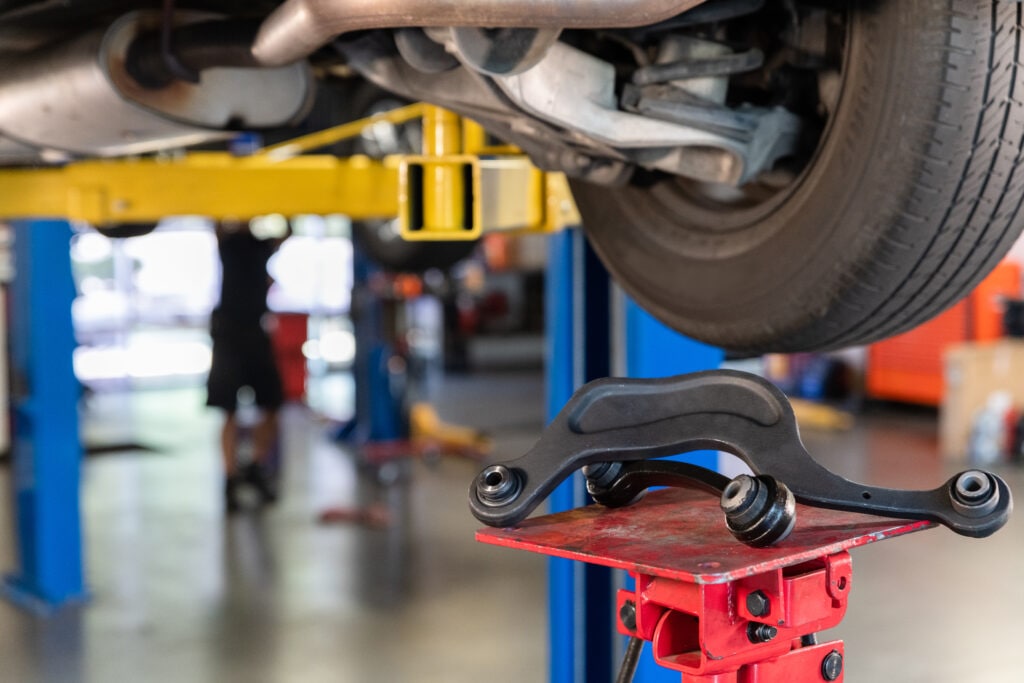
How to Replace Control Arms and Bushings to Fix a Bouncy Suspension

If your car bounces repeatedly after a bump, the fault is almost always the struts or shocks, not the control arms. Control arm and bushing failures produce a single sharp clunk, vague steering, or a wander — not a continuous oscillation. Confirm the pattern before buying parts.
Bounce frequency and decay rate are the fastest diagnostic. A worn strut or shock lets the body continue moving after the initial bump, typically oscillating two to three times before settling. A worn control arm bushing produces one clunk as the arm shifts, then the body settles. If the bounce repeats, you are looking at dampers. If it clunks once and wanders, you are looking at bushings or ball joints.
Load sensitivity separates the two further. Bushing noise worsens over sharp bumps, during cornering, and under braking because the arm is moving under load. Strut bounce is present on smooth roads and gets worse with speed because the damper cannot control the spring. Noise type is the third filter: control arm bushings clunk or creak, ball joints pop or click, and struts clunk over expansion joints while also causing body float.
A common misdiagnosis appears in the Reddit thread 'Bouncing after Control Arm replacement,' where DIYers replaced control arms and still had bounce. The real cause was usually a worn strut or shock that was never tested. Before ordering anything, do a bounce test at each corner: push down firmly and release. More than one rebound means the damper is done. Then inspect the control arm bushings for cracks and play.
Symptom Checklist for Worn Control Arms and Bushings — What Each Symptom Actually Indicates
Clunking over bumps is most often worn control arm bushings or sway bar links. If the clunk is metallic and sharp, check ball joints. A rubbery thud points to bushings; a metallic click or pop points to a ball joint that has lost its grease and clearance.
Wandering or vague steering means worn control arm bushings are allowing the arm to shift under load, which changes alignment dynamically. The car may feel like it is tracking its own path, especially under braking or acceleration. Uneven tire wear on the inner or outer edge indicates camber or toe changes from worn bushings or a bent arm. If the wear is feathered across the tread, suspect toe; if it is concentrated on one edge, suspect camber.
Vibration at speed could be wheel balance, but if it is accompanied by clunking, suspect control arm bushings or ball joints. A bushing that has separated will let the arm move under load, which can set up a vibration that feels like a wheel imbalance but does not change with tire rotation.
Loaded vs. Unloaded Bushing Inspection: What You Can and Cannot See With the Vehicle on the Ground
On the ground with the suspension loaded, you can check for excessive movement by rocking the steering wheel or using a pry bar on the arm. You cannot see cracks that close under load. A bushing that looks fine on a lift may still be soft and deflect under load, which is why loaded inspection is the only way to confirm a bushing is actually causing a complaint.
On a lift with the suspension unloaded, you can see cracks, tears, and separation. But a bushing that looks fine unloaded may still be soft and deflect under load. Use both states: unloaded to find physical damage, loaded to find deflection.
Without a lift, jack up one corner and place a stand under the lower control arm to simulate ride height, then inspect. A Facebook question 'How can I diagnose bad control arms/bushings without a lift?' got the correct answer: use a floor jack to load the suspension and pry the arm, then check for play at the ball joint and bushing. If you can move the arm more than a few millimeters with a pry bar, the bushing is worn.
Full Control Arm Assembly vs. Pressing in New Bushings: Decision Criteria Based on Ball Joint, Rust, and Labor
If the ball joint is worn, replace the whole arm. Pressing in bushings alone leaves a worn ball joint, and you will be back under the car within a year. If the arm is rusted or the bushing shell is seized, replacing the assembly is often faster and safer than pressing. Rust weakens the arm and makes bushing removal unpredictable.
Labor cost matters. Pressing bushings requires a press and may take longer than swapping a complete arm. For DIYers without a press, a complete arm is usually the better choice. The question 'Can I replace just the bushing or do I need the whole arm?' is answered by ball joint condition and rust: if the ball joint is tight and the arm is clean, press bushings; if either is questionable, replace the arm.
For Hyundai and Kia applications, JS Suspension offers both complete control arms and individual bushings. For example, the Control Arm — 54500-S1AA0 and the Large suspension bushing — 54584-3S100 cover the same platform, so you can choose based on condition. If you are replacing the arm, you may still need the bushing for the opposite side or for a trailing arm.
Torque Specs and Tightening Sequence: Why Control Arm Bolts Must Be Torqued at Ride Height
Torquing at droop preloads the bushing, causing it to twist and fail early. Torquing at ride height sets the bushing in its neutral position. This is the step most DIYers skip, and it is the reason new bushings fail prematurely or cause a persistent bounce.
The sequence is: snug all bolts with the suspension at droop, lower the vehicle to ride height, then torque to spec with a torque wrench. If you cannot access the bolts at ride height, use a jack to compress the suspension to ride height before torquing. Never guess the torque value. The question 'What torque should I use on control arm bolts?' is answered by consulting the factory service manual for your specific vehicle. Do not use generic values.
Post-Replacement Alignment: Why Skipping It Causes Tire Wear and Mimics a Persistent Bounce
Replacing control arms changes camber, caster, and toe. Without alignment, the vehicle may pull, wander, and wear tires unevenly. Uneven toe can feel like a bounce or wander, leading you to misattribute the problem to the new parts. The question 'Do I need an alignment after replacing control arms?' is answered with a simple yes, always.
Alignment should be performed with the vehicle at ride height and with the suspension settled. Drive the car around the block to settle the suspension before the alignment. If you skip this, the alignment may be off, and you will chase a bounce that is actually a toe problem.
Troubleshooting Persistent Bounce After Replacement: Bushing Clocking, Ball Joints, and Other Misattributed Causes
Improper bushing clocking is the first suspect. If the bushing was not torqued at ride height, it may be twisted and cause a bounce or clunk. This is not a parts defect; it is an installation error. Recheck the torque procedure.
Worn ball joints are the second suspect. If not replaced with the arm, a worn ball joint can cause clunking and wander that feels like a bounce. The third suspect is struts or shocks. If the bounce was originally misdiagnosed, it will persist after control arm replacement. The Reddit thread 'Bouncing after Control Arm replacement' lists struts, springs, and improper installation as the common causes.
If you have replaced the arms and bushings, torqued at ride height, and aligned the car, and the bounce remains, go back to the damper test. A strut that fails the bounce test is the cause, not the new control arms.
OEM vs. Aftermarket Control Arms and Bushings: What to Buy
OEM rubber bushings prioritize comfort and noise isolation. Aftermarket polyurethane bushings offer firmer handling but transmit more noise and vibration. For a daily driver, OEM-style rubber is usually the better choice. For a track car, polyurethane may be acceptable.
When buying control arms, consider whether the arm includes a ball joint and bushings. A complete arm with a ball joint saves labor. If you are buying bushings separately, match the part number to your vehicle. JS Suspension lists specific bushings such as the Rear Trailing Arm Bushing — 55274-2W000 for Hyundai and Kia applications. Verify the OEM number against your VIN before ordering.
For wholesale and importers, JS Suspension supports installers with a range of control arms and bushings. The decision framework is simple: if the ball joint is worn or the arm is rusted, buy the complete arm; if the arm is clean and the ball joint is tight, buy the bushing. Always replace in pairs for the same axle.
FAQ
How do I know if my bounce is from control arms or struts?
Do a bounce test at each corner. More than one rebound means struts or shocks. A single clunk with vague steering means control arms or bushings.
Can I replace just the control arm bushings?
Yes, if the ball joint is tight and the arm is not rusted. If the ball joint is worn or the arm is rusted, replace the complete arm.
Do I need an alignment after replacing control arms?
Yes. Replacing control arms changes camber, caster, and toe. Skipping alignment causes tire wear and can mimic a bounce.
Why does my car still bounce after replacing control arms?
The most common causes are improper bushing clocking (not torqued at ride height), worn ball joints, or worn struts/shocks that were misdiagnosed.
What torque should I use on control arm bolts?
Consult the factory service manual for your specific vehicle. Torque at ride height, not at droop.
---
Related