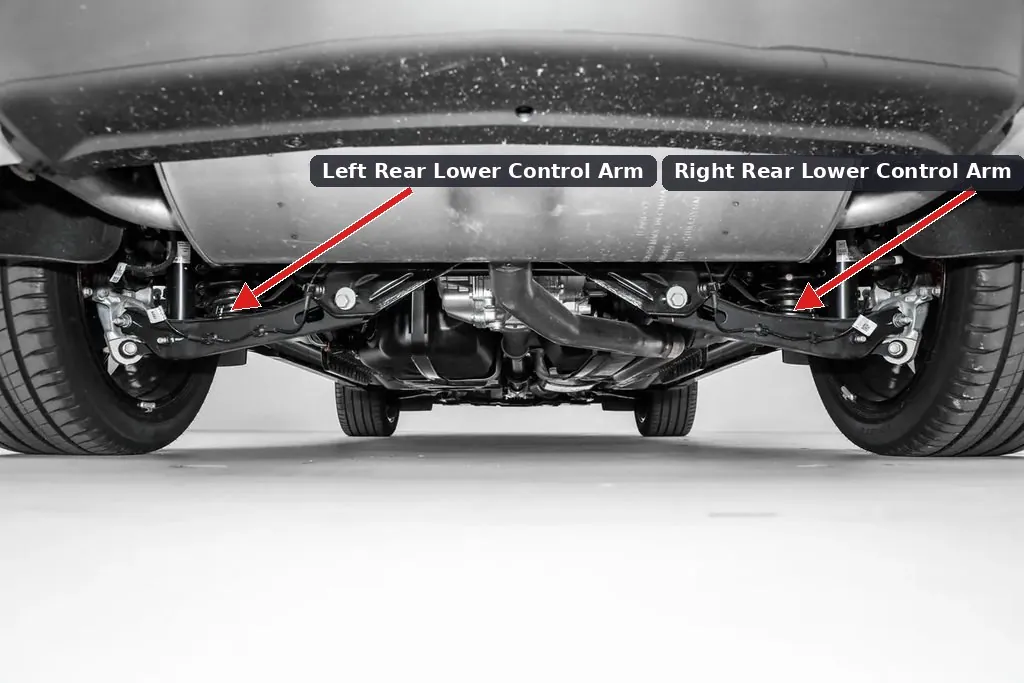
Rear Assist Arm: Function, Symptoms, and Replacement Guide
A rear assist arm is a secondary suspension link that manages dynamic rear toe and camber change under load. It supplements the primary control arm — it is not the main lateral locator, not the fore-aft locator, and not the static toe adjuster. It is the compliance-tuning link that keeps rear geometry predictable when the chassis rolls, brakes, or accelerates.
That distinction matters at the parts counter. A clunk from a worn trailing arm bushing will not be fixed by replacing the assist arm. A wandering rear end caused by a collapsed assist-arm bushing will not be fixed by a new toe link. Misdiagnosis wastes money and leaves the original noise in place.
Rear Assist Arm vs. Control Arm, Trailing Arm, and Toe Link
The naming confusion is the root cause of most misdiagnosis. Each link in a multi-link rear suspension has a defined job:
| Link | Primary job | What it is NOT |
|---|---|---|
| Control arm | Lateral and vertical location of the hub | Not the fore-aft locator, not the toe adjuster |
| Trailing arm | Fore-aft location, resists brake and drive torque | Not the lateral locator |
| Toe link | Sets static toe (adjustable on many platforms) | Not a dynamic compliance link |
| Assist arm | Manages dynamic toe change and bushing compliance under load | Not the main lateral or fore-aft locator |
Platform variance is significant. On some vehicles the assist arm is a distinct, separately serviceable part; on others the same function is integrated into a multi-link rear setup where the "assist" behavior comes from a specific link's bushing rate. Verify your specific rear suspension layout before ordering anything.
Diagnostic Sequence: Isolating the Rear Assist Arm From Other Rear Suspension Failures
Confirm the assist arm is the failed component before buying parts. The sequence below is repeatable and rules out the common look-alike failures.
Step 1 — Symptom Mapping
Match the complaint to the component most likely to cause it. A single clunk over sharp bumps points toward a sway bar link or shock mount. A wandering rear end under load points toward a compliance bushing — assist arm or trailing arm. Uneven rear tire wear with feathered edges points toward a toe-holding link. Mapping first prevents the shotgun approach of replacing every arm in the rear.
Step 2 — Static Inspection
With the vehicle on a lift or jack stands and the suspension loaded or supported at ride height, inspect the assist arm bushings for cracking, separation from the sleeve, or excessive play. Use a pry bar between the arm and its mount to check for movement that should not exist. Compare left versus right — asymmetry is the strongest single indicator of a failed bushing.
Step 3 — Dynamic Confirmation
Static inspection misses bushings that only fail under load. Rock the wheel side-to-side and fore-aft with a helper watching the arm, or road test over a known bumpy section with a helper listening. The goal is to reproduce the noise and pinpoint whether it originates at the assist arm, the sway bar link, or the trailing arm bushing.
Step 4 — Rule-Out Checklist
Before condemning the assist arm, verify that worn sway bar bushings, loose shock mounts, and broken or stretched exhaust hangers are not the actual source. These three produce clunks that owners frequently misattribute to suspension arms.
Step 5 — Decision Gate
Proceed to replacement only if the assist arm or its bushing shows measurable play or visible degradation. If the arm is tight and the bushing is intact, the noise is coming from somewhere else — return to Step 1 with the new information.
Symptoms of a Bad Rear Assist Arm — and the Mechanical Cause Behind Each One
Each symptom below maps to a specific mechanical failure. Understanding the cause lets you prioritize and validate the diagnosis rather than guessing.
Clunking over bumps. A worn or separated bushing allows metal-to-metal contact or excessive arm movement. The clunk is the sound of the arm shifting in its mount.
Vague or wandering rear end. Excessive compliance in the assist arm bushing lets the rear hub steer under load. The driver feels the rear end "follow" the road rather than track it.
Uneven or accelerated rear tire wear. When the assist arm no longer holds rear toe within specification, the tire scrubs laterally as the vehicle rolls. Feathered or cupped inner or outer edges are the tell.
Handling instability during lane changes or cornering. Dynamic toe change exceeds what the chassis can compensate for. The rear feels disconnected or steps out mid-corner.
These symptoms overlap with trailing arm bushing failure, sway bar link wear, and shock mount degradation. The diagnostic sequence above is what confirms the assist arm as the source — the symptom list alone does not.
Bushing vs. Complete Arm Replacement: Decision Criteria Based on Arm Condition
Choose the replacement scope based on inspection findings, not guesswork. The arm's condition determines whether pressing new bushings is viable or whether the whole arm must be replaced.
Bushing-only replacement is viable when: the arm itself is straight, free of corrosion perforation, and the bushing bore is not elongated or damaged. Pressing new bushings is cost-effective in this case.
Complete arm replacement is required when: the arm is bent, heavily corroded, has cracked welds, or the bushing bore is out-of-round. Pressing new bushings into a compromised arm will not restore proper geometry.
Tooling and labor. Bushing replacement requires a press and the correct adapters. Complete arm replacement is often faster and avoids the risk of distorting the arm during pressing.
Cost trade-off. Bushing-only is cheaper in parts but higher in labor if the arm must be removed and pressed. Complete arm replacement may be more economical overall depending on labor rates and arm availability.
For Hyundai and Kia applications, JS Suspension stocks rear trailing arm bushings and control arms across multiple platforms — see the Rear Trailing Arm Bushing — 55274-2W000 and Control Arm — 54500-S1AA0 listings for reference.
OEM vs. Aftermarket Rear Assist Arms: Construction, Durability, and NVH Trade-offs
Construction differences between OEM and aftermarket arms affect durability and noise, vibration, and harshness (NVH). Choose based on your priorities, not price alone.
Stamped steel vs. tubular construction. Stamped steel arms are common OEM. Tubular aftermarket arms can offer higher stiffness but may transmit more road noise into the cabin.
Rubber vs. spherical bushings. Rubber bushings isolate NVH but degrade over time. Spherical or polyurethane bushings improve precision but increase NVH. The choice depends on use case — daily driver versus performance application.
Corrosion protection. OEM arms often have e-coat or paint. Aftermarket arms vary. Check coating type against your climate — a coastal or salt-belt vehicle needs more protection than a dry-climate one.
Fitment and quality. Not all aftermarket arms are equal. Verify the arm is designed for your specific platform and matches OEM geometry. A visually similar arm with different bushing rates will change handling behavior.
Torque Specifications and Alignment Requirements After Rear Assist Arm Replacement
Fasteners must be tightened to manufacturer specification, typically with the suspension at ride height to avoid bushing preload. Exact torque values vary by platform and must be sourced from the vehicle's service manual.
A four-wheel alignment is mandatory after replacement. The assist arm directly affects rear toe and camber — skipping alignment causes tire wear and handling issues that will be blamed on the new part.
Rear toe and camber must be set to the manufacturer's specification. Request a printout of before and after readings from the alignment shop.
If replacing bushings rather than the complete arm, ensure they are clocked correctly and tightened at ride height. Incorrect clocking preloads the bushing and causes premature failure.
Safety Warning: Driving With a Failed Rear Assist Arm
A severely worn or broken assist arm can cause sudden rear steering, especially during emergency maneuvers or high-speed lane changes. This is a loss of rear toe control — the rear of the vehicle no longer tracks predictably.
Continued driving with a failed assist arm can destroy rear tires rapidly, increasing the risk of a blowout. The tire damage is a symptom of the geometry problem, not a separate issue.
A failed assist arm also stresses other suspension components, turning a single-part repair into a multi-part repair if ignored.
If the assist arm is confirmed failed, limit driving to a safe, low-speed trip to a repair facility. Do not continue normal use.
Next Steps: Confirming Fitment and Sourcing the Correct Rear Assist Arm
Verify fitment before ordering. Use the JS Suspension catalog or contact support with the vehicle's year, make, model, and trim to confirm the correct assist arm for your application.
Gather your inspection findings. Note whether the arm is reusable (bushing-only) or requires complete replacement — this determines the part to order.
Prepare for installation. Confirm access to torque specs and a qualified alignment shop before starting the job.
Wholesale and importers: contact JS Suspension for bulk pricing and application-specific availability.

FAQ
Can I replace just the rear assist arm bushing instead of the whole arm?
Yes, if the arm is straight, free of corrosion perforation, and the bushing bore is not elongated or damaged. If the arm is bent, heavily corroded, has cracked welds, or the bore is out-of-round, replace the complete arm.
Do I need an alignment after replacing a rear assist arm?
Yes. The assist arm directly affects rear toe and camber. A four-wheel alignment is mandatory after replacement, with rear toe and camber set to the manufacturer's specification.
How do I confirm the rear assist arm is the failed component and not the trailing arm or sway bar link?
Follow the diagnostic sequence: map the symptom, perform a static inspection with the suspension at ride height, confirm dynamically under load, and rule out sway bar bushings, shock mounts, and exhaust hangers before condemning the assist arm.
What happens if I keep driving with a failed rear assist arm?
You risk sudden rear steering during emergency maneuvers, rapid rear tire wear and possible blowout, and accelerated wear on other suspension components.
---
Related