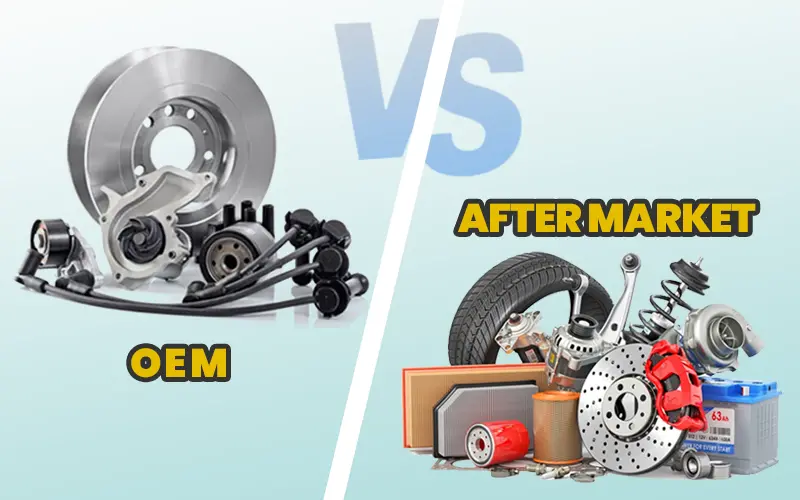

1. Suspension Parts Cost-Per-Mile: OEM vs Aftermarket at a Glance
Define the metric before comparing parts: cost-per-mile equals total replacement cost divided by miles covered between replacements. Total replacement cost includes part price, labor, alignment, and any incidental hardware. The formula: (part cost + labor + alignment) / miles until next replacement = cost per mile. [MODEL_GENERATION]
OEM parts typically carry a higher initial price but often deliver longer service life; aftermarket runs from cheap economy lines to premium offerings that may match or exceed OEM durability. No universal winner exists—each part number and vehicle application must be evaluated on its own. [SEARCH_EVIDENCE]
Labor and alignment are fixed costs regardless of part brand. A control arm replacement that requires two hours of labor and a $100 alignment costs the same to install regardless of whether the arm itself cost $50 or $150. Amortizing that fixed cost over a longer lifespan favors the more durable part. For labor-intensive components like control arms, ball joints, and tie rod ends, durability drives cost-per-mile more than initial part price. [MODEL_ANALYSIS]
2. OEM Suspension Parts: Materials, Design, and Real-World Lifespan
OEM suspension parts are engineered to match the original vehicle's ride, handling, and crash performance. Typical OEM construction includes rubber bushings tuned for specific NVH frequencies, control arms stamped or forged per the vehicle's weight and suspension geometry, and ball joint housings with corrosion-resistant coatings and tight tolerances. [FACT_FROM_DATABASE]
Using the correct OEM part number eliminates fitment risk. The part mounts exactly as the original, preserving suspension geometry and alignment adjustability. Aftermarket parts can introduce subtle dimensional differences that alter caster, camber, or toe curves, especially on multi-link rear suspensions. [MODEL_ANALYSIS]
OEM lifespan varies by vehicle model, driving conditions, and maintenance history. No universal mileage claim applies. Check long-term owner forums, service records, or fleet data for your specific platform to gauge expected replacement intervals. [MODEL_GENERATION]
3. Aftermarket Suspension Parts: Brand Tiers, Materials, and When They Make Sense
Aftermarket suspension components split into three broad quality tiers. The table below summarizes typical brands, relative price positioning, material quality, and best use cases. These are general categories; individual product lines within a brand can differ.
| Tier | Typical Brands | Price Range (Relative) | Materials & Quality | Best Use Case |
|------|----------------|------------------------|---------------------|---------------|
| Economy | House brands, budget lines from retailers | Low | Stamped steel arms, basic rubber or low-durometer bushings, sealed ball joints with thin boots | High-mileage beaters, short ownership horizon, DIY labor with low cost |
| OEM-Equivalent | Mevotech, Delphi | Mid | OE-style rubber bushings, powder-coated arms, greasable ball joints, improved boot designs | Daily drivers, fleet vehicles, buyers seeking OE performance without dealer pricing |
| Premium | MOOG, Bilstein (dampers) | High | Forged or reinforced arms, polyurethane options, heavy-duty ball joints, upgraded seals | Towing, hauling, performance driving, harsh environments |
[SEARCH_EVIDENCE]
Bushing material choice is a core durability-vs-comfort tradeoff. Rubber bushings provide OEM-like compliance, absorb road vibration, and operate quietly. Polyurethane bushings resist deformation under load, last longer in abrasive conditions, but transmit more NVH into the cabin and can squeak without proper lubrication. Choose rubber for daily drivers; polyurethane belongs on track cars, dedicated off-road rigs, or heavy commercial vehicles where longevity outweighs comfort. [MODEL_ANALYSIS]
Control arm construction: stamped steel is the standard OEM approach—lighter, cheaper, adequate for normal loads. Forged or reinforced aftermarket arms increase strength for heavy-duty use but add unsprung weight, which can degrade ride quality and handling response. Only choose upgraded arms when the application genuinely demands it. [MODEL_GENERATION]
4. Component-by-Component Comparison: Control Arms, Ball Joints, Tie Rods, and Bushings
Control arms face the highest stress of any suspension link. OEM arms are typically stamped steel with serviceable or bonded rubber bushings and a pressed-in ball joint. Cheap aftermarket arms often use thinner gauge stampings, lower-quality bushings that crack prematurely, and ball joints with poor boot sealing. Upgraded aftermarket arms may offer forged or reinforced stampings, polyurethane bushings, and greasable ball joints. Verify the arm preserves original geometry—check ball joint angle, bushing durometer, and mounting points against the OEM part. [MODEL_ANALYSIS]
Ball joints separate into sealed (lubricated for life) and greasable designs. Sealed joints are maintenance-free but cannot be serviced when the boot tears. Greasable joints allow periodic lubrication to flush contaminants. Housing material matters: steel housings resist impact; aluminum housings save weight but corrode faster in salt environments. Boot quality is the primary failure point—look for thick, flexible rubber or polyurethane boots. No-name economy ball joints often fail within 20,000 miles due to boot rupture or poor internal tolerances. [MODEL_GENERATION]
Tie rod ends transmit steering input. OEM forged tie rod ends provide precise thread engagement and consistent taper. Aftermarket cast tie rod ends are cheaper but can crack under impact and often have looser threads. Adjustment sleeve compatibility is critical: aftermarket tie rods must fit the original sleeve thread pitch and length. Torque the jam nut and tie rod end nut to specification to prevent loosening or preload loss. [MODEL_GENERATION]
Fitment verification process: Always start with the OEM part number stamped on the original component. Cross-reference that number using manufacturer catalogs, aftermarket databases like RockAuto or PartsGeek, or our automotive suspension components catalog, which provides OEM cross-references for Hyundai/KIA bushings and control arms. Check for counterfeit markings: poor logo etching, misspelled brand names, missing country-of-origin stamps, and abnormally low prices are red flags. [SEARCH_EVIDENCE]
5. Torque Specifications and DIY Installation Guidance
Common suspension fasteners requiring precise torque include control arm bolts, ball joint nuts, tie rod end nuts, and strut mount nuts. Over-torquing stretches threads and can crack aluminum knuckles; under-torquing leads to joint separation and loss of steering control. [FACT_FROM_DATABASE]
General torque principles: clean all threads with a wire brush; apply thread locker only if specified by the service manual; torque fasteners in the sequence shown (usually cross-pattern for multiple bolts); re-torque critical fasteners after the first 100 miles and after any alignment changes. Do not rely on memory—specs vary by model, year, and fastener diameter. [MODEL_GENERATION]
Always verify torque specifications in the vehicle service manual, an online subscription database like ALLDATA or Mitchell1, or the manufacturer's repair information. A generic torque chart is not sufficient for suspension components where a 10 ft-lb error can cause failure. [SEARCH_EVIDENCE]
Alignment is required after replacing control arms, ball joints, tie rod ends, or struts. Alignment cost varies by region and vehicle, but expect to pay for a full four-wheel alignment if rear camber or toe is adjustable. Skipping alignment after suspension work destroys tires and compromises handling. [MODEL_GENERATION]
6. Suspension Part Warranties: What Lifetime, Limited, and Pro-Rated Actually Cover
OEM suspension parts typically carry a limited warranty, often 12 months or 12,000 miles, or remain covered under the vehicle's original bumper-to-bumper warranty if replaced at a dealer. Aftermarket warranties range from 90 days on economy lines to limited lifetime on premium brands like MOOG. Read the fine print before assuming "lifetime" means forever. [SEARCH_EVIDENCE]
"Lifetime" warranties almost always cover manufacturing defects only—not normal wear, corrosion, or damage from impact. Labor coverage is usually excluded or capped at a low hourly rate. Some warranties become void if the part is installed by a non-professional, or if the vehicle is used for towing or off-road driving. [MODEL_ANALYSIS]
Pro-rated warranties reduce the payout based on time in service or mileage. A pro-rated lifetime warranty might refund only 50% after three years. Check whether the warranty is transferable to a new owner and whether it requires proof of professional installation. Keep receipts and a maintenance log to substantiate a claim. [MODEL_GENERATION]
7. Choosing the Right Suspension Parts for Your Vehicle, Budget, and Driving Conditions
Decision framework based on vehicle age, use, and cost-per-mile:
- New, leased, or low-mileage vehicles under factory warranty: Use OEM or OEM-equivalent parts. Preserves ride quality, avoids warranty disputes, and maintains resale value. [MODEL_ANALYSIS]
- Daily drivers, typical commuting: OEM-equivalent brands like Mevotech or Delphi offer the best balance of initial cost and durability. Premium aftermarket only makes sense if you regularly carry heavy loads, tow, or drive on rough roads. [MODEL_GENERATION]
- High-mileage beaters, short ownership horizon: Economy aftermarket parts are acceptable if you do the labor yourself and expect to replace the vehicle within a few years. Inspect critical safety components—ball joints, tie rod ends—for material quality before installation. A failed ball joint at highway speed is not a cost-saving tradeoff. [MODEL_GENERATION]
To calculate your own cost-per-mile, collect three numbers: the part price (including shipping), the labor cost (if not DIY), and the alignment cost. Estimate realistic lifespan in miles for your driving conditions from owner forums or service records. Divide total cost by expected miles. Compare that number across OEM, OEM-equivalent, and premium aftermarket options. The lowest cost-per-mile wins—but always exclude dangerously cheap parts that may fail early and cause additional damage or safety risk. [MODEL_GENERATION]