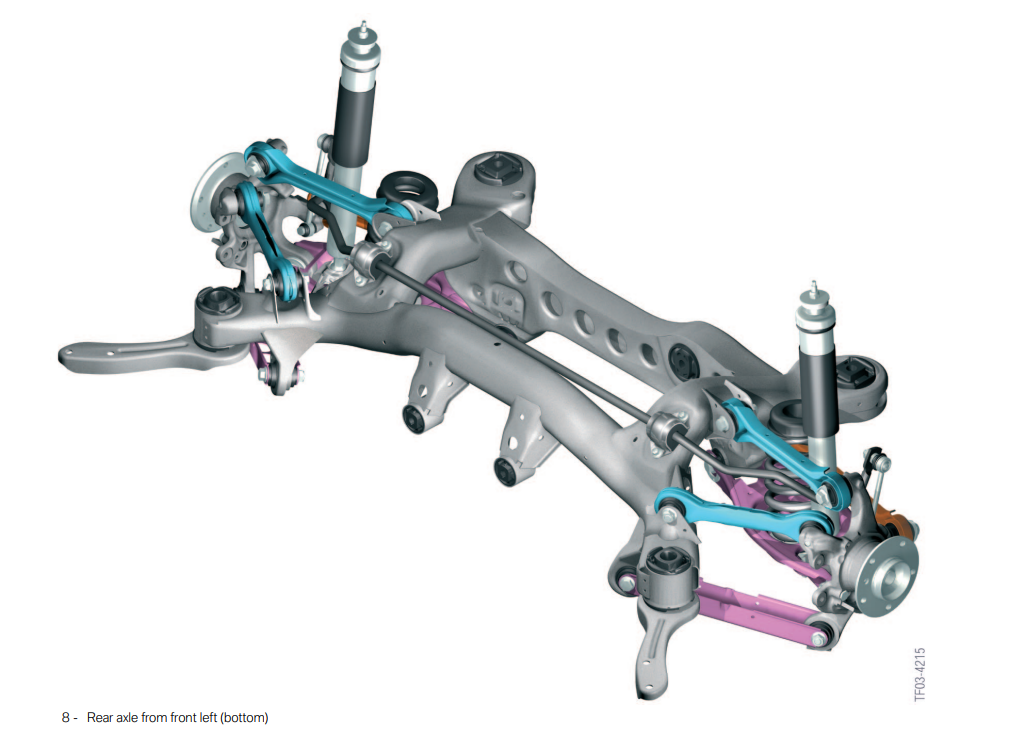
Multi-Link Suspension Layout: 3-Link vs 4-Link vs 5-Link — How Link Count Drives Alignment, Wear, and Parts Selection
Multi-link suspension is defined as three or more control links per wheel, with independent suspension separating handling and ride quality [SEARCH_EVIDENCE]. But the generic label 'multi-link' tells you almost nothing about alignment behavior — the specific link count and geometry do [MODEL_ANALYSIS]. Link count is the first thing a mechanic or parts buyer should confirm before ordering components or diagnosing wear [MODEL_ANALYSIS]. Layout-first thinking prevents the most common failure mode: buying parts by label and getting repeat comebacks [MODEL_ANALYSIS].
A 3-link rear suspension and a 5-link rear suspension share the 'multi-link' name but behave differently under load, wear at different rates, and require different parts. Confirming link count takes two minutes with a flashlight and a mirror. It prevents a $400 mistake.
Component Map: What Each Part Does — and How Its Role Shifts With Link Count
Core components: control arms (links), bushings, ball joints, and the wheel carrier/hub assembly [SEARCH_EVIDENCE]. As link count increases, individual links take on more specialized roles — a 5-link layout distributes camber, toe, and compliance functions across more dedicated arms than a 3-link [MODEL_ANALYSIS]. Bushing stiffness and ball joint condition affect alignment stability differently depending on how many links share the load [MODEL_ANALYSIS]. The wheel carrier is the fixed reference point — link geometry relative to it determines camber gain and toe change [MODEL_ANALYSIS].
In a 3-link layout, one link often handles both camber and toe duties, so a worn bushing there affects two alignment angles at once. In a 5-link, a worn toe link changes toe only. That distinction matters when you're reading an alignment sheet and deciding which part to replace.
For Hyundai/KIA applications, large suspension bushings such as Large suspension bushing — 54584-2D000 and Large suspension bushing — 54584-3S100 are common wear points on the lower control arm. Small suspension bushings like Small suspension bushing — 54551-F9000 and Small suspension bushing — 54551-2D000 handle compliance on the upper or trailing links. Rear trailing arm bushings — for example, Rear Trailing Arm Bushing — 55274-D3000 and Rear Trailing Arm Bushing — 55274-2W000 — are frequent replacement items on older Hyundai/KIA multi-link rear suspensions.
3-Link vs 4-Link vs 5-Link: How Link Count, Length, and Angle Drive Camber Gain, Toe Change, and Bump Steer
3-link layouts typically use fewer, longer links with more compromise between camber control and toe stability [MODEL_ANALYSIS]. 4-link layouts add a dedicated link to separate camber and toe functions, improving camber gain predictability [MODEL_ANALYSIS]. 5-link layouts distribute camber, toe, and compliance across dedicated arms, allowing tighter control of bump steer and toe change under load [MODEL_ANALYSIS]. Link length and mounting angle matter as much as count — a poorly angled 5-link can behave worse than a well-designed 3-link [MODEL_ANALYSIS].
A 3-link rear suspension often uses a trailing arm plus two lateral links. The trailing arm controls fore-aft location; the lateral links control camber and toe. When the trailing arm bushing wears, toe changes under braking and acceleration. When a lateral link bushing wears, camber drifts.
A 4-link adds a second lateral link, usually to separate camber from toe. This reduces the compromise: you can tune camber gain without disturbing toe. A 5-link goes further, adding a dedicated toe link and sometimes a compliance link. The result is tighter control of bump steer and toe change under load, but more wear points.
Link length and angle determine the instant centre. A long link that's nearly horizontal gives different camber gain than a short link at a steep angle. Two 5-link suspensions can behave completely differently if their link lengths and mounting points differ.
Geometry Fundamentals as Diagnostic Signals: Instant Centre, Roll Centre, Toe, Camber, Bump Steer
Instant centre and roll centre are determined by link geometry — they shift when bushings wear or links bend [MODEL_ANALYSIS]. Toe change under compression (bump steer) is a layout-specific signature: a 5-link with a worn toe link will show different symptoms than a 3-link with a worn trailing arm [MODEL_ANALYSIS]. Camber gain is the rate of camber change through suspension travel — it's set by link length and angle, not by the 'multi-link' label [MODEL_ANALYSIS]. Alignment readings that drift outside spec after a fresh alignment often point to a specific worn link or bushing, not a generic 'multi-link problem' [MODEL_ANALYSIS].
When you see a car that wanders under braking or feels unstable over bumps, that's a bump steer symptom. On a 5-link, check the toe link first. On a 3-link, check the trailing arm bushing. The symptom is similar; the suspect list is different.
Camber gain shows up as uneven tire wear on the inside or outside edge. If camber gain is too aggressive, the inside edge wears. If it's insufficient, the outside edge wears. The fix is rarely 'more camber' — it's usually a worn link or bushing that changed the geometry.
Multi-Link vs Double Wishbone vs MacPherson Strut: Camber Gain, Toe Change, and Packaging Trade-Offs
Double wishbone typically offers more predictable camber gain because the upper and lower arms define the instant centre directly [SEARCH_EVIDENCE]. MacPherson strut is simpler and more compact but has limited camber gain control because the strut serves as both spring/damper and locating member [SEARCH_EVIDENCE]. Multi-link layouts can approach double-wishbone camber control while offering more packaging flexibility, especially at the rear [SEARCH_EVIDENCE]. Toe change behavior under load differs: multi-link can be tuned more precisely than MacPherson but adds more wear points [MODEL_ANALYSIS].
For a parts buyer, the practical difference is wear points. A MacPherson strut has fewer components to wear. A multi-link has more. That doesn't make multi-link worse — it makes it more sensitive to part quality. Cheap bushings in a 5-link will fail faster than cheap bushings in a MacPherson strut because there are more of them and they're loaded differently.
Wear Patterns and Common Problems Mapped to Specific Links and Mileage Ranges
Bushing wear is the most common multi-link failure, and its location depends on which link carries the most compliance load in that layout [SEARCH_EVIDENCE]. Noise (clunks, squeaks) often traces to a specific ball joint or bushing — the link count and geometry narrow the suspect list [MODEL_ANALYSIS]. Alignment drift after a fresh alignment typically indicates a worn or bent link, not a need for more adjustment range [MODEL_ANALYSIS]. Mileage ranges for wear vary by layout and driving conditions — higher link counts mean more wear points, but not necessarily shorter service life if quality parts are used [MODEL_ANALYSIS].
On a 3-link rear, the trailing arm bushing is often the first to go — typically noticeable by 80,000–120,000 km on rough roads. On a 5-link, the toe link bushing and the lower camber link bushing tend to wear first. Clunks over bumps usually mean a worn bushing or ball joint. Squeaks often mean a dry or cracked bushing. Vague steering or wandering under braking points to a worn toe link or trailing arm bushing.
For Hyundai/KIA vehicles, rear trailing arm bushings such as Rear Trailing Arm Bushing — 55274-4T000 and Rear Trailing Arm Bushing — 55274-4Q000 are common replacement items. Large suspension bushings like Large suspension bushing — 54584-BU000 and Large suspension bushing — 54584-F9000 handle high loads on the lower control arm. Small suspension bushings such as Small suspension bushing — 54551-4V000 and Small suspension bushing — 54551-3S100 are used on upper or auxiliary links.
Aftermarket Parts Selection: Bushing Material, Link Construction, and Adjustability vs NVH, Durability, and Alignment Service
Bushing material (rubber, polyurethane, spherical) changes NVH, compliance, and alignment stability — and the right choice depends on layout and use case [MODEL_ANALYSIS]. Link construction (stamped steel, forged, tubular) affects strength and weight but also how the link behaves under load and how long it holds alignment [MODEL_ANALYSIS]. Adjustability (camber/toe arms with threaded adjusters) can restore alignment range on lowered or worn vehicles, but adds service complexity and potential for slippage [MODEL_ANALYSIS]. Cheapest-available parts often compromise geometry and durability, leading to repeat comebacks and dissatisfied customers [MODEL_ANALYSIS].
For a daily driver, rubber bushings are usually the right choice: they absorb noise and vibration and last well if the layout is correct. Polyurethane bushings reduce compliance and improve alignment stability but transmit more noise. Spherical bearings are for track use — they eliminate compliance but require frequent inspection and replacement.
When selecting replacement control arms, match the link's function. A camber link needs to hold camber under load; a toe link needs to resist toe change. Stamped steel arms are fine for many applications, but forged or tubular arms offer better strength and stiffness for performance use. Adjustable arms are useful for lowered cars where factory adjustment range is insufficient, but they add a maintenance point — check the lock nuts regularly.
For Hyundai/KIA applications, control arms such as Control Arm — 54500-S1AA0 and Control Arm — 54500-CG000 are direct-fit replacements. Always confirm link count and position before ordering.
Putting It Together: A Layout-First Workflow for Diagnosis, Parts Ordering, and Alignment
Step 1: Confirm link count and layout before ordering any parts [MODEL_ANALYSIS]. Step 2: Match symptoms to specific links and bushings using the layout-specific wear map [MODEL_ANALYSIS]. Step 3: Select replacement components based on geometry correctness, durability, and NVH requirements — not price alone [MODEL_ANALYSIS]. Step 4: After installation, verify alignment against factory specs and road-test for bump steer and camber gain behavior [MODEL_ANALYSIS].
This workflow prevents the most common mistake: replacing a whole assembly when only one bushing is worn. It also prevents the second most common mistake: installing a cheap bushing that fails in 20,000 km and causes a comeback.
For Hyundai/KIA multi-link rear suspensions, start by identifying whether the vehicle uses a 3-link, 4-link, or 5-link layout. Then inspect the trailing arm bushings, large suspension bushings, and small suspension bushings for cracks, tears, or excessive play. Replace only what's worn, but use quality parts. After installation, set camber and toe to factory specs and road-test on a route with varied surfaces to confirm bump steer and camber gain behavior.