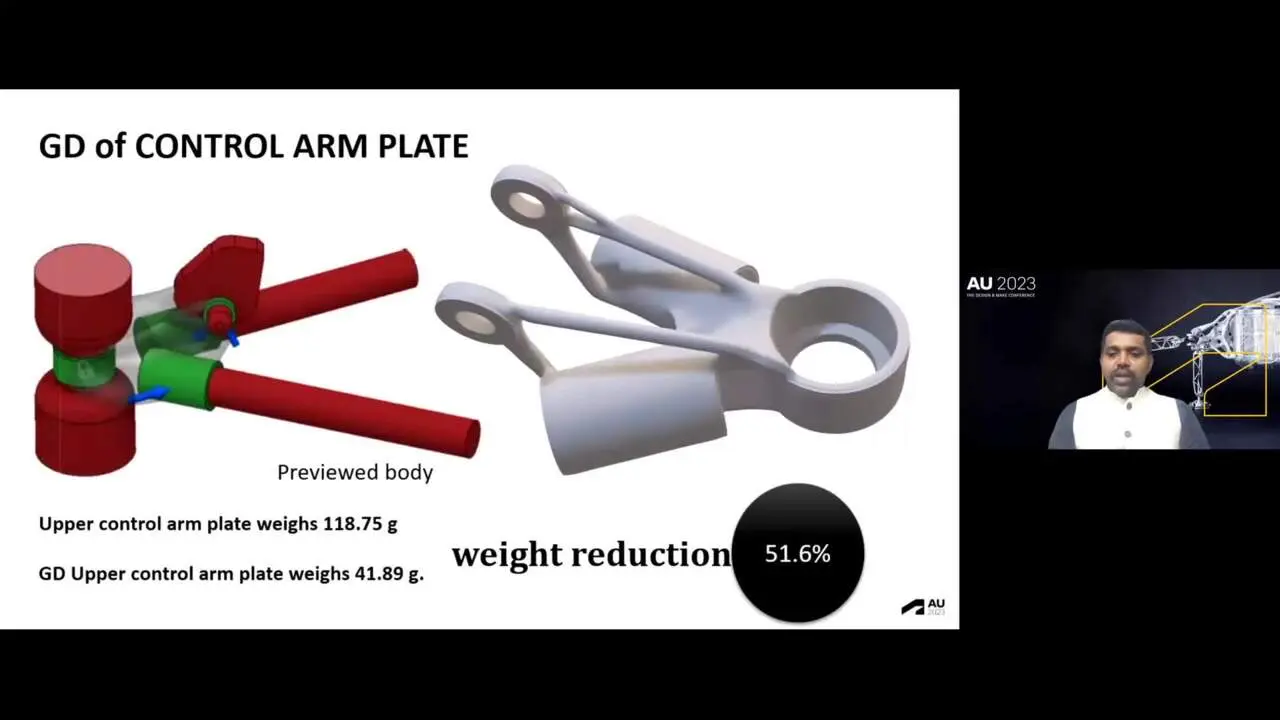
Generative Engineering of Automotive Suspension Components: From CAD to Cost

Generative design can cut suspension component weight by 30-50%, but that weight reduction often comes with higher per-part manufacturing costs. For manufacturers, the decision to adopt generative engineering hinges on a total cost analysis that includes material, manufacturing, validation, and supply chain changes—not just the bill of materials.
Why Cost Per Part Increases
Generative designs typically feature complex, organic geometries that are difficult to produce with traditional methods like forging or casting. Additive manufacturing (AM) is often required to realize the full potential, and AM has higher per-part costs due to slower build rates, powder or filament material costs, and post-processing needs. For example, a titanium control arm produced via powder bed fusion can cost several times more than a forged steel equivalent.
When Generative Design Wins
For low-volume, performance-critical parts—such as in motorsports or limited-production supercars—the weight savings and performance gains justify the higher unit cost. For high-volume mass production, traditional methods may still be more economical, unless the design is adapted for casting or forging.
The Break-Even Point
The cost-effectiveness depends on part complexity, material choice, and production volume. A simple bracket might not benefit, but a complex upright with integrated mounting points could. Use a total cost model that includes tooling amortization, material waste, and validation costs.
Actionable Next Steps
For each candidate part, calculate the total cost per part for both generative and traditional designs at your expected volume. Include material, manufacturing, post-processing, and validation. Only proceed if the total cost is competitive or the performance gain is worth the premium.
Material Selection for Generative Suspension Designs: Strength, Fatigue, and Cost
Material choice is the most critical factor in generative design for suspension components, as it directly impacts strength, fatigue life, manufacturability, and cost. Common materials include aluminum alloys (6061, 7075), titanium (Ti-6Al-4V), and high-strength steels. Each has trade-offs that must be evaluated for your specific application.
Aluminum Alloys
6061 is cost-effective and weldable, but has lower fatigue strength. 7075 offers higher strength but is more expensive and harder to weld. Both are suitable for AM or casting. For suspension arms, 7075 is often preferred for its strength-to-weight ratio, but fatigue life must be validated.
Titanium (Ti-6Al-4V)
Offers excellent strength-to-weight and corrosion resistance, but is expensive and difficult to machine. AM is the preferred method for complex titanium parts, but powder costs are high. Titanium is often used in high-performance or aerospace-inspired suspension components.
High-Strength Steels
Cheaper than titanium and aluminum, but heavier. Generative design can reduce weight by optimizing geometry, but steel's higher density limits weight savings. Steels are best for mass-produced parts where cost is paramount.
Fatigue Life Is Critical
Suspension components experience cyclic loading, so generative designs must be validated for fatigue. The complex geometries can create stress concentrations that differ from traditional designs. Use fatigue analysis software and physical testing to ensure durability.
Manufacturing Impact
Material choice dictates the manufacturing process. Titanium and aluminum are compatible with powder bed fusion, while steels may be better suited for casting or forging. Post-processing needs—like heat treatment, surface finishing, and machining of critical interfaces—add cost and time.
Actionable Next Steps
For each material candidate, obtain quotes for material and manufacturing at your volume. Conduct fatigue testing on representative samples. Use a decision matrix that weighs performance, cost, and manufacturability.
From CAD to Production: Integrating Generative Designs with Traditional Manufacturing
Generative designs often require additive manufacturing for full benefit, but they can be adapted for casting or forging with design modifications. The key is to understand the constraints of each process and modify the generative output accordingly.
Adapting for Casting
Generative designs can be smoothed and thickened for castability. This may reduce weight savings but allows for high-volume production. For example, a control arm designed with generative tools can be converted to a castable shape with draft angles and uniform wall thickness.
Adapting for Forging
Forging requires simpler shapes with no undercuts. Generative designs can be used as a starting point, but significant redesign may be needed. The result is a part that is stronger than cast but with less geometric complexity.
Hybrid Approaches
Use generative design to create a topology-optimized shape, then adapt it for traditional manufacturing. This approach can yield weight savings of 10-20% compared to fully traditional designs, with minimal cost increase.
Post-Processing and Surface Finish
Generative parts often require CNC machining of mating surfaces, threads, and bearing seats. Surface finish may need to be improved for fatigue resistance. These steps add cost and time.
Tooling Costs
For casting or forging, tooling costs can be significant but are amortized over high volumes. For low volumes, additive manufacturing avoids tooling costs but has higher per-part costs. Use a cost model to determine the crossover point.
Actionable Next Steps
Work with your manufacturing partners early in the design process. Use design for manufacturability (DFM) guidelines to adapt generative outputs. Consider hybrid approaches that balance weight savings with production efficiency.
Validation and Testing of Generative Suspension Components: Ensuring Safety and Reliability
Generative-designed suspension parts are safety-critical, so validation is non-negotiable. The complex internal geometries may require non-destructive testing (NDT) like CT scanning, and fatigue testing is essential. Regulatory compliance (e.g., FMVSS, ISO) must be met, and generative designs need to be certified.
NDT for Complex Geometries
CT scanning can detect internal voids or defects that are invisible to surface inspection. This is especially important for additively manufactured parts, which can have porosity. Budget for CT inspection on a sample basis.
Fatigue Testing
Generative parts may have different failure modes than traditionally designed parts. Conduct fatigue tests to determine the endurance limit and validate the design under cyclic loads. This is critical for suspension components that endure millions of cycles.
Regulatory Compliance
Depending on your market, you must comply with standards like FMVSS (U.S.) or ECE (Europe). Generative designs must be certified to meet these standards. Work with a testing lab that can perform the required tests and provide documentation.
Validation Costs
These can be significant—CT scanning, fatigue testing, and certification can add thousands of dollars per part. Factor these costs into your total cost analysis. For low-volume parts, validation costs may be prohibitive.
Actionable Next Steps
Develop a validation plan early. Include NDT, fatigue testing, and certification. Use simulation to reduce the number of physical tests needed. Partner with a certified testing lab.
Software Tools for Generative Design of Suspension Parts: A Comparative Overview
Leading tools for generative design include nTopology, Fusion 360, Ansys Discovery, and Altair Inspire. Each has strengths and weaknesses, and the right choice depends on your team's expertise and specific needs.
nTopology
Excels at implicit modeling and lattice structures. It offers fine control over geometry and is ideal for complex, organic designs. It has a steeper learning curve but is powerful for advanced users. Pricing is subscription-based, typically higher than others.
Fusion 360
Autodesk's generative design module is user-friendly and integrates with CAD. It offers cloud-based solving and is good for beginners. It supports multiple materials and manufacturing methods. Subscription cost is moderate.
Ansys Discovery
Combines simulation and generative design. It allows real-time simulation and can optimize for structural performance. It's good for engineers who need to validate designs within the same tool. Pricing is on the higher end.
Altair Inspire
Focuses on topology optimization and is easy to learn. It integrates with Altair's simulation suite. It's cost-effective for basic generative design. It may lack some advanced features like lattice generation.
Key Features to Consider
Topology optimization, lattice structures, integration with CAD, simulation capabilities, and support for multiple manufacturing methods. Also consider the learning curve and support.
Actionable Next Steps
Evaluate each tool with a trial project. Consider your team's skill level and budget. Choose a tool that aligns with your manufacturing processes and validation needs.
Case Studies: Generative Design in Production Suspension Components
Real-world examples demonstrate the feasibility and cost-effectiveness of generative design in suspension components. While specific data is limited, these cases illustrate the potential.
Case Study 1: Low-Volume Performance Control Arm
A control arm designed with generative design and produced via additive manufacturing for a low-volume performance car. The part achieved a 40% weight reduction compared to the original steel forging. Cost per part was higher, but the performance gain justified it for a limited production run.
Case Study 2: Suspension Upright for Casting
A suspension upright was redesigned using generative design, then adapted for casting. The result was a 15% weight reduction with minimal cost increase, as the casting process was unchanged. This shows that generative design can be used for mass production when adapted properly.
Case Study 3: Mass-Produced Component Optimized for Manufacturability
In this case, generative design was used not to minimize weight but to optimize for manufacturability, reducing material waste and cycle time. The part was produced using traditional forging, and the design changes reduced cost by 5%.
These cases highlight that generative design is not a one-size-fits-all solution. The key is to align the design goals with the manufacturing process and cost constraints.
Cost-Benefit Analysis: Is It Worth It?
Generative design is worth it when the total cost of ownership—including weight savings, performance gains, and manufacturing costs—is favorable. For high-volume production, traditional methods often win unless the design is adapted for casting or forging. For low-volume or performance-critical parts, generative design can be cost-effective.
Total Cost Model
Include material, manufacturing, post-processing, validation, and tooling amortization. Also consider the value of weight reduction, which can improve fuel efficiency or performance.
Break-Even Analysis
For a given part, calculate the cost per part for generative and traditional designs. Determine the production volume at which the costs are equal. If your volume is below the break-even point, generative design may be viable.
Risk Factors
Generative designs may have higher validation costs and longer development times. These risks must be managed.
Actionable Next Steps
Use a total cost model to compare designs. Consider the strategic value of weight reduction for your product line. Start with a pilot project to validate the process.
Future Trends: Generative Design in EVs and Autonomous Vehicles
Electric vehicles (EVs) and autonomous vehicles (AVs) are driving the adoption of generative design in suspension components. EVs need to reduce weight to extend range, and AVs require precise, reliable components. Generative design can help achieve these goals.
Weight Reduction for EVs
Every kilogram saved can increase range. Generative design can reduce suspension weight by 30-50%, which is significant for EVs. This is a key driver for adoption.
Integration with New Architectures
EVs and AVs have different packaging constraints, such as battery placement and sensor integration. Generative design can create components that fit these new architectures.
Materials and Manufacturing
As AM becomes more cost-effective, generative design will be more viable for mass production. New materials and processes will expand the possibilities.
Actionable Next Steps
Monitor developments in AM and materials. Consider how generative design can support your EV or AV product roadmap.
Conclusion: Embracing Generative Engineering
Generative engineering offers significant potential for suspension components, but it requires a careful evaluation of costs, materials, manufacturing, and validation. By following the decision frameworks in this article, you can determine where generative design makes sense for your products.
Start with a pilot project to gain experience. Work with your manufacturing partners and software vendors to develop a workflow. As the technology matures, generative design will become an essential tool for automotive suspension engineers.
For more information on suspension components and our manufacturing capabilities, explore our automotive suspension components and learn about our manufacturing facility. We also offer a range of Large suspension bushings and other parts that can benefit from advanced design techniques.
FAQ
What is generative engineering in suspension design?
Generative engineering uses algorithms to explore design alternatives based on defined constraints and goals, often producing organic shapes that optimize for weight, strength, and manufacturability.
How much weight can be saved with generative design?
Weight savings of 30-50% are possible compared to traditional designs, but the actual amount depends on the component, material, and manufacturing process.
Is generative design cost-effective for mass production?
It can be, if the design is adapted for casting or forging. For high volumes, traditional methods may still be cheaper unless the generative design is optimized for manufacturability.
What materials are best for generative suspension parts?
Aluminum alloys, titanium, and high-strength steels are common. The choice depends on strength, fatigue, cost, and manufacturability.
What are the main challenges in adopting generative design?
Higher per-part costs, validation requirements, and the need to adapt designs for traditional manufacturing are key challenges.
How does generative design impact validation and testing?
Generative parts may require additional NDT and fatigue testing due to complex geometries, increasing validation costs.
What software tools are recommended for generative design?
nTopology, Fusion 360, Ansys Discovery, and Altair Inspire are popular options, each with different strengths and pricing.
Can generative design be used for safety-critical suspension parts?
Yes, but rigorous validation and compliance with standards like FMVSS or ECE are essential.
What is the future of generative design in EVs and AVs?
Weight reduction for range extension and integration with new architectures make generative design increasingly relevant for EVs and AVs.
How do I start with generative engineering?
Begin with a pilot project, evaluate total costs, and collaborate with manufacturing partners and software vendors to develop a workflow.