Ball Joint Wear Inspection: The Replace-or-Monitor Decision
To check a ball joint, raise the vehicle on jack stands, load the suspension, and watch for relative movement between the stud and housing while a helper rocks the steering 10–15 degrees. If you see or feel play at the stud, or find a torn boot with grease loss, replace the joint. If play is within specification and the boot is intact, monitor at every oil change. [MODEL_ANALYSIS]
A clunk over bumps does not automatically mean a bad ball joint. Tie rod ends, control arm bushings, sway bar links, and wheel bearings produce front-end noises that get misattributed every day. The correct sequence is: attribute the symptom to the right component, measure play against a real tolerance, then decide whether to monitor, replace, or stop driving. [MODEL_ANALYSIS]
Symptom-to-Component Differentiation: Which Part Is Actually Making the Noise
Before you lift the vehicle, map the symptom to the most likely source. This prevents unnecessary parts swapping and gets you to the correct inspection faster. [MODEL_ANALYSIS]
Ball Joint
A sharp, single clunk or pop over uneven pavement. The stud moves within a worn housing, and the clearance creates a distinct impact when load transfers. [MODEL_ANALYSIS]
Tie Rod End
Steering shimmy and uneven tire wear rather than a distinct clunk. The tie rod connects the steering rack to the knuckle; when its socket wears, steering input becomes vague and the tire can feather or cup. [MODEL_ANALYSIS]
Control Arm Bushing
A dull thud or wander that is felt more than heard. The bushing isolates the control arm from the subframe; when the rubber degrades, the arm shifts under load, producing a muted thump and vague handling. A clunk that appears only under braking or acceleration points here — the bushing compresses and releases under torque, producing a thud absent during steady-state cruising. [MODEL_ANALYSIS]
Sway Bar Link
A lighter rattle that appears on small bumps at low speed. The link connects the sway bar to the control arm; worn link ball joints or deteriorated bushings create a rapid, lighter rattle over washboard surfaces. [MODEL_ANALYSIS]
Wheel Bearing
A speed-dependent hum that changes pitch when loading the bearing left or right. This is a different diagnostic pathway entirely: a humming that rises with vehicle speed and shifts when you swerve. If you hear a hum, inspect the bearing, not the ball joint. [MODEL_ANALYSIS]
Use this symptom map to narrow your suspicion before you raise the vehicle.
Loaded vs. Unloaded Inspection: Step-by-Step Methods with Safety Non-Negotiables
Safety first: jack stands and wheel chocks are mandatory. Never work under a vehicle supported only by a jack. A hydraulic jack can fail; jack stands are the only acceptable support. Chock the rear wheels to prevent rolling. This is non-negotiable. [MODEL_ANALYSIS]
Unloaded Method
Raise the vehicle, support it on jack stands, and remove the wheel if necessary for access. Grasp the tire at top and bottom and rock it vertically to feel for play. Then grasp at front and rear to check horizontal play. Vertical play often indicates wear in the ball joint itself; horizontal play can indicate tie rod end wear or combined wear. Direction matters for attribution. Some ball joints are designed with a small amount of vertical play when unloaded, so the loaded method is often more representative of real-world wear. [MODEL_ANALYSIS]
Loaded Method
With the vehicle on the ground or on a drive-on lift, have a helper rock the steering wheel only enough to load the joint — about 10–15 degrees of steering input. While the helper holds that load, feel the ball joint housing and stud simultaneously. If you feel relative movement between the stud and housing, the joint is worn. This simulates road load and reveals play that disappears when the suspension hangs free. [MODEL_ANALYSIS]
Pry Bar Check
For a more precise check, place a pry bar under the control arm near the ball joint and pry upward to unload the joint. Watch for vertical movement between the stud and the housing. This is a common technique in independent shops. Always ensure the pry bar is placed safely and the vehicle is stable. [MODEL_ANALYSIS]
How Much Play Is Too Much: Wear Tolerance, Boot Condition, and the Replace-or-Monitor Decision
Any play beyond manufacturer specification warrants replacement. If the specification is not available, any detectable vertical or horizontal play that produces a clunk or steering change is grounds for replacement. This is the core decision rule. [MODEL_ANALYSIS]
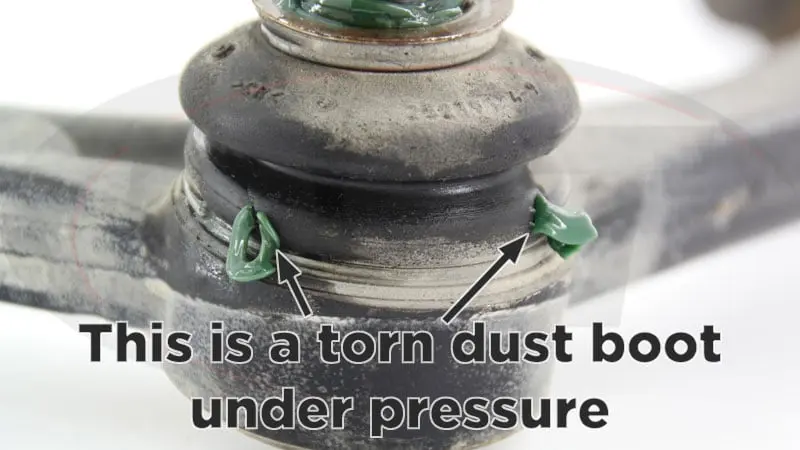
Vertical play often indicates wear in the ball joint itself, while horizontal play can indicate tie rod end wear or combined wear. Direction matters for attribution. A torn boot with grease loss or contamination is a replace-now condition even if play is not yet detectable, because the joint is on borrowed time. Once the boot is compromised, water and grit enter, and the joint will fail prematurely. [MODEL_ANALYSIS]
Decision criteria: play magnitude, boot condition, grease loss, mileage, and driving consequences. If the joint is dry, rusty, or has a torn boot, replace. If play is within spec and the boot is intact, monitor with regular inspections. Document your findings and set a re-inspection interval based on play magnitude and boot condition. For a joint with slight play and an intact boot, re-inspect at the next oil change. For a joint with a torn boot but no detectable play, replace immediately. [MODEL_ANALYSIS]
The Cost of Waiting: Steering Precision, Tire Wear, and Separation Risk
Loss of steering precision is the first consequence. As play increases, the driver experiences vague steering, wandering, and delayed response, which degrades vehicle control. You may find yourself making constant small corrections. [MODEL_ANALYSIS]
Accelerated tire wear follows. Excessive play changes suspension geometry dynamically, causing uneven or cupped tire wear that increases cost and reduces grip. A worn ball joint allows the wheel to tilt in and out, scrubbing the tire. [MODEL_ANALYSIS]
Safety-critical risk of separation: a ball joint that fails completely can separate, causing loss of wheel control and a potential crash. This is the ultimate consequence of waiting. At speed, separation can lead to an immediate loss of steering and a rollover risk. [MODEL_ANALYSIS]
Impact on safety systems: ABS and ESC rely on consistent wheel position and steering input; excessive play can degrade their effectiveness, though specific system interactions should be described cautiously without fabricating test data. The takeaway: do not delay replacement once wear is confirmed. [MODEL_ANALYSIS]
After the Inspection: Alignment, Torque-to-Spec, and Re-Inspection
Alignment is required after ball joint replacement because suspension geometry changes. Skipping alignment leads to uneven tire wear and poor handling. Even if the new joint is identical to the old, the act of disassembly and reassembly can shift camber and toe. [MODEL_ANALYSIS]
Torque-to-spec is mandatory: under-torquing can cause the stud to loosen, while over-torquing can damage the joint or housing. Always use the manufacturer's specified torque values. Do not guess. Use a calibrated torque wrench. [MODEL_ANALYSIS]
Re-inspection after installation: after a short drive, re-check torque and play to confirm the joint is seated and functioning correctly. Some joints settle after the first heat cycle. If only inspecting and not replacing, document the findings and set a re-inspection interval based on play magnitude and boot condition. [MODEL_ANALYSIS]
Why Ball Joints Fail: Manufacturer Perspective on Vehicle Type, Usage, and the OEM vs. Aftermarket Trade-Off
Failure points vary by vehicle type. Fleet vehicles with high mileage and constant load, off-road vehicles exposed to dirt and water, and high-mileage commuters with worn boots are all common candidates for premature ball joint wear. Usage patterns matter: frequent rough-road driving, heavy loads, and lack of grease maintenance accelerate wear. Sealed vs. greasable designs have different maintenance profiles. Greasable joints allow you to purge contaminants, but they require regular service; sealed joints are maintenance-free but cannot be refreshed. [MODEL_ANALYSIS]
OEM vs. aftermarket trade-off: OEM parts offer guaranteed fit and original durability, while quality aftermarket parts may offer improved materials or greasable designs at a lower cost — but low-cost aftermarket parts can be a false economy. From a manufacturer's lens, the key is matching the replacement part to the application and usage, not just the lowest price. For a daily commuter, a quality sealed joint may suffice. For an off-road vehicle, a greasable joint with a reinforced boot may last longer. [MODEL_ANALYSIS]
When replacing suspension components, consider the entire system. For Hyundai and KIA applications, control arms and bushings are available through our catalog. For example, the Control Arm — 54500-CG000 is a direct-fit option for specific models. Also, inspect related components like stabilizer link ball joints, such as Front Stabilizer Link Ball Joints — 54830-0U000, which can contribute to clunking if worn. [FACT_FROM_DATABASE]
Frequently Asked Questions
Q: Can I drive with a bad ball joint?
A: If there is any detectable play or a torn boot, do not delay replacement. Driving with a worn ball joint risks separation and loss of control. If you must drive to a shop, do so at low speed and avoid bumps. [MODEL_ANALYSIS]
Q: How often should ball joints be inspected?
A: Inspect at every oil change or at least annually. High-mileage vehicles, off-road vehicles, and those with greasable joints should be checked more frequently. [MODEL_ANALYSIS]
Q: What causes ball joint wear?
A: Wear is caused by loss of lubrication, contamination from a torn boot, and normal fatigue over time. Rough roads and heavy loads accelerate it. [MODEL_ANALYSIS]
Q: Can I replace just one ball joint?
A: It is best to replace both sides at the same time to maintain balanced handling. However, if one side is worn and the other is within spec, replacing only the worn side is acceptable. [MODEL_ANALYSIS]
Q: Do I need an alignment after replacing a ball joint?
A: Yes. Replacing a ball joint disturbs the suspension geometry, so an alignment is required to prevent uneven tire wear and handling issues. [MODEL_ANALYSIS]