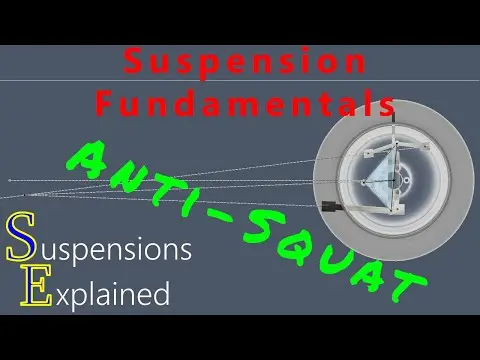
Anti-Squat Suspension Geometry: Measure, Tune, and Optimize for Traction and Ride

Anti-squat is the resistance of the rear suspension to compress under acceleration, expressed as a percentage. It directly affects traction and ride comfort, but there is no universal ideal—the optimal setting depends on your vehicle type, suspension design, and intended use. This guide explains how anti-squat works, how to measure it, and how to adjust it for your specific application.
The Physics of Anti-Squat: Weight Transfer and Suspension Forces
When you accelerate, weight shifts to the rear, compressing the rear suspension—this is squat. The suspension geometry determines how much of that compression is resisted. The key is the instant center and the side view swing arm (SVSA). The instant center is the point where the suspension links' lines intersect when viewed from the side. The line from the rear tire contact patch to the instant center defines the anti-squat force direction. Anti-squat percentage is the ratio of the vertical component of that force to the horizontal component, relative to the weight transfer. Too much anti-squat can cause wheel hop; too little results in excessive squat and reduced traction.
Understanding Anti-Squat Percentage
Anti-squat percentage is calculated by comparing the instant center height to the center of gravity (CG) height. A simplified formula is: (instant center height / CG height) × 100. If the instant center is at the same height as the CG, you get 100% anti-squat, meaning the suspension resists all squat. Values above 100% mean the rear actually rises under power; below 100% allows some squat. The actual calculation involves more complex geometry, but this gives a practical baseline.
Anti-Squat vs. Anti-Dive vs. Anti-Lift
Anti-squat is often confused with anti-dive and anti-lift. Anti-dive is the resistance to front suspension dive under braking. Anti-lift is the resistance to rear suspension lift under braking. While they all use similar geometric principles, they apply to different dynamic conditions. Anti-squat specifically addresses acceleration squat. Understanding the distinction prevents misapplication of tuning concepts.
How to Measure Anti-Squat in Your Vehicle
To measure anti-squat, you need to identify your suspension type—solid axle, independent rear suspension (IRS), etc.—and locate the instant center. For a solid axle with a 4-link, extend lines through the upper and lower link bars; their intersection is the instant center. For IRS, use the control arm pivot points. Measure the height of the instant center and the CG height (often estimated). Then apply the simplified formula. Use a string, tape measure, or laser level to mark points. Online calculators can help with the math. Always measure with the vehicle at ride height and on level ground.
Tuning Anti-Squat for Different Applications (Drag, Road, Off-Road)
Drag racing often uses high anti-squat (100-150%) to maximize traction, but too much can cause wheel hop. Street driving benefits from moderate anti-squat (50-100%) to balance traction and ride comfort. Off-road vehicles typically use lower anti-squat to allow suspension articulation and absorb bumps. Adjustment methods include changing link mount heights, relocating brackets, or using adjustable arms. Increasing anti-squat can reduce ride quality and cause harshness, so trade-offs must be considered.
Common Misconceptions and Myths
Myth: More anti-squat is always better for traction. Reality: Excessive anti-squat can cause wheel hop and instability. Myth: Anti-squat is the same as anti-dive or anti-lift. Reality: They are distinct phenomena. Myth: You can set anti-squat to 100% and forget it. Reality: Conditions and vehicle setup change; periodic re-evaluation is needed. Myth: Anti-squat only matters for drag racing. Reality: It affects all vehicles under acceleration, including street and off-road.
Manufacturer Insights: Designing for Anti-Squat
OEMs design anti-squat to balance traction, ride comfort, and stability based on the vehicle's purpose. Sports cars prioritize traction and handling, so they may use higher anti-squat. Trucks and SUVs may use lower values to maintain ride quality. Aftermarket parts like adjustable arms and brackets allow fine-tuning beyond stock. For example, a performance-oriented sedan might have 80% anti-squat from the factory, while a drag-oriented muscle car might be tuned to 120%.
Conclusion: The Role of Anti-Squat in Vehicle Dynamics
Anti-squat is a tunable parameter that affects traction and ride. To apply this knowledge, measure your current anti-squat, determine your goals, and make adjustments. Consult with suspension experts if unsure, as improper adjustments can affect safety. For quality suspension components, consider our automotive suspension components and Large suspension bushing options.
FAQ
What is anti-squat percentage?
Anti-squat percentage is a measure of how much the rear suspension resists squat under acceleration, calculated as the ratio of instant center height to CG height, expressed as a percentage.
How does anti-squat affect traction?
Proper anti-squat improves launch traction by controlling weight transfer, while too much can cause wheel hop and too little can lead to excessive squat and reduced grip.
Can I adjust anti-squat on my vehicle?
Yes, anti-squat can be adjusted by changing suspension link mount heights, relocating brackets, or using adjustable arms, depending on your suspension type.
Is higher anti-squat always better?
No, higher anti-squat is not always better. Excessive anti-squat can cause wheel hop and harsh ride, so the optimal setting depends on your vehicle's use and desired balance.
What is the difference between anti-squat and anti-dive?
Anti-squat resists rear suspension squat under acceleration, while anti-dive resists front suspension dive under braking. They are distinct geometric phenomena.
How do I measure anti-squat on my car?
To measure anti-squat, locate the instant center for your suspension type, measure its height and the CG height, then apply the formula: (instant center height / CG height) × 100. Use a string, tape measure, or laser level for accuracy.
What anti-squat percentage is best for drag racing?
Drag racing often uses 100-150% anti-squat to maximize traction, but too much can cause wheel hop, so careful tuning is necessary.
Does anti-squat affect ride comfort?
Yes, higher anti-squat can reduce ride comfort by making the suspension feel harsh, so a balance must be struck for street use.