Active Anti-Roll Bars: Hydraulic vs Electric Architecture, Cost, and When They Beat a Passive Setup

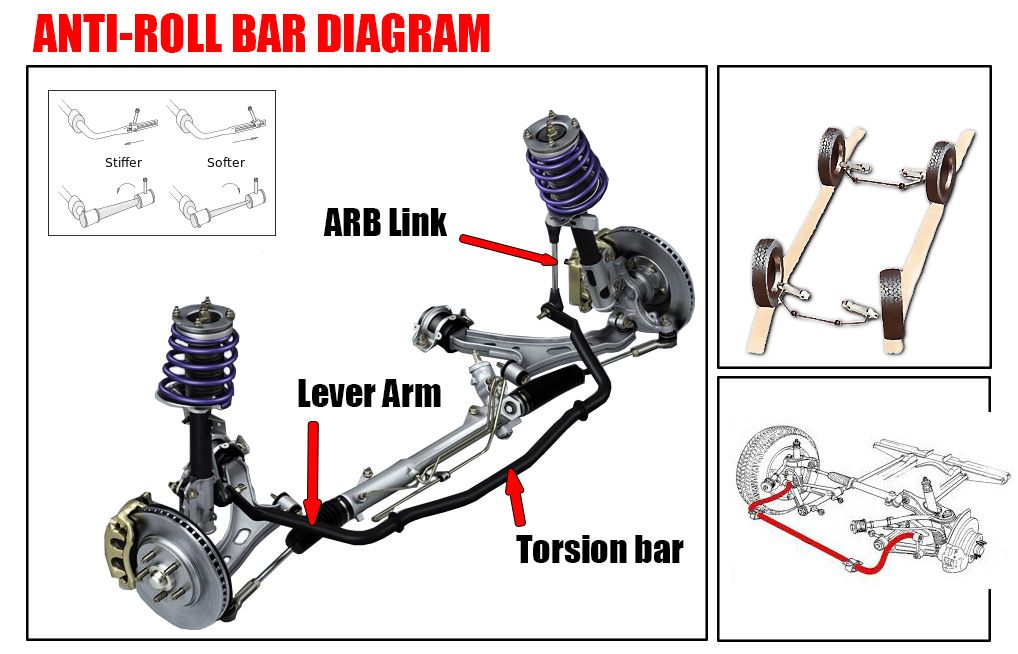
An active anti-roll bar replaces the fixed torsional spring rate of a passive bar with a variable-rate actuator at one or both ends of the bar, controlled by a chassis ECU. The bar itself does not disappear. The actuator changes how much of the bar's torsional resistance is transmitted to the opposite wheel, varying roll stiffness without changing the physical bar diameter.
The control loop reads steering angle, lateral acceleration (yaw and lateral G sensors), vehicle speed, and sometimes individual wheel speeds. The ECU commands the actuator to increase or decrease effective roll stiffness in real time. Hydraulic systems use a rotary actuator or hydraulic motor integrated into the bar, fed by a pump and valve block. Electric systems use a motor-gearbox unit, often a planetary or harmonic drive, at the bar split point.
For buyers and mechanics, the functional model matters because it determines what can be diagnosed. A passive bar has no ECU, no sensors, and no actuator. An active system has at least four failure domains: the bar and actuator assembly, the hydraulic or electrical power supply, the sensor suite, and the chassis ECU calibration. If a platform cannot support the sensor and power architecture, it cannot support an active ARB.
Before quoting or stocking an active ARB component, confirm the vehicle has the chassis ECU, the correct sensor set, and either the hydraulic circuit or the 48V/12V supply the actuator requires. A mechanically identical bar without those supporting systems will not function.
Hydraulic vs Electric Active ARB Architectures: Which One Fits Which Platform
Hydraulic active ARBs offer high force density and fast response but add fluid, leak, and pump-service complexity. Electric active ARBs simplify plumbing but demand stable electrical supply and often 48V architecture. The architecture decision drives packaging, serviceability, and which vehicles you will see in the bay.
Hydraulic systems (e.g., Mercedes-Benz Active Body Control lineage, BMW Dynamic Drive) use an engine-driven or electric pump, accumulators, valve blocks, and hydraulic lines. They typically appear on heavier luxury sedans and SUVs where high roll moment control is needed. Service implications include fluid service, accumulator and pump diagnostics, and line integrity checks.
Electric systems (e.g., Audi/Volkswagen active roll stabilization, Porsche PDCC on some platforms) use a 48V or 12V motor-gearbox at the bar. They are increasingly common where packaging, efficiency, and integration with 48V mild-hybrid systems matter. Service implications differ: motor/gearbox inspection, connector and voltage-drop testing, and ECU calibration awareness.
Match the architecture to your service capability. If your shop cannot handle hydraulic fluid service and pressure testing, hydraulic active ARB work is a sublet. If you lack 48V-safe tooling and voltage-drop diagnostic skills, electric active ARB work is equally risky.
What Active ARBs Actually Change vs a Well-Tuned Passive Setup
Active ARBs decouple roll stiffness from single-axis tuning: they can reduce body roll in corners without the ride harshness a stiffer passive bar would add in straight-line and single-wheel bumps. They can also intentionally increase roll stiffness at one axle to tune handling balance (understeer/oversteer) dynamically, which a passive bar cannot do without a mechanical compromise.
The comfort gain is real but not free. Active systems add weight, cost, and failure modes. A well-matched passive bar plus adaptive dampers can close much of the gap for many street-driven vehicles. Off-road and uneven-surface behavior is a genuine differentiator: active ARBs can disconnect or soften to allow articulation, which passive bars cannot do.
For a buyer deciding between an active ARB and a passive upgrade, the honest comparison is not "active vs nothing." It is "active vs a correctly specified passive bar with quality dampers." If the vehicle already has adaptive dampers and the use case is street driving, a passive bar upgrade may deliver most of the roll reduction at a fraction of the cost and complexity.
Define the use case first. If the requirement is articulation, dual-axle roll tuning, or simultaneous comfort and roll control on a heavy platform, active ARBs justify evaluation. If the requirement is flatter cornering on a daily driver, price a passive bar and damper package before committing to active.
Real Vehicles That Use Active Anti-Roll Bars — and What That Means for Parts Sourcing
Hydraulic active ARB examples include BMW Dynamic Drive (E60/E63, F01/F10, some X5/X6), Mercedes-Benz Active Body Control (ABC) on S-Class and some CL/GL, and Porsche PDCC on Cayenne/Panamera. Electric active ARB examples include Audi A8/S8 and some Q7/Q8 with active roll stabilization, Volkswagen Touareg, and certain 48V-equipped luxury platforms.
These systems are typically paired with adaptive dampers and, in some cases, torque vectoring or rear-wheel steering. That means parts sourcing often involves multiple chassis modules, not just the bar. Aftermarket support is thin: most active ARB components are OE-only or limited to a few specialist rebuilders.
For importers, this changes the stocking decision. Active ARB components are not commodity parts. They are platform-specific assemblies with calibration dependencies. Before committing to stock, verify core return, calibration, and warranty terms. If those terms are unclear, the risk sits with you, not the supplier.
Build a platform list before building a stock list. Identify which active ARB platforms are actually in your market and serviceable by your network. For platforms where you cannot verify calibration and warranty support, focus on the passive suspension components that surround the vehicle instead.
Cost and Complexity Reality: Purchase, Maintenance, and Repair for Buyers and Workshops
Active ARB components (bar with actuator, ECU, sensors, pump/valve block for hydraulic) are typically several times the cost of a passive bar and often sold as assemblies, not individual service parts. Maintenance cost differs by architecture: hydraulic systems need fluid and filter service, accumulator checks, and leak inspection; electric systems need connector and voltage-drop checks, motor/gearbox inspection, and sometimes calibration after replacement.
Repair cost is driven by diagnosis as much as parts. Common failures include actuator motor/gearbox wear, hydraulic pump/valve faults, sensor faults, and wiring/connector corrosion. Diagnosis often requires OEM-level scan tools and calibration, which raises labor and tooling cost. Not all shops have the scan tools, fluid handling, or calibration access. This affects whether a repair is a dealer-only job or can be handled by an independent.
For buyers, the practical question is not "what does the part cost" but "what does the repair cost in my market." A part that requires dealer calibration may be economically unviable for an independent shop even if the part itself is available.
Price the full repair path, not just the component. Include scan tool access, calibration, fluid handling (hydraulic), and voltage-drop testing (electric). If any step is unavailable, the repair is a sublet or a dealer job.
Reliability and Common Failure Points: What Actually Fails and Why
Hydraulic system failures include pump wear or failure, valve block sticking, accumulator loss of pre-charge, fluid leaks at lines and seals, and contaminated fluid causing actuator damage. Electric system failures include motor brush/gear wear, gearbox backlash or binding, connector corrosion, voltage supply issues (especially on 48V systems), and ECU calibration faults after battery or module replacement.
Sensor and wiring failures are a distinct category. Lateral acceleration, yaw, steering angle, and wheel speed sensors feed the control loop. A single faulty sensor can disable the system and trigger a chassis warning. This is a common misdiagnosis trap: the customer reports "the sway bar failed," but the actual fault is a sensor or connector.
Retrieve chassis/ABS codes first, verify sensor inputs, then test actuator command and feedback. Hydraulic systems need pressure testing; electric systems need voltage-drop and motor current testing. Do not replace the actuator before confirming the sensor inputs and power supply are correct.
Build a diagnostic sequence that starts with codes and sensor data, not with parts. If the actuator is replaced without verifying the control loop, the same fault will return.
Integration With Adaptive Dampers, Torque Vectoring, and Chassis Electronics
Active ARBs share sensor inputs and CAN/FlexRay data with adaptive dampers, ESP, torque vectoring, and rear-wheel steering. A fault or mismatch in one system can affect the others. This is why sourcing and calibration decisions cannot be made in isolation.
Replacing an active ARB actuator or ECU often requires recalibration or coding to the vehicle. Aftermarket parts must be compatible with the chassis network, not just mechanically fit. When specifying or stocking parts, buyers should verify whether the active ARB is part of a bundled chassis option (e.g., a sport package with adaptive dampers) because this affects part numbers and interchangeability.
For retrofits, the surrounding electronics are the limiting factor. Adding an active ARB to a vehicle not originally equipped is rarely plug-and-play and often requires ECU, wiring, and sensor additions that may not be economically viable.
Before ordering, confirm the vehicle's chassis option code and whether the active ARB is bundled with other systems. If the option code is unclear, the part number risk is high.
Decision Framework: When Active ARBs Justify the Complexity — and When a Passive Setup Wins
Choose active ARB when the vehicle platform already has the electrical or hydraulic infrastructure, the use case demands both comfort and roll control (heavy luxury SUV, performance sedan), or off-road articulation is required. Choose passive ARB when the vehicle is a daily driver without chassis electronics, the budget or service network cannot support calibration and OEM diagnostics, or the handling goal can be met with a well-matched bar and dampers.
For importers and wholesalers: stock active ARB components only for platforms with proven demand and service capability. Otherwise focus on passive bars, links, bushings, and dampers where volume and margin are more predictable. For mechanics: invest in chassis scan tool capability and calibration access before taking on active ARB work. Otherwise refer or sublet to avoid comebacks.
The decision is not about which technology is superior. It is about which technology fits the vehicle, the use case, and the service network. A passive bar that is correctly specified and installed will outperform an active system that cannot be diagnosed or calibrated in your market.
Apply the framework to one platform at a time. If the platform, use case, and service capability all align, active ARB work is viable. If any one of the three is missing, a passive setup is the lower-risk choice.
FAQ
Can I add an active anti-roll bar to a car that did not come with one?
Rarely as a practical retrofit. The surrounding electronics are the limiting factor: you would need the chassis ECU, the correct sensor set, and either the hydraulic circuit or the 48V/12V supply the actuator requires. Without those, a mechanically identical bar will not function.
Is an active ARB always better than a passive bar?
No. Active systems add weight, cost, and failure modes. For a street-driven daily driver with adaptive dampers, a correctly specified passive bar plus quality dampers can deliver most of the roll reduction at a fraction of the cost and complexity.
What fails first on an active ARB?
Failures cluster in the actuator (motor/gearbox wear or hydraulic pump/valve faults), the sensor suite, and the wiring/connectors. A single faulty lateral-G, yaw, steering angle, or wheel speed sensor can disable the system and trigger a chassis warning — often misdiagnosed as a failed bar.
Why does an active ARB repair cost so much?
Diagnosis, not just parts. OEM-level scan tools, calibration, fluid handling (hydraulic), and voltage-drop testing (electric) all add labor and tooling cost. If any of those steps is unavailable to your shop, the job becomes a sublet or dealer-only repair.
Should an importer stock active ARB components?
Only for platforms with proven demand and service capability in your market. Active ARB parts are platform-specific assemblies with calibration dependencies, not commodity parts. Verify core return, calibration, and warranty terms before committing to stock.
---
Related