What a Torsion Beam Rear Suspension Actually Is
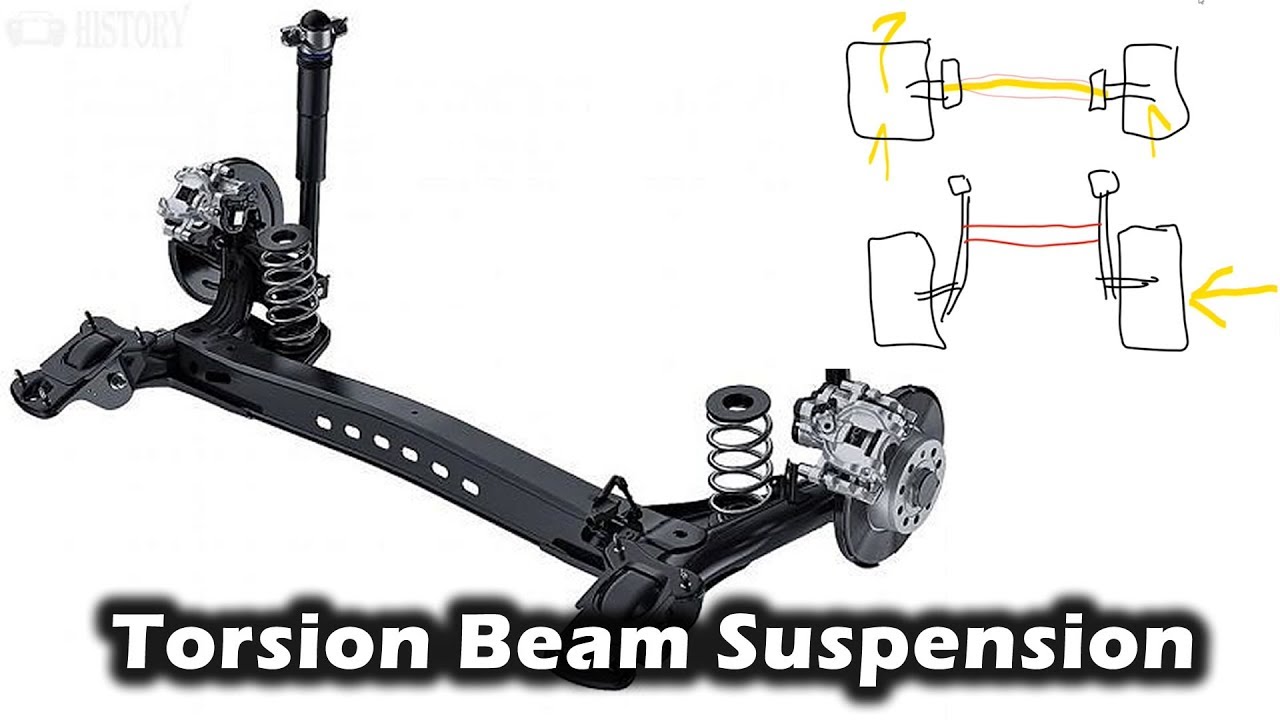
A torsion beam rear suspension connects the two rear wheel hubs with an H-shaped or twist-beam member, pivots at front bushings, and twists along its length to allow limited independent wheel movement. It is not a solid axle. The beam is deliberately designed to twist — which is why the same architecture is also called a twist-beam axle, semi-rigid axle, or compound crank suspension depending on the manufacturer.
The geometry is straightforward. Two trailing arms run fore-aft and carry the wheel hubs and spring seats. A transverse beam joins them, usually welded between the arms. That beam's cross-section — open C-channel, closed box, or tubular — and its material thickness determine both torsional stiffness (resistance to twisting) and bending stiffness (resistance to vertical deflection). Under cornering, the beam twists so the outer wheel can gain camber relative to the inner wheel. Under vertical wheel travel, the beam bends. The front pivot bushings control fore-aft and lateral compliance, which directly affects NVH, rear alignment stability, and wear.
For parts buyers and importers, the practical takeaway is that "torsion beam" describes a family, not a single part. A compact hatchback beam and an MPV beam can look similar but differ in cross-section, wall thickness, bushing type, and pivot geometry. Treating them as interchangeable is a fitment and warranty risk.
Torsion Beam vs Independent Rear Suspension: A Decision Framework
Torsion beam is typically lower cost to manufacture and simpler to assemble than multi-link or double wishbone, which is why it dominates compact hatchbacks, small MPVs, and cost-sensitive segments. The compact transverse beam also packages efficiently, leaving more rear cargo space and a lower floor height than a multi-link setup with its additional arms and subframe.
Handling is where the comparison gets misrepresented. A well-tuned torsion beam delivers predictable, stable behaviour for daily driving. Independent suspension offers more scope for camber and toe adjustment, which matters for performance applications, but that adjustability is only valuable if the vehicle actually needs it. For a commuter hatchback, the torsion beam's fixed geometry is not a defect — it is a design choice that reduces cost, weight, and service complexity.
Weight is not a universal win either way. A torsion beam can be lighter or heavier than an independent setup depending on beam material and design. A thin-walled open-section beam may be lighter than a multi-link assembly; a heavy closed-section beam with large bushings may not be. Buyers evaluating a platform should look at the specific design, not the category label.
Common vehicles using torsion beam include many compact hatchbacks, small MPVs, and cost-sensitive models. Multi-link and double wishbone appear more often in larger or performance-oriented vehicles. The decision framework for a buyer or importer is: match the suspension type to the intended use, budget, and cargo needs — not to a hierarchy.
How Beam Stiffness and Bushing Rates Are Tuned
Torsional stiffness of the beam controls roll resistance and camber change during cornering. A stiffer beam reduces body roll but can reduce ride comfort because it transmits more of one wheel's motion to the other. Bending stiffness affects vertical compliance and load-carrying behaviour, influencing how the beam reacts to bumps and cargo loads. These two stiffness values are tuned together, not independently.
Bushing rates at the front pivots control fore-aft and lateral compliance. Softer bushings absorb road noise and small impacts, improving NVH and comfort. Stiffer bushings reduce alignment change under load, improving steering response and stability, but they transmit more vibration into the cabin. Manufacturers tune these variables to match vehicle class: a compact hatchback may use softer bushings for comfort, while a sporty variant may use stiffer bushings and a stiffer beam.
Aftermarket support includes stiffer bushings, rear sway bars, and beam stiffening. Realistic gains are often modest for daily driving but can improve response and reduce roll. A rear sway bar adds roll stiffness and can tune balance, but it may reduce independence and comfort. Beam stiffening is limited by the original design; welding or bracing may not yield significant gains and can introduce stress risers if not engineered properly.
For mechanics and buyers, the tuning question is: what is the vehicle used for? If it is a daily driver, softer bushings and a stock beam are usually the right choice. If it is a sporty variant or a track-focused build, stiffer bushings and a sway bar may be justified — but the gains should be measured against the NVH trade-off.
Bushings, Pivots, and Wear: Inspection and Replacement Decisions
Bushing cracking, hardening, or separation is the most common wear point on a torsion beam. Symptoms include clunking over bumps, vague rear alignment, and uneven tyre wear. Inspect the front pivot bushings for cracks, tears, or excessive movement. If the rubber has separated from the metal sleeve, replacement is due.
Beam corrosion is a structural concern, especially in salt-belt regions. Inspect for rust, perforation, and weld cracks along the transverse beam and at the trailing arm junctions. A corroded beam can compromise structural integrity and should be replaced, not repaired, unless the manufacturer explicitly permits welding.
Pivot wear at the front bushings can cause fore-aft movement, affecting stability and accelerating tyre wear. Check for play by rocking the wheel or using a pry bar with the vehicle on a lift. If the pivot hardware is worn, replace the bushings and inspect the mounting points for elongation.
Replacement is justified when bushings are cracked or separated, the beam is corroded or cracked, or alignment cannot be maintained. Otherwise, bushing replacement alone may restore behaviour. After replacement, a rear alignment check is recommended where adjustable. Many torsion beam designs have limited or no rear adjustment, so bushing condition is critical to maintaining alignment. For Hyundai and Kia applications, correct rear trailing arm bushings include part numbers such as Rear Trailing Arm Bushing — 55274-D3000, Rear Trailing Arm Bushing — 55274-2W000, and Rear Trailing Arm Bushing — 55274-4T000. Always verify the OE number against the vehicle before ordering.
Aftermarket Upgrades: What Actually Works
Stiffer bushings reduce compliance, improving steering response and reducing alignment change under load, but they increase NVH. Polyurethane bushings are a common upgrade for drivers who accept more vibration in exchange for sharper response. For a daily driver, the trade-off is often not worth it; for a sporty build, it can be.
A rear sway bar adds roll stiffness, which can reduce understeer or tune balance, but it may reduce independence and comfort. It is a tuning tool, not a universal improvement. Beam stiffening is often limited by the original design; welding or bracing may not yield significant gains and can introduce stress risers if not engineered. Realistic gains from these upgrades are modest improvements in response and roll control for daily driving — not a substitute for a fully independent performance suspension.
Buyers should separate marketing claims from engineering reality. A stiffer bushing does not transform a torsion beam into a multi-link. A sway bar does not add camber adjustment. The right upgrade depends on the vehicle's intended use and the driver's tolerance for NVH.
How Torsion Beam Design Varies Across Manufacturers
Design variations include beam cross-section (open C vs closed), material thickness, bushing type (rubber vs hydraulic), and pivot geometry. These differ by manufacturer and model. A beam from one compact hatchback will not necessarily fit another, even if both are torsion beam designs.
Vehicle classes using torsion beam include compact hatchbacks, MPVs, and cost-sensitive segments. Some performance variants may use a stiffer beam or different bushings, but the architecture remains the same. For importers, the implication is that bushings, beams, and sway bars are often model-specific. Interchanging parts without verifying fitment can cause alignment issues or premature wear.
Importers should verify OE numbers and design details rather than assuming all torsion beam parts are universal. For Hyundai and Kia applications, the parts database includes specific rear trailing arm bushings such as Rear Trailing Arm Bushing — 55274-4Q000, Rear Trailing Arm Bushing — 55274-2S000, and Rear Trailing Arm Bushing — 55274-2H000. Cross-referencing the OE number against the vehicle's VIN or parts catalogue is the only reliable way to confirm fitment.
When Torsion Beam Is the Right Choice — and When It's a Compromise
Torsion beam is the right choice for cost-sensitive vehicles, space-constrained designs such as compact hatchbacks and MPVs, and daily driving where comfort and cargo space matter more than ultimate handling. It is a compromise for performance-oriented driving, frequent track use, or applications requiring extensive rear alignment adjustment.
The "always inferior" narrative is misleading. Many torsion beam vehicles are praised for practicality and reliability. The decision factors are intended use, budget, cargo needs, and willingness to accept NVH trade-offs from upgrades. A buyer who needs a reliable commuter with maximum cargo space should not reject a torsion beam vehicle. A buyer who needs adjustable rear camber for track use should look for an independent suspension platform.
For mechanics and importers, the final framework is: identify the suspension type, verify the specific design and part numbers, inspect wear points, and recommend upgrades only when they match the vehicle's intended use. Torsion beam is not a defect — it is a design choice with clear trade-offs.
FAQ
Can a torsion beam rear suspension be upgraded?
Yes, but with limits. Stiffer bushings and a rear sway bar can improve response and reduce roll. Beam stiffening is constrained by the original design and may introduce stress risers if not engineered properly. Gains are modest for daily driving.
When should I replace the beam instead of just the bushings?
Replace the beam when it is corroded, cracked, or when alignment cannot be maintained. If the beam is structurally sound, bushing replacement alone may restore behaviour.
Are all torsion beam bushings interchangeable?
No. Bushing type, dimensions, and pivot geometry vary by manufacturer and model. Always verify the OE number against the vehicle's VIN or parts catalogue before ordering.
Does a rear sway bar make a torsion beam handle like independent suspension?
No. A sway bar adds roll stiffness and can tune balance, but it does not add camber adjustment or transform the architecture. It is a tuning tool, not a conversion.