Tie Rod End Symptoms at the Steering Wheel: Diagnose Inner vs Outer, Then Order the Right Part
Excessive free play at the steering wheel — the dead zone you feel before the front wheels respond — is the single strongest indicator of tie rod end wear. Shimmy, wandering, and clunks can come from a dozen front-end components. Free play that exists with the engine off and the wheel rocked lock-to-lock almost always traces back to a worn tie rod end, a worn rack, or both.
Here is how to read the steering wheel like a diagnostic tool, isolate inner versus outer, and decide what to order before you spend money.
Steering Wheel Symptoms That Point to Tie Rod Ends (and What They Don't)
Free play at the rim: the primary signal
Measure free play at the rim. With the engine off, gently rock the wheel left and right. You are looking for the arc the wheel travels before the tires begin to move. More than roughly one inch of free play at the rim is a red flag.
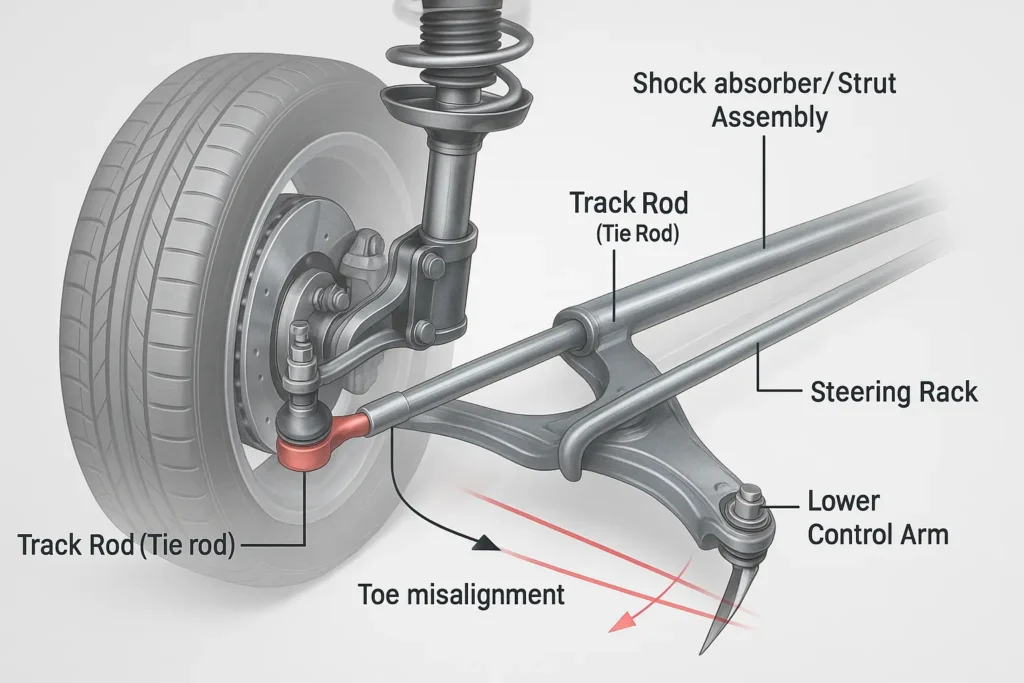
Tie rod ends are the most common cause because they are the last mechanical link between the steering rack and the steering knuckle. Any looseness in the ball-and-socket joint shows up directly as lost motion at the wheel.
Shimmy at 45–65 mph: felt in the wheel, not the seat
Shimmy or vibration at 45–65 mph that changes with road surface and is felt in the steering wheel — not the seat — narrows the suspect list considerably. Tire balance issues usually produce a consistent vibration at a specific speed range. Tie rod end shimmy is more irregular; it comes and goes with pavement texture and is often accompanied by a slight wander.
If the vibration is in the seat, suspect driveline or rear suspension. If it is in the wheel, suspect tie rods, wheel bearings, or control arm bushings.
Wandering or vague on-center: only a tie rod symptom when paired with free play
Wandering or a vague on-center feel that requires constant correction is a tie rod end symptom only when paired with free play. Without free play, that same vague feel points to rack play or an alignment problem.
This distinction matters. Replacing tie rod ends on a car with a worn steering rack will not fix the wander — it will just move the play from one component to another.
Clunking over bumps: usually not the tie rod end
Clunking over bumps felt through the steering wheel is more often a ball joint or control arm bushing than a tie rod end. Tie rod ends typically clunk during steering input — when you turn the wheel — not during vertical suspension travel. If the clunk happens when you hit a bump while driving straight, look at ball joints and bushings first.
Inner vs Outer Tie Rod Ends: How Each One Talks to the Steering Wheel
Outer tie rod end: vertical play and a pronounced dead zone
Outer tie rod end wear typically shows up as vertical play at the wheel — 12 and 6 o'clock wiggle — and a more pronounced dead zone at the steering wheel. The outer tie rod end connects to the steering knuckle. When its ball stud wears, the knuckle can move vertically relative to the tie rod. That vertical movement translates into a larger dead zone before the wheel responds.
Inner tie rod end: horizontal play and a vaguer wander
Inner tie rod end wear often presents as horizontal play — 3 and 9 o'clock wiggle — and a vaguer, wandering feel rather than a distinct clunk. The inner tie rod end threads into the steering rack and connects to the outer tie rod. When its socket wears, the entire tie rod assembly can move horizontally, producing a wandering sensation that is harder to pin down than the sharper feedback of a worn outer joint.
Both inner and outer wear can produce similar steering wheel free play. The wheel wiggle test at different clock positions is what separates them. You cannot diagnose inner versus outer by feel alone from the driver's seat.
Inner vs outer tie rod end: quick comparison
| | Outer tie rod end | Inner tie rod end |
|---|---|---|
| Connects to | Steering knuckle | Steering rack |
| Typical wheel play | Vertical — 12 and 6 o'clock | Horizontal — 3 and 9 o'clock |
| Steering wheel feel | Pronounced dead zone | Vague, wandering feel |
| Key failure clue | Clunk during steering input | Looseness felt at the rack joint |
| Replacement access | Straightforward with basic hand tools | Often requires an inner tie rod tool |
| Alignment after replacement | Required — toe changes | Required — toe changes |
Inner tie rod end vs rack play: location is the difference
A worn inner tie rod end can mimic steering rack play. The difference is location. Rack play is felt at the pinion — the input shaft where the steering column connects. Inner tie rod play is felt at the inner joint, where the tie rod meets the rack.
If you grab the inner tie rod and can move it independently of the rack, the inner tie rod end is worn. If the entire rack moves when you turn the pinion, the rack itself is the problem.
The 10-Minute At-Home Tie Rod End Inspection Sequence
This sequence confirms or rules out tie rod end wear before you order anything. You need a jack, jack stands, and a helper for the final step.
Step 1 — Steering wheel free-play test
Engine off. Rock the wheel gently left and right. Measure the dead zone before the front wheels move. More than about an inch of free play at the rim is a red flag. This test is free and takes 30 seconds. If there is no free play, tie rod ends are unlikely to be the primary culprit — but continue the sequence to be sure.
Step 2 — Wheel-off wiggle test at 3 and 9 o'clock
Raise the front of the vehicle and support it on jack stands. Grab the tire at 3 and 9 o'clock and wiggle it. Play here points to tie rod ends (inner or outer) or rack play. If the tire moves easily with little resistance, you have confirmed a problem in the steering linkage.
Step 3 — Wheel-off wiggle test at 12 and 6 o'clock
Grab the tire at 12 and 6 o'clock and wiggle. Play here points to ball joints or wheel bearings, not tie rod ends. If you feel play at 12 and 6 but not at 3 and 9, the tie rod ends are probably fine and you should inspect the ball joints and wheel bearings.
Step 4 — Visual confirmation
With the wheel off the ground, have a helper rock the steering wheel while you watch the tie rod ends. Look for lost motion between the inner and outer joints. A worn joint will move before the steering knuckle does. You can also feel the joint with your hand while the helper rocks the wheel — a worn tie rod end will transmit a distinct click or looseness.
Step 5 — Isolate inner vs outer
Clamp or hold the outer tie rod and re-check for play at the inner joint. If the outer moves independently of the inner, the outer is worn. If the inner moves independently of the rack, the inner is worn. If both move together with no independent play, the rack may be the source.
One Side or Both? Outer-Only or Inner-and-Outer Together?
Replacing one side vs both
If one outer tie rod end is worn and the other side shows no play, replacing just the worn side is mechanically acceptable. However, the alignment cost is the same whether you replace one side or both. Many DIYers replace both sides at once to avoid a second alignment later. If you are paying a shop for the alignment, the labor savings from doing both sides now usually outweigh the cost of the second part.
Inner and outer on the same side
Inner and outer tie rod ends on the same side wear at different rates. If the outer is worn, inspect the inner. Replacing both together saves a second alignment and a second teardown. The inner tie rod end is typically harder to access and may require a special tool, so doing both while you are already in there is efficient.
The pull you may feel after replacing one side
Replacing one side only can leave a slight steering pull if the new part's length differs from the worn part's effective length. Alignment corrects this, but only if performed after installation. If you skip alignment, the pull will remain and you may mistakenly blame the new part.
Mileage is not a diagnosis
For wholesale buyers and importers: pair replacement is the more common customer expectation for vehicles over 100,000 miles, but the decision should be driven by inspection, not mileage alone. A 120,000-mile car with tight tie rod ends does not need them replaced.
Alignment After Tie Rod End Replacement: Why Skipping It Undoes the Repair
Tie rod ends set toe. Replacing them changes toe angle even if you count threads and try to match the old length. Thread counting gets you close, but it is not precise enough to avoid tire wear. Toe is measured in fractions of a degree, and a half-turn difference on the tie rod can be enough to scrub tires over a few thousand miles.
Skipping alignment after tie rod end replacement causes rapid, uneven tire wear — typically inner or outer edge scrub — and a steering wheel that is off-center. The off-center wheel is the most obvious symptom: you are driving straight, but the wheel is turned slightly left or right. This is not a defective part; it is an alignment issue.
A car that pulls or has an off-center steering wheel after tie rod replacement is almost always an alignment issue, not a defective part. Before you return the part or order a replacement, get the alignment checked. If the pull persists after a proper alignment, then you have a part problem or another worn component.
Alignment should be performed with the vehicle at ride height and the steering wheel locked centered. This is a shop procedure, not a DIY driveway task for most readers. Budget for it as part of the repair cost.
What to Verify Before Ordering: Thread Direction, Size, Taper, and Included Hardware
Thread direction
Thread direction is the most common ordering mistake. Some tie rod ends and inner tie rods use left-hand threads. Ordering a right-hand thread for a left-hand application means the part will not thread on. Always verify thread direction against the vehicle's rack or outer tie rod before ordering. If you are unsure, check the part number on the existing component or consult a service manual.
Thread size and pitch
Inner and outer tie rod ends have specific thread sizes. Verify against the vehicle's rack or outer tie rod before ordering. A thread gauge or caliper will confirm the size. Do not assume that because a part looks similar, it will fit.
Taper dimensions
Taper dimensions are critical. The ball stud taper must match the steering knuckle or center link. A mismatched taper will not seat or torque correctly. If the taper is wrong, the stud will not lock into the knuckle, and the joint will loosen even if the nut is tight. This is a safety-critical fit.
Included hardware
Confirm whether the part includes a jam nut, boot, and cotter pin. Missing hardware means a second order and a delayed repair. Some aftermarket tie rod ends include new hardware; others do not. Check the product description or ask the supplier before ordering.
For wholesale buyers and importers
Verify thread direction and taper across the entire SKU range. A single mislabeled SKU can generate returns across a whole vehicle platform. If you are sourcing tie rod ends for a specific platform, request a sample and verify fitment before committing to a large order.
From Diagnosis to Order: Matching Your Steering Wheel Symptom to the Right Tie Rod End
Outer tie rod end
Free play plus 3-and-9 wheel play plus outer joint movement equals outer tie rod end. Order the outer for that side. If the outer joint moves independently when you hold the inner, the outer is worn.
Inner tie rod end
Free play plus 3-and-9 wheel play plus inner joint movement equals inner tie rod end. Order the inner for that side. If the inner joint moves independently of the rack, the inner is worn.
Both sides or both joints
Play on both sides or both joints means order both sides and both ends. Budget for one alignment. If you are replacing both inner and outer on both sides, you will need four parts and one alignment.
No free play, no wheel play
No free play and no wheel play means tie rod ends are likely not the culprit. Re-check ball joints, wheel bearings, control arm bushings, and rack play before ordering anything. If you have already replaced the tie rod ends and the symptom persists, the problem is elsewhere.
When you are ready to order, verify thread direction, thread size, taper, and included hardware. If you are unsure about fitment, contact the supplier with your VIN or the OEM part number from the existing component. A few minutes of verification prevents a return and a delayed repair.
For related suspension components, see our automotive suspension components page, including our stabilizer links, tie rod ends and ball joints. If you are sourcing control arms or bushings, our quality control process ensures that thread direction and taper are verified across production runs. To learn more about our manufacturing standards, visit about our company.
FAQ
Can a bad tie rod end cause the steering wheel to shake?
Yes — but only if the shimmy is felt in the steering wheel and changes with road surface. A consistent vibration at a specific speed range is more likely tire balance. If the vibration is in the seat, look at driveline or rear suspension.
How much steering wheel free play is too much?
More than roughly one inch of free play at the rim, measured with the engine off, is a red flag. That lost motion points to tie rod ends, rack play, or both.
Can I replace just one tie rod end?
If one outer tie rod end is worn and the other side shows no play, replacing just the worn side is mechanically acceptable. But the alignment cost is the same either way, so many DIYers replace both sides to avoid a second alignment later.
Do I need an alignment after replacing tie rod ends?
Yes. Tie rod ends set toe, and replacing them changes toe angle even if you count threads. Skipping alignment causes uneven tire wear and an off-center steering wheel.
How do I know if it's the inner or outer tie rod end?
Use the wheel wiggle test at different clock positions. Play at 3 and 9 o'clock points to tie rod ends. To separate inner from outer, hold the outer and re-check for play at the inner joint. If the outer moves independently, the outer is worn. If the inner moves independently of the rack, the inner is worn.
Will a bad tie rod end cause wandering?
Wandering or a vague on-center feel is a tie rod end symptom only when paired with free play. Without free play, that same vague feel points to rack play or an alignment problem.