Tie Rod End Replacement: A Decision-First Guide
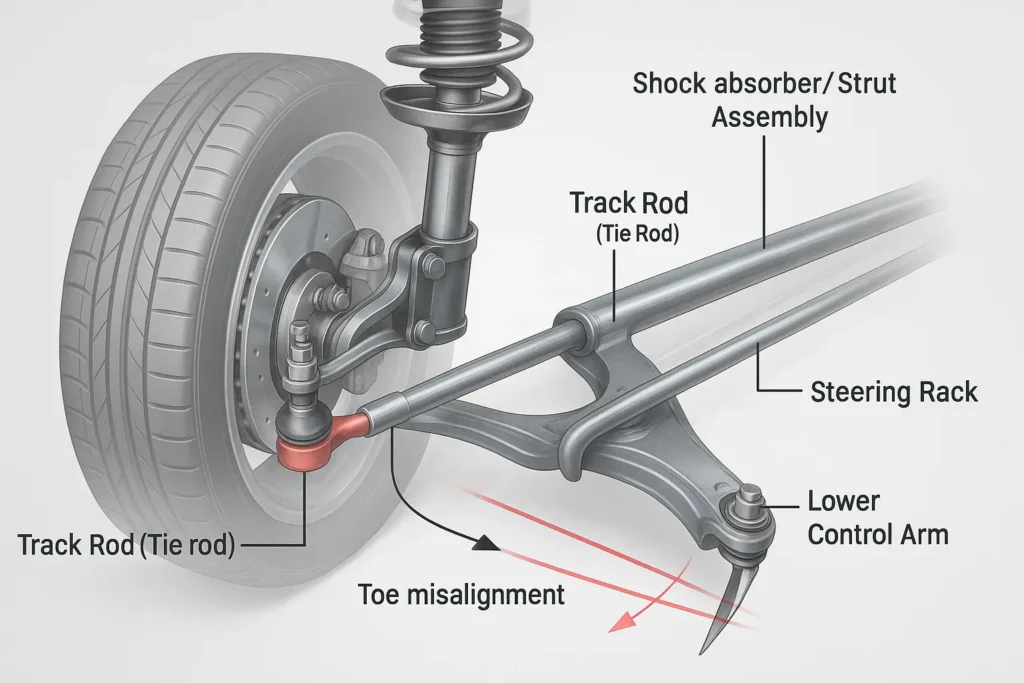
If you can feel obvious free play or hear a clunk when rocking the front tire, do not drive the vehicle — tow it. A tie rod end is the pivot that transmits steering input from the rack to the wheel. Once its ball stud develops play, you lose precise control of where the front tires point, and in severe cases the stud can separate from its socket, letting the wheel steer independently of the steering wheel. Confirm the wear before you buy parts or book a shop.
Confirm the Tie Rod End Is Actually the Problem
Symptoms follow a predictable pattern because the tie rod is the last link in the steering chain: steering play (the wheel moves before the tires respond), wandering or vague on-center feel at highway speed, clunking over bumps, and uneven or feathered front tire wear. Feathered wear — saw-tooth tread block edges across the tire — is the classic signature of a toe angle that changes as you drive, which is exactly what a loose tie rod produces.
Loaded vs Unloaded Inspection
A jack-stand check with the suspension hanging unloaded can produce a false negative. The most reliable check is with the suspension loaded — on ramps or with a helper — because the ball stud is under the same load it sees on the road. If you must check unloaded, use a pry bar under the tire to load the joint while a second person watches the tie rod end for movement. Inner tie rod play is often invisible without a helper or a pry bar.
Rock Test and Direction of Play
Grasp the tire at 3 and 9 o'clock and rock it side to side. Any lateral movement, clunk, or visible slop at the ball stud confirms wear. Then inspect the rubber boot: cracks, grease loss, or rust streaks mean the joint has lost lubrication and is on its way out.
The direction of movement tells you what is worn. Play at 3 and 9 o'clock points to the tie rod or steering linkage. Play at 12 and 6 o'clock points to the wheel bearing or ball joint. If the wheel moves in both directions, you likely have more than one worn component. This distinction prevents you from replacing the wrong part.
Inner vs Outer Tie Rod End: Which Is Worn and Should You Replace Both?
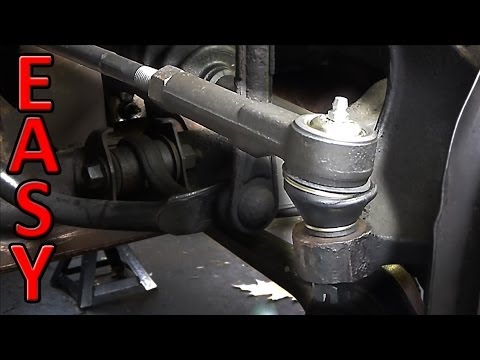
The outer tie rod end is the most common wear point. It connects the inner tie rod to the steering knuckle and takes the brunt of road shock and steering load. The inner tie rod end threads into the steering rack and wears less often, but it can develop play — especially if the boot is torn and contaminants enter the joint.
Step-by-Step Isolation Sequence
- With the front end raised and the suspension loaded (ramps or helper), rock the tire at 3 and 9 o'clock and watch the outer tie rod at the knuckle. Any play at the ball stud confirms outer wear.
- If the outer is tight but the wheel still moves, grab the inner tie rod near the rack and push it up and down. Any movement here means the inner joint is failing.
- If both inner and outer are tight but the wheel still moves, the rack itself is worn — this is beyond a tie rod end replacement.
Replace One or Both?
Replace both sides when wear is comparable. If one outer tie rod is worn, the other has seen the same mileage and road conditions and is usually close behind. Replacing both maintains even steering response and avoids a second alignment a few months later.
Replace inner and outer together if the inner has play or its boot is damaged. If only the outer is worn and the inner is tight with an intact boot, replacing just the outer is acceptable. This is a judgment call based on inspection, not mileage alone.
Outer Tie Rod End Replacement: Tools, Count-Turns Method, and Step-by-Step
You can replace an outer tie rod end in a driveway with basic hand tools, provided the components are not seized by rust. The critical step is preserving the toe setting so you can drive safely to an alignment shop.
Tool List
Jack and jack stands, lug wrench, penetrating oil, wire brush, tie rod end puller or pickle fork, combination wrenches, torque wrench, and a marker or paint pen.
Count-Turns Method
Before removal, count and record the number of turns required to unscrew the outer tie rod end from the inner tie rod. Mark the threads with a paint pen so you can see the original position. When you install the new outer tie rod, thread it on the same number of turns. This keeps the toe setting close enough to drive to an alignment shop without destroying your tires.
Step-by-Step
Raise and support the vehicle, then remove the wheel. Loosen the jam nut on the inner tie rod. Separate the outer tie rod from the steering knuckle using a puller or pickle fork. Unscrew the outer tie rod, counting the turns. Install the new outer tie rod the same number of turns. Tighten the jam nut, then reconnect to the knuckle.
Torque Specs: Where to Find Them
Torque specs vary by vehicle, thread size, and joint design. Do not guess and do not rely on a generic chart. The correct value is in the OEM service manual for your specific year, make, model, and engine. If you do not have the manual, your dealer parts counter or a factory service information subscription can provide it. A torque wrench is mandatory — an under-torqued jam nut or knuckle nut can back out and cause steering loss.
Tie Rod End Replacement Cost: What Drives the $100–$400 Range
Parts cost $100–$400 depending on vehicle, whether you choose OE-quality or aftermarket, and whether you replace inner, outer, or both. Labor is typically 1–2 hours per side, and an alignment adds $80–$150. All figures are estimates; actual prices vary by region, vehicle, and shop.
| Component | Estimate | Notes |
|---|---|---|
| Outer tie rod end (one side) | $30–$80 | Aftermarket vs OE-quality |
| Inner tie rod end (one side) | $40–$120 | More labor to access |
| Labor (per side) | 1–2 hours | Shop rate varies |
| Alignment | $80–$150 | Required after replacement |
| Total (one side, outer only) | $110–$230 | Parts + labor + alignment |
| Total (both sides, outer only) | $190–$380 | Parts + labor + alignment |
Cost drivers include vehicle make and model, rust and seized components, and whether an inner tie rod requires rack removal (rare). DIY saves labor but requires tools and skill; a shop provides warranty and alignment.
DIY or Shop? A Decision Framework
DIY Is Viable If:
- You have the tools listed above, including a torque wrench and tie rod end puller.
- You have a second vehicle to drive to the alignment shop.
- The outer tie rod is the only worn component and rust has not seized the jam nut or knuckle.
- You are confident working under a supported vehicle.
Book a Shop If:
- The inner tie rod or rack is involved.
- Rust has seized components.
- You do not have a torque wrench or the OEM torque spec.
- You cannot complete a professional alignment immediately after.
Safety is non-negotiable: improper installation can cause steering loss, and torque specs must be followed. Post-replacement alignment is required. DIY alignment (string method, tape measure) is not a substitute for a professional alignment. A shop provides warranty, alignment, and inspection of related components.
OE-Quality vs Aftermarket Tie Rod Ends: A Manufacturer's Inspection Guide
"OE-quality" is not a regulated term. Treat it as a claim to verify, not a guarantee. Concrete, checkable criteria:
- Supplier quality certification: Ask for IATF 16949 or equivalent documentation. Only accept certifications you can verify from supplier documents.
- Material spec: Forged steel is preferred over cast for the housing and stud. Ask for the material callout.
- Boot material: Neoprene or high-grade rubber resists cracking and grease loss better than cheap substitutes.
- Warranty: A meaningful warranty indicates the supplier stands behind the part.
Inspection during routine maintenance: check the boot for cracks, grease loss, and rust; check for play at the ball stud; replace if any are present. Inspect tie rod ends every oil change or at least annually. For wholesale/importers: verify supplier quality certifications and material specs; do not assume low price equals value.
What Happens If You Delay Tie Rod End Replacement?
A worn tie rod end can fail suddenly, causing loss of steering control, wheel separation, and a crash. Delayed replacement accelerates tire wear and can damage the inner tie rod or steering rack, increasing repair cost. The wallet impact is direct: a $110–$230 outer-only job can become a $400+ inner-and-outer job plus a new set of front tires if you wait. Prompt replacement with OE-quality parts and a professional alignment restores steering precision and extends tire life.
FAQ
Can I drive with a bad tie rod end?
It depends on the severity. If you feel slight play but no clunk and the steering still responds predictably, drive slowly and directly to a shop for inspection. If you feel obvious free play, hear a clunk when rocking the tire, or the steering wanders, do not drive — tow it. A severely worn tie rod end can separate suddenly and cause loss of steering control.
Do I need an alignment after replacing a tie rod end?
Yes. The count-turns method only preserves the toe setting closely enough to drive to an alignment shop; it is not a substitute for a professional alignment. Skipping alignment will cause uneven tire wear and may leave the steering off-center.
Should I replace both tie rod ends at the same time?
Inspect the other side. If wear is comparable, replace both. If the other side is tight with an intact boot, replacing just the worn side is acceptable. There is no universal mileage rule — the decision is based on inspection.
How much does tie rod end replacement cost?
Parts cost $100–$400 depending on vehicle, whether you choose OE-quality or aftermarket, and whether you replace inner, outer, or both. Labor is typically 1–2 hours per side, and an alignment adds $80–$150. All figures are estimates; actual prices vary.
Can I replace a tie rod end myself?
DIY is viable if you have the tools, a second vehicle, and confidence, and if the outer tie rod is the only worn component. It is not viable if the inner tie rod or rack is involved, or if rust has seized components. Safety is non-negotiable: improper installation can cause steering loss, and torque specs must be followed.