Tie Rod End Play: Axial Rotation vs. Radial Play — The Only Distinction That Matters
A tie rod end with perceptible radial play has failed and must be replaced. A tie rod end that rotates smoothly around its own axis is doing exactly what it was designed to do. The confusion between these two movements is the single largest source of misdiagnosis in steering complaints — and the reason some drivers replace healthy parts while others drive on failed joints.
A tie rod end is a preloaded ball-and-socket joint. It is engineered to pivot, not to translate. When the ball stud moves in and out perpendicular to its axis, the bearing surface inside the housing has worn, clearance has opened, and the joint can no longer transmit steering input with precision. That is the failure mode. Axial rotation — the stud twisting in its socket — is the articulation that lets the steering knuckle move through suspension travel and steering input without binding.
Axial Rotation vs. Radial Play: What You Are Actually Feeling
Axial rotation is the ball stud twisting in its socket around its own axis. This is designed-in movement. It allows the steering knuckle to articulate through suspension travel and steering input. A healthy tie rod end should rotate freely and smoothly by hand — if it does not, that is a separate problem.
Radial play is in-and-out movement of the stud perpendicular to its axis. This indicates wear between the stud and the bearing surface inside the housing. Any perceptible amount means the joint has failed. There is no acceptable radial play value to compare against.
The forum phrase "some play is normal" is technically true only for axial rotation. Applying it to radial play is the misinformation that leads people to drive on failed joints. When you grab the tie rod end and twist it, you are testing axial rotation. When you push and pull it along the stud axis, you are testing radial play. These are different tests with different pass/fail criteria.
Symptom-to-Play Mapping: Which Complaints Actually Point at the Tie Rod
Clunking over bumps, steering wander, vague on-center feel, and uneven or feathered tire wear are the recurring symptom cluster associated with tie rod play. Clunking plus wander plus feathered wear is a high-probability tie rod signature. Any single symptom alone is not — it overlaps with rack, bearing, and alignment issues.
On-center vagueness is the earliest steering-feel symptom because radial play lets the knuckle move before the rack input is transmitted. The driver turns the wheel, the rack moves, but the knuckle has already shifted within the joint's clearance. The result is a dead zone around center that feels vague and disconnected.
Modern vehicles may surface ADAS or steering-angle-sensor codes or lane-keep errors before the driver notices mechanical symptoms. The sensor sees steering angle that does not match vehicle yaw. The system interprets this as a fault and may disable lane-keep assist or trigger a steering-angle-sensor calibration code. If you are chasing an ADAS code and the steering feels slightly vague, inspect the tie rod ends before replacing sensors.
Hands-On Isolation: Tie Rod vs. Rack vs. Wheel Bearing
Wheel-on, engine-off, assistant rocking the steering wheel through the free-play zone while the inspector watches and feels the outer tie rod is the fastest first-pass test. This isolates the outer tie rod from the rack because you are observing the joint while the steering system is loaded in both directions.
Wheel-off with the suspension loaded and a pry bar between the tie rod and a solid reference lets the inspector feel radial play directly. A dial indicator mounted to the housing and zeroed on the stud gives a repeatable number. This is the reference method for quantifying play.
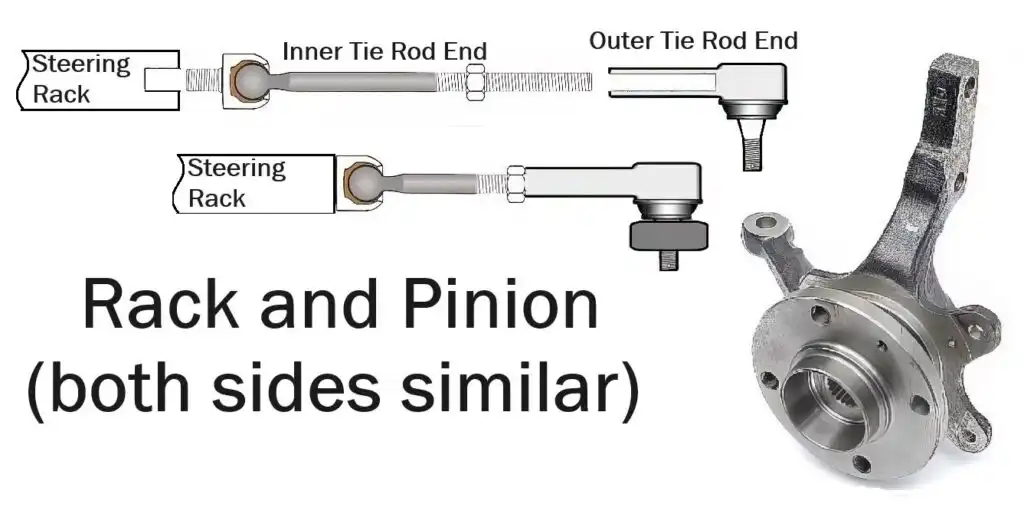
Rack play shows up as movement at the inner tie rod socket or at the rack housing itself, not at the outer ball stud. Wheel bearing play shows up as movement at the hub face and changes with brake application. If you grab the tire at 12 and 6 o'clock and rock it, wheel bearing play will show as movement at the hub. If you grab at 3 and 9 o'clock, tie rod play will show as movement at the outer tie rod.
Inner vs. outer localization: grab the outer tie rod body and the inner tie rod separately. Play at the outer ball stud is an outer tie rod end. Play at the inner socket is an inner tie rod end or rack. If the inner tie rod moves where it threads into the rack, the rack itself may be worn.
How Much Play Is Too Much: Quantifying the Replacement Trigger
A dial indicator zeroed on the ball stud with the housing held rigid is the reference method. Any radial deflection reading above zero that is repeatable indicates joint wear. There is no specification for acceptable radial play because the joint is designed to have none.
Feel-based threshold: if you can see or feel in-and-out movement of the stud with hand force, the joint has failed. You do not need a dial indicator to make the replacement decision — you need it only to document the failure or to detect marginal wear before it becomes obvious by hand.
Axial rotation should be free and smooth. A stud that is stiff, notchy, or gritty in rotation is also a replacement trigger even without radial play. A stiff joint will not articulate properly, which can cause steering bind or memory steer.
Driving on confirmed radial play accelerates tire wear, loads the remaining steering components, and degrades steering precision progressively. The risk is loss of steering control, not sudden wheel detachment. The joint will not fail catastrophically without warning — it will get progressively worse, and the driver will adapt to the degradation until an emergency maneuver exposes the loss of precision.
Tire Wear and Alignment: Why a Worn Tie Rod End Cannot Be Aligned Out
Radial play lets the toe angle change dynamically under load, producing feathered or cupped wear that a static alignment cannot correct because the alignment rack cannot see dynamic toe change. The alignment rack measures toe with the vehicle stationary. A worn tie rod end allows toe to change as the vehicle rolls and the suspension loads and unloads. The alignment is set to a moving target.
Feathering is the toe-related wear signature. Cupping is more often a damping or runout issue, so the wear pattern helps separate tie rod from other causes. Feathered wear — where the tread blocks are worn on one edge and raised on the other — indicates the tire is being dragged sideways as it rolls. That is a toe problem, and a worn tie rod end is a common cause.
Aligning a vehicle with a worn tie rod end sets toe to a moving target. The alignment will drift as soon as the vehicle is driven. Replacement must precede alignment. Aligning first wastes the alignment and does not address the wear source.
Replacement Decision: Inner, Outer, Both — and What to Buy
Replace the failed end. Replace both sides when the vehicle has comparable mileage on the opposite side, because both ends have seen the same service life and the same road inputs. If one side has failed at 80,000 miles, the other side is not far behind.
Inner and outer tie rod ends wear at different rates depending on load path and boot condition. Inspect both and replace whichever shows radial play or rotational stiffness. The outer end typically wears faster because it is exposed to road debris and sees more articulation. The inner end is protected by the boot but can wear if the boot is torn.
Pairing is recommended because a new end on one side and a worn end on the other produces asymmetric steering response and uneven tire wear. The new end will be tight; the worn end will have play. The steering will pull or feel different left to right.
A professional alignment is mandatory after replacement. Toe will change and must be reset to specification. Do not attempt to set toe by counting threads — the tie rod end must be installed to the correct length, and the alignment rack is the only way to verify toe angle.
Lifted and Modified Suspensions: Why Tie Rod Angles Change the Wear Equation
Lifting or lowering the vehicle changes tie rod angle relative to the rack and knuckle, which changes the load path through the ball stud and can accelerate wear. The joint is designed to operate within a specific angular range. When you change ride height, you move the joint outside that range.
Bump steer and altered steering geometry from a lift can mimic tie rod play symptoms even when the joint is sound. Bump steer is a geometry problem — the tie rod angle causes toe change as the suspension compresses. It feels like play but is not. Inspection must separate geometry-induced feel from actual radial play.
Modified vehicles should be inspected more frequently because the joint is operating outside its original design envelope. A lifted vehicle may wear tie rod ends in half the mileage of a stock vehicle.
Correcting geometry with appropriate components is a separate decision from replacing a worn joint. A worn joint must be replaced regardless of geometry. If you have a lifted vehicle and the tie rod ends are worn, replace them first, then address geometry if bump steer is still present.
Frequently Asked Questions
Can I drive with a bad tie rod end?
You can drive, but you should not. Radial play degrades steering precision progressively and accelerates tire wear. The risk is loss of steering control in an emergency maneuver, not sudden wheel detachment.
How long do tie rod ends last?
Service life varies with road conditions, driving style, and suspension geometry. There is no universal mileage interval. Inspect at every oil change or whenever steering feel changes.
Do I need an alignment after replacing tie rod ends?
Yes. Toe will change when you replace a tie rod end, and it must be reset to specification. Aligning before replacement is a waste of money.
Can a bad tie rod end cause a clunk?
Yes. Radial play allows the stud to move within the housing, producing a clunk over bumps or when steering load changes direction.
Will a bad tie rod end cause a vibration?
Not typically. Vibration is more often a wheel balance, tire, or bearing issue. Tie rod play causes wander, vague on-center feel, and uneven tire wear.
---
Related