Suspension Shock Absorber Technology: A Manufacturer's Guide to Working Principles, Types, and Quality
Shock absorbers are the most misunderstood component in a vehicle's suspension. They do not absorb impacts from the road—the springs do that. Instead, shock absorbers control the unwanted motion of the springs, converting kinetic energy into heat. This guide goes beyond the generic explanations to give you the engineering insight you need to diagnose problems, choose the right replacement, and understand why quality matters.
How Shock Absorbers Work: The Hydraulic Principle and Its Implications
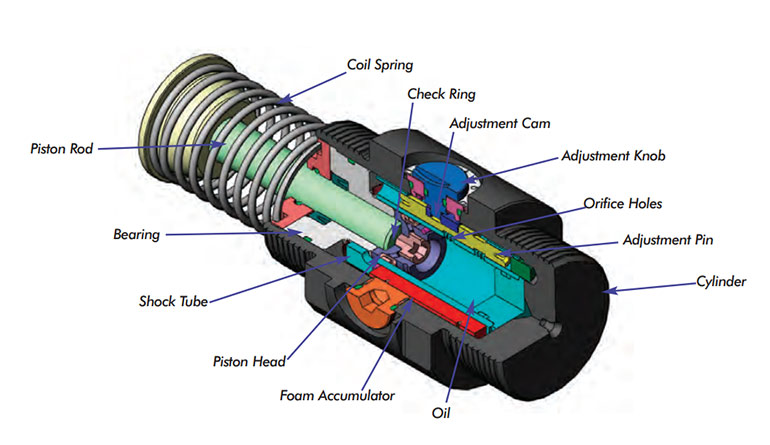
Shock absorbers convert kinetic energy from suspension movement into heat through hydraulic fluid displacement. Inside every hydraulic shock absorber is a piston that moves through oil-filled chambers. As the suspension compresses and extends, the piston forces fluid through small orifices and valves, creating resistance that dampens the spring's oscillations.
The damping force is controlled by the size of these orifices and the viscosity of the fluid. Smaller passages or thicker fluid create more resistance, resulting in a stiffer ride. Conversely, larger passages or thinner fluid allow easier movement, giving a softer feel. This tuning is critical: too much damping makes the ride harsh, while too little leads to excessive bouncing and poor handling.
This principle applies to all hydraulic shock absorbers, regardless of type. Whether you have a twin-tube, monotube, or even an electronically controlled adaptive shock, the physics remain the same. Understanding this is essential for diagnosing damping issues—if a shock feels weak or fails to control motion, the problem often lies in worn seals, low fluid, or valving that no longer matches the vehicle's spring rate.
Twin-Tube vs. Monotube: Design Trade-offs and Application Suitability
Twin-tube shocks have an inner and outer tube, with a base valve and piston; they are cost-effective and provide good ride comfort. The inner tube contains the piston and oil, while the outer tube acts as a reservoir for extra oil and gas. This design allows for a longer stroke in a compact package, making it ideal for most passenger vehicles.
Monotube shocks have a single tube with a floating piston separating gas and oil; they offer better heat dissipation and performance, but are more expensive. Because the gas is in direct contact with the oil chamber (separated by a floating piston), monotube designs can be mounted upside down, reducing unsprung weight. They also have a larger oil volume, which helps prevent fade during aggressive driving.
Design affects performance, durability, and mounting flexibility. Twin-tube shocks are generally more compliant on rough roads, but they are prone to aeration if the oil foams under extreme use. Monotube shocks maintain consistent damping over long periods of hard driving, making them the choice for performance and off-road applications.
Vehicle application should dictate the choice. For a daily driver that sees normal road conditions, a quality twin-tube shock provides a comfortable ride at a lower cost. For a vehicle used for towing, off-roading, or spirited driving, monotube shocks offer better control and heat resistance. When selecting, consider the trade-offs: cost, ride comfort, and intended use.
Shocks vs. Struts: Structural Differences and Replacement Considerations
A shock absorber is a standalone damping component; a strut is a structural component that also provides damping and supports the vehicle's weight. Struts are a major part of the suspension system—they replace the upper control arm and ball joint, and they locate the wheel. This means struts must bear the vehicle's weight and manage lateral forces, while shocks only control vertical motion.
Struts are part of the suspension system and require proper alignment after replacement. Because struts affect the vehicle's geometry, any replacement must be followed by a wheel alignment to ensure even tire wear and stable handling. Shocks, on the other hand, do not affect alignment, so no alignment is necessary after replacement.
Replacement procedures differ significantly between shocks and struts. Replacing a shock is typically a straightforward bolt-on job. Replacing a strut involves compressing the coil spring, removing the strut assembly, and often replacing the mount and bearing. This is more labor-intensive and requires specialized tools. Identifying which your vehicle has is critical for correct parts ordering—ordering a shock when you need a strut, or vice versa, is a common mistake.
Signs of Shock Absorber Failure: What to Look For and Why
Common symptoms include excessive bouncing, uneven tire wear, nose diving under braking, and fluid leaks. If your vehicle continues to bounce more than two or three times after hitting a bump, the shocks are likely worn. Uneven tire wear, especially cupping or scalloping, indicates that the tires are losing contact with the road due to insufficient damping. Nose diving under braking or rear squat during acceleration suggests that the shocks are no longer controlling weight transfer.
A simple bounce test can indicate worn shocks. Press down firmly on the bumper of your vehicle and release. If the vehicle continues to bounce more than two or three times, the shocks are likely worn. However, this test is not foolproof—it only checks the shocks' ability to control low-frequency motion. For a more accurate diagnosis, inspect the shocks visually.
Ignoring these signs can lead to increased stopping distances and premature wear of other suspension components. Worn shocks allow the tires to lose contact with the road, reducing traction and increasing braking distances. They also cause excessive motion that stresses springs, bushings, and mounts, leading to premature failure of these parts.
Visual inspection for leaks and damage is essential. Look for oil residue on the shock body, which indicates a seal leak. Check for dents, corrosion, or damage to the shock rod. Also, inspect the mounting bushings and brackets for wear or cracks. If you find any of these issues, it's time to replace the shocks.
Advanced Shock Absorber Technologies: Adaptive and Magnetorheological Systems
Adaptive shocks use electronically controlled valves to adjust damping in real-time based on driving conditions. These systems use sensors to monitor vehicle speed, steering angle, and body motion. A control module then adjusts the shock's valving to provide the optimal damping for the situation—firm for cornering and braking, soft for cruising. This improves both ride comfort and handling.
Magnetorheological (MR) shocks use fluid containing magnetic particles that change viscosity in response to a magnetic field, allowing rapid damping adjustments. By varying the magnetic field strength, the shock can change its damping characteristics almost instantly. This technology offers even faster response than adaptive systems, making it ideal for high-performance vehicles.
These systems require sensors and control modules, adding complexity and cost. They are more expensive to manufacture and repair. However, they offer significant benefits in terms of ride quality and handling. Understanding these technologies is important for diagnosing issues in modern vehicles and for considering upgrades. If you have a vehicle with adaptive or MR shocks, it's essential to use the correct replacement parts and follow proper diagnostic procedures.
Manufacturing Processes and Materials: What Determines Shock Absorber Quality
Quality is determined by materials, manufacturing precision, and quality control. High-quality shocks use chrome-plated piston rods that resist corrosion and wear. The seals are made from durable compounds that maintain their integrity over a wide temperature range. The internal valves are precisely machined to ensure consistent damping.
Cheap shocks often use inferior materials and lack rigorous testing, leading to premature failure. For example, a low-quality piston rod may have a thin chrome layer that wears off quickly, causing seal damage and fluid leaks. The seals themselves may be made from low-grade rubber that hardens and cracks. Additionally, cheap shocks may not be properly gas-charged, leading to aeration and inconsistent damping.
Look for signs of quality such as smooth piston rod finish, robust welds, and proper gas charging. A high-quality shock will have a flawless chrome finish on the rod, with no pitting or scratches. The welds on the mounting brackets should be clean and uniform. When you compress a gas-charged shock, it should extend smoothly and firmly.
Understanding these factors helps buyers avoid counterfeit or substandard parts. Counterfeit shocks are a growing problem, and they often look like the real thing but fail quickly. To ensure you're getting a quality product, buy from reputable manufacturers and suppliers. Check for certifications and quality standards. At our manufacturing facility, we adhere to strict quality control processes to ensure every shock meets our standards. For more on how we ensure quality, visit our quality control page.
Troubleshooting: Why New Shocks May Still Bounce and How to Fix It
If new shocks don't solve bouncing, other suspension components may be worn. Springs, bushings, and mounts all work together with the shocks to control motion. If a spring is sagging or broken, it can't support the vehicle's weight properly, causing bouncing even with new shocks. Similarly, worn bushings allow excessive play in the suspension, leading to instability.
Incorrect installation can cause issues. Loose mounting bolts or improper torque can allow the shock to move, creating noise and affecting performance. Always follow the manufacturer's torque specifications and use new mounting hardware if necessary. Also, ensure that the shock is properly oriented—some shocks are position-sensitive and must be installed in the correct direction.
Shock absorber valving may be mismatched to the vehicle's weight and spring rate. If you install shocks with valving that is too soft or too firm for your vehicle, the ride will be compromised. This is especially common when using generic shocks that are not specifically tuned for your vehicle. Always check the shock's specifications to ensure they match your vehicle's requirements.
A systematic inspection process is necessary to identify the root cause. Start by checking the springs for sagging or damage. Then inspect the bushings and mounts for wear. Finally, verify that the shocks are installed correctly and are the correct type for your vehicle. If everything checks out, the issue may be with the shock itself—contact the manufacturer for warranty support.
Selecting Quality Shocks: A Decision Framework for Buyers
Consider vehicle type, driving conditions, and performance expectations. A heavy-duty truck used for towing will require different shocks than a compact car used for commuting. Off-road enthusiasts need shocks with more travel and durability, while sports car owners prioritize handling and responsiveness. Define your priorities before you start shopping.
Match the shock type and valving to the vehicle's spring rate and weight. The shock's damping force must be compatible with the springs to achieve the desired ride and handling. If you're unsure, consult the vehicle's owner's manual or a suspension specialist. Using the wrong valving can lead to a harsh ride or poor control.
Evaluate quality indicators such as materials, manufacturing, and warranty. Look for shocks with chrome-plated rods, high-grade seals, and robust construction. Check the warranty—a longer warranty often indicates higher confidence in the product. Also, consider the manufacturer's reputation and whether they provide technical support.
Balance cost against expected lifespan and performance benefits. Cheap shocks may save money upfront, but they often fail sooner and provide inferior performance. Investing in quality shocks can improve ride comfort, handling, and safety, and they may last longer, saving you money in the long run. For a wide range of quality suspension components, including bushings and control arms, browse our product catalog.
By understanding the technology behind shock absorbers, you can make informed decisions that enhance your vehicle's performance and safety. Whether you're a mechanic, a parts buyer, or a DIY enthusiast, this knowledge is essential for proper maintenance and repair.