Which Bushing Is Failing? Map the Symptom to the Location Before You Buy Anything
A clunk over bumps is not a diagnosis. The same noise can come from a front lower control arm bushing, a sway bar end link or bracket bushing, or a strut mount, and each one takes a different part, a different tool, and a different labor path. Isolate the location first, then order.
Clunking over bumps and during braking most often traces to control arm bushings, because the arm carries braking and cornering load and a collapsed bushing lets the arm shift under those forces. Squeaking and rattling over small bumps is more typical of sway bar bushings, which rotate constantly and dry out or wear at the bar-to-bracket interface. A dull knock or steering vagueness points toward strut mounts, where the bearing plate and rubber isolate the spring and damper from the body.
Uneven or accelerated tire wear, especially inner-edge cupping, is a downstream symptom of control arm bushing deflection changing alignment geometry. It is not a tire problem by itself, and a new set of tires will wear the same way until the bushing is addressed.
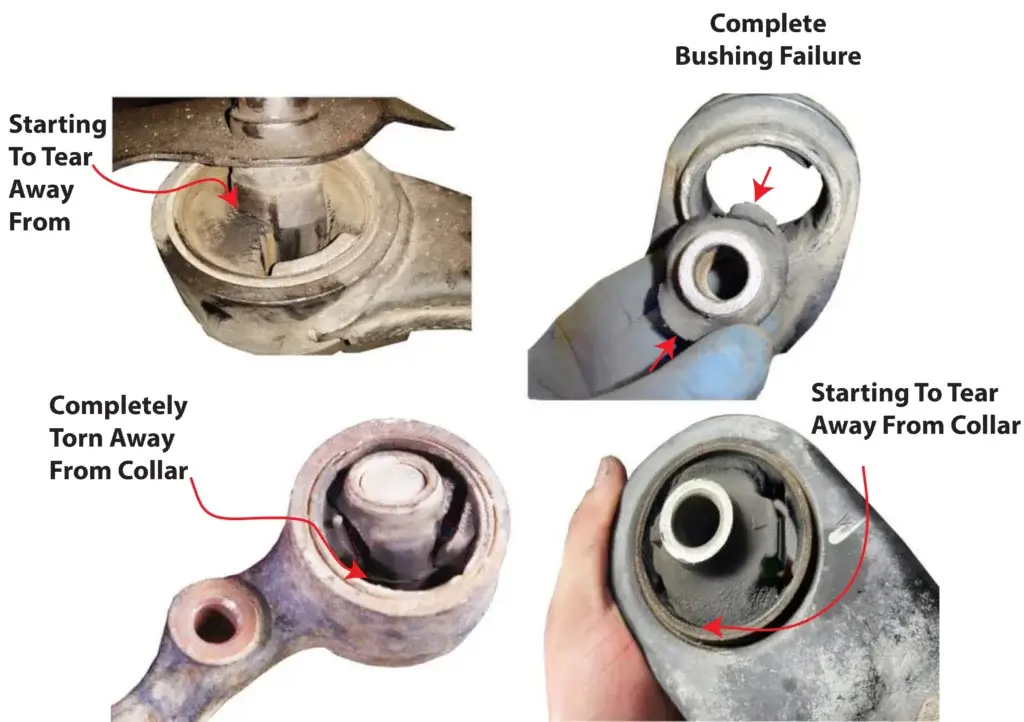
A simple test sequence separates the three locations without a lift. Bounce test: push down hard on each corner and listen for a knock near the strut top. Pry bar check: with the wheel off and the suspension loaded, pry gently against the control arm at the bushing bore and watch for movement that exceeds the rubber's designed flex. Visual inspection: look for cracked, torn, or separated rubber at the control arm, missing or flattened sway bar bracket bushings, and a strut mount that shows rust streaks or a separated rubber-to-plate bond.
Bushing-Only vs Complete Control Arm Assembly: The Decision That Costs More Than the Part
Replace the bushing only when the arm is straight, the ball joint is tight with an intact boot, and corrosion at the bushing bore is minimal. Replace the complete assembly when the ball joint is worn, the arm is bent, or the bore is rusted enough that pressing a new bushing risks cracking the arm.
Vehicle age and climate drive the call more than mileage. Older vehicles in salt-belt regions usually have corroded bores and seized ball joints, making the full assembly the lower-risk path even though the part costs more. A bushing-only job on a corroded arm can consume a weekend and still end at the shop with a cracked arm.
The real cost difference between replacing a lower control arm yourself and paying a dealership is dominated by labor and alignment, not the bushing itself. That means the wrong path costs more in labor than the part ever would. If you press bushings into an arm that should have been replaced, you pay twice.
A three-question checklist decides it in under a minute: Is the ball joint tight? Is the arm straight? Is the bore corroded? Two or more "no" answers point to the complete assembly. Our [Control Arm](/products/control-arm-002) listings for Hyundai and KIA applications cover the full-assembly path, while [Rear Trailing Arm Bushing](/products/bushing-001) and [Large suspension bushing](/products/bushing-001-2) cover the press-in path where the arm is sound.
Rubber vs Polyurethane: Match the Material to How the Vehicle Is Actually Driven
Rubber is the correct default for daily drivers. It absorbs road noise and vibration and delivers the ride the chassis was designed around. Polyurethane trades NVH for durability and reduced deflection, and it is appropriate only when the driver accepts added noise, vibration, and harshness, typically performance, track, or heavy-load use. It should not be sold as a free upgrade for a commuter car.
Material choice interacts with the bushing-only vs assembly decision. If you are pressing bushings into a factory arm, rubber keeps the factory NVH baseline; polyurethane changes it. If you are replacing the whole arm, the arm's bushing material is already set by the supplier, so the material decision is made for you.
OEM vs aftermarket bushing questions are common, and the honest answer is that material and durometer matter more than the brand label for ride quality. A rubber bushing from a reputable aftermarket supplier will ride like rubber; a poly bushing will transmit more road texture regardless of whose name is on the box. For Hyundai and KIA applications, our [Small suspension bushing](/products/bushing-001-3) and [Rear Trailing Arm Bushing](/products/bushing-002) lines are built to the OE fitment so the material and dimensions match the chassis.
DIY vs Shop: Decide Based on Tools, Corrosion, and Whether You Can Get an Alignment
"Can I replace bushings myself?" is a top question, and the honest answer depends on whether you have a press or bushing press tooling, not on willingness. A bushing press or suitable press tooling is non-negotiable for control arm bushings. Sway bar bushings are often a hand-tool job. Strut mounts require spring compression and are the least DIY-friendly of the three.
Heavy corrosion turns a bushing-only job into an assembly-replacement job, which changes the DIY calculus. A seized bore can consume a weekend and still require a shop, so inspect the bore before you commit. If the arm is coming off anyway and the bore is questionable, the assembly path is the realistic one.
The DIY vs dealership cost difference is real, but it only holds if you can complete the job and then get an alignment. If you cannot get the vehicle to an alignment rack after the repair, the savings evaporate in tire wear. Budget the alignment as part of the job, not as an optional add-on.
Installation Essentials: Press Tooling, Ride-Height Tightening, and Torque Discipline
Rubber bushings must be tightened at ride height, not with the suspension hanging, because the bushing is bonded and will tear or preload if torqued at droop. This is the single most common installation failure, and it is invisible until the bushing fails early.
Bushing press tooling must support the arm bore so the bushing goes in square. Pressing at an angle tears the bushing or cracks the arm. Use the correct receiver cup on the back side and drive the bushing straight, not with a hammer.
Torque specifications must come from the vehicle's service data. Do not guess, and do not use a generic chart. The final tighten happens with the suspension loaded, which usually means the vehicle is on ramps or the suspension is supported at ride height.
A post-replacement alignment is required because bushing replacement changes control arm geometry. Skipping it causes uneven tire wear and handling drift. The alignment is not a sales add-on; it is the step that makes the new bushing last.
What Delaying the Repair Actually Costs: Tire Wear, Alignment Drift, and Compounding Damage
Worn control arm bushings let the arm move under load, which changes alignment dynamically and accelerates inner-edge tire wear. A set of tires can cost more than the bushing job, so waiting is rarely the cheaper path.
Alignment drift from worn bushings cannot be corrected by an alignment alone. The alignment will not hold until the bushing is replaced, so paying for an alignment on worn bushings is money spent twice.
A worn bushing increases movement that accelerates wear on adjacent components, so deferring can convert a bushing-only job into an assembly job. "Can I drive with worn bushings?" is a common question, and the honest answer is that it is drivable but the cost of waiting shows up in tires and handling. The vehicle will not fail suddenly, but it will consume tires and steering precision while you wait.
Parts and Labor: How to Read a Bushing Replacement Quote Without Getting Upsold
"How much does it cost to replace suspension bushings?" is a top question, and the answer must separate parts, labor, and alignment rather than give one number. The quote structure differs by path: bushing-only is low parts cost but high labor; complete assembly is higher parts cost but lower labor; alignment is a separate line item either way.
Dealership vs independent shop vs DIY differ mainly in labor rate and whether alignment is bundled. Compare the total, not the hourly rate. A shop with a higher hourly rate that bundles alignment can be cheaper than a low-rate shop that sends you elsewhere for the alignment.
Ask three questions of any shop: Are you pressing bushings or replacing the arm? Is the alignment included? Are you tightening at ride height? The answers tell you whether the quote is for the job you actually need. If the shop cannot answer the ride-height question, the bushing will likely fail early.
For parts sourcing, our [automotive suspension components](/products) catalog covers bushing and control arm lines for Hyundai and KIA applications, and our [quality control](/quality) process is part of how we hold fitment. If you are evaluating wholesale or import sourcing, [about our company](/about) explains how we work with buyers.
FAQ
How long do suspension bushings last?
Bushing life depends on material, climate, and driving load. Rubber bushings degrade with ozone, heat, and salt exposure, and polyurethane resists those but transmits more NVH. There is no universal mileage figure; inspect at every tire rotation once the vehicle is past its mid-life.
Can I drive with worn bushings?
Yes, but the cost of waiting shows up in tires and handling. Worn control arm bushings change alignment dynamically and accelerate inner-edge tire wear, and the alignment will not hold until the bushing is replaced.
Do I need an alignment after replacing bushings?
Yes. Bushing replacement changes control arm geometry, and skipping the alignment causes uneven tire wear and handling drift. The alignment is part of the job, not an optional add-on.
Post-Replacement Care and Maintenance
After replacement, re-check torque at the ride-height fasteners after the first few hundred miles, and inspect the new bushings for cracking or separation at the next oil change. If you chose polyurethane, expect the NVH change to be immediate and permanent; if that is not acceptable, rubber was the right call. Keep the alignment printout with your service records so the next alignment has a baseline.