What Is a 1/4 Car Suspension Model and Why Should You Care?

The quarter car model is a simplified representation of one corner of a vehicle's suspension, capturing the essential vertical dynamics that determine ride comfort and handling. It reduces a complex system to two masses—sprung and unsprung—connected by a spring and damper, with a tire spring at the bottom. This model is the foundational tool that suspension engineers use daily to analyze, simulate, and design the components you buy and install.
If you are a parts buyer, mechanic, or DIY enthusiast, understanding the quarter car model helps you make informed decisions about springs, dampers, and bushings. Instead of relying on guesswork or marketing hype, you can use the same engineering principles that OEMs use to select parts that match your vehicle's needs and your driving preferences.
The model's purpose is to analyze vertical dynamics—how the vehicle body and wheel respond to road inputs. It answers questions like: How much does the body bounce over a bump? How quickly does the wheel follow the road? What spring rate and damping coefficient will provide the best compromise between comfort and control? By isolating one corner, engineers can study these interactions without the complexity of the full vehicle, making it a practical tool for initial design and troubleshooting.
For real-world decisions, the quarter car model bridges the gap between abstract concepts and tangible parts. When you choose a coilover kit, select a replacement damper, or even decide on a bushing stiffness, you are implicitly making choices about the sprung and unsprung masses, spring rates, and damping characteristics. The model gives you a framework to evaluate those choices before you spend money.
Breaking Down the Quarter Car Model: Components and Degrees of Freedom
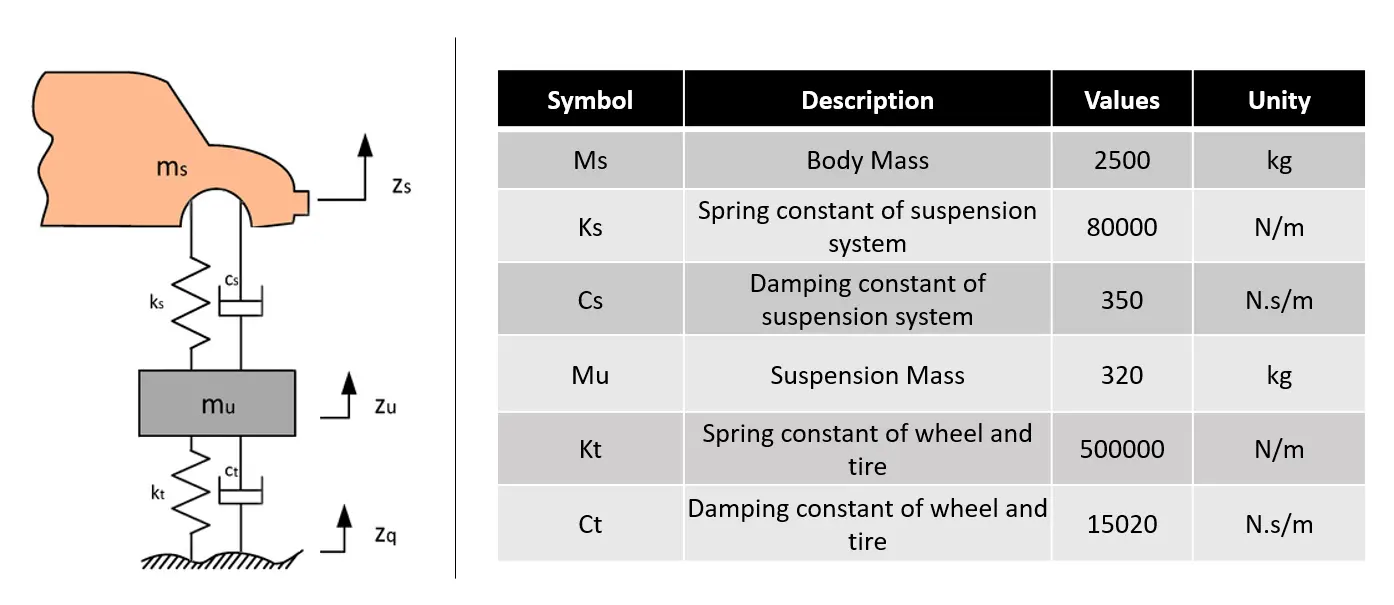
The quarter car model consists of two masses: the sprung mass (the vehicle body portion supported by the suspension) and the unsprung mass (the wheel, tire, and associated components such as the brake caliper and upright). These masses are connected by a spring and a damper, which represent the suspension spring and shock absorber. The tire is modeled as a spring (and sometimes a damper) connecting the unsprung mass to the road.
The model has two degrees of freedom: the vertical displacement of the sprung mass (zs) and the vertical displacement of the unsprung mass (zu). The road input (zr) is the displacement of the road surface, which acts as an excitation to the system.
A schematic diagram typically shows the sprung mass (often labeled as m_s) sitting on top of the spring and damper, which are connected to the unsprung mass (m_u). The unsprung mass then connects to the road via the tire spring (k_t). This simple arrangement captures the essential dynamics of a single corner of the vehicle.
To relate this to actual parts: the sprung mass is the portion of the vehicle body that the suspension supports—roughly one quarter of the total body mass for a typical passenger car. The unsprung mass includes the wheel, tire, brake rotor, and part of the suspension links. The spring and damper are the physical components you replace or upgrade. The tire stiffness is a property of the tire itself, which affects how the wheel follows the road.
Deriving the Equations of Motion: A Step-by-Step Guide
Applying Newton's second law to each mass yields the equations of motion that govern the quarter car model. For the sprung mass (m_s), the forces are the spring force and the damper force from the suspension. For the unsprung mass (m_u), the forces include the suspension spring and damper, plus the tire spring force.
Define the variables: zs is the vertical displacement of the sprung mass, zu is the vertical displacement of the unsprung mass, and zr is the road input. The suspension spring has stiffness k_s, the damper has coefficient c_s, and the tire has stiffness k_t.
The equations of motion are:
m_s zs'' = -k_s (zs - zu) - c_s * (zs' - zu')
m_u zu'' = k_s (zs - zu) + c_s (zs' - zu') - k_t (zu - zr)
These are two coupled second-order differential equations. They assume small displacements and linear components—meaning the spring rate and damping coefficient are constant, and the system behaves linearly around its equilibrium point.
To derive these, draw a free body diagram for each mass. For the sprung mass, the only forces are from the spring and damper, which act upward when the suspension is compressed. For the unsprung mass, the suspension forces act downward, while the tire force acts upward. Summing forces and applying Newton's law gives the equations above.
This derivation is the basis for all quarter car analysis. Once you have these equations, you can simulate the system's response to various road inputs, analyze its frequency response, and design controllers or select parameters.
Key Parameters: What They Mean and How to Choose Them
The quarter car model's behavior is governed by four key parameters: sprung mass (m_s), unsprung mass (m_u), spring rate (k_s), and damping coefficient (c_s). Tire stiffness (k_t) also plays a role but is often fixed by tire choice.
Sprung mass is the portion of the vehicle body supported by the suspension at that corner. Typical values for a passenger car range from 250 to 400 kg per corner, while SUVs and trucks can be higher. Sports cars may have lower sprung mass due to lightweight construction.
Unsprung mass is the mass of the wheel, tire, brake components, and part of the suspension links. It typically ranges from 30 to 50 kg for a passenger car, but can be lower with lightweight wheels and aluminum components. Reducing unsprung mass improves ride and handling because the wheel can follow road irregularities more easily.
Spring rate (k_s) is the stiffness of the suspension spring, typically expressed in N/mm or lbs/in. For a passenger car, it might be 20-40 N/mm; for a sports car, 40-80 N/mm. Higher spring rates reduce body roll and improve handling but can degrade ride comfort.
Damping coefficient (c_s) is the force per unit velocity of the damper, typically expressed in N·s/m. It is not a single number in practice because dampers are velocity-dependent, but for linear models, a constant coefficient is used. The damping ratio (ζ) is often used instead, which is the ratio of actual damping to critical damping. For ride comfort, a damping ratio around 0.2-0.4 is common; for handling, higher damping may be needed.
Trade-offs are inherent: softer springs and lower damping provide better ride comfort but more body motion and less responsive handling. Stiffer springs and higher damping improve handling but transmit more road harshness. The quarter car model allows you to quantify these trade-offs and find a balance that suits your driving needs.
Guidelines for parameter selection: Start with the sprung mass and desired ride frequency. The ride frequency (natural frequency of the sprung mass) is typically 1-1.5 Hz for passenger cars, 1.5-2 Hz for sports cars. The spring rate can be calculated as k_s = m_s * (2πf)^2. Then choose damping to achieve a desired damping ratio, often 0.2-0.4 for comfort-oriented setups.
Practical Applications: How the Quarter Car Model Drives Real Suspension Design
The quarter car model is not just an academic exercise; it is used extensively in industry to simulate ride comfort, optimize components, and evaluate performance. For example, engineers use road profiles defined by ISO 8608 to simulate driving over various surfaces. By inputting these profiles into the quarter car model, they can predict the vertical acceleration of the sprung mass, which correlates with ride comfort.
One common application is optimizing spring and damper characteristics for a target ride frequency. Suppose you want a ride frequency of 1.2 Hz for a passenger car with a sprung mass of 350 kg. The required spring rate is k_s = 350 (2π1.2)^2 ≈ 19,900 N/m or about 20 N/mm. Then you select a damper to achieve a damping ratio of 0.3, which gives a damping coefficient of c_s = 2ζsqrt(k_sm_s) ≈ 20.3sqrt(19900350) ≈ 2,500 N·s/m.
The model also evaluates the effect of unsprung mass on wheel hop and road holding. Wheel hop is the resonant frequency of the unsprung mass, typically 10-15 Hz. A higher unsprung mass lowers this frequency, which can reduce tire contact with the road, especially at high speeds. By reducing unsprung mass—for example, using lighter wheels—you can improve road holding.
Case study: selecting coilovers for a sports car. Suppose you have a sports car with a sprung mass of 300 kg per corner and an unsprung mass of 40 kg. You want to improve handling without sacrificing too much comfort. Using the quarter car model, you can simulate different spring rates and damping settings to see their effect on body acceleration and wheel travel. You might find that a spring rate of 60 N/mm with a damping ratio of 0.5 provides the best compromise for your driving style.
In practice, engineers use simulation tools like MATLAB/Simulink to implement the quarter car model and run these analyses. They can also use the model to design active suspension controllers or evaluate the effect of component wear.
Quarter Car vs. Half Car vs. Full Car Models: When to Use Which?
The quarter car model is the simplest, capturing only vertical motion at one corner. It is sufficient for analyzing vertical dynamics, ride comfort, and component selection. However, it ignores pitch and roll motions, which are important for handling and stability.
The half car model includes two corners (e.g., front and rear on one side) and captures pitch motion in addition to bounce. It has four degrees of freedom: vertical displacement of the sprung mass, pitch angle, and vertical displacements of the two unsprung masses. This model is useful for studying pitch dynamics, such as braking dive and acceleration squat.
The full car model includes all four corners and captures roll, pitch, and bounce motions. It has seven degrees of freedom (three for the body: vertical, pitch, roll, and four for the wheels). This model is necessary for analyzing roll dynamics, such as cornering roll and load transfer.
Comparison: The quarter car model is computationally efficient and easy to analyze, but it cannot predict pitch or roll. The half car model adds pitch but is more complex. The full car model is the most accurate but requires more data and computation.
When to use which? For initial design and component selection, the quarter car model is often sufficient. For example, if you are choosing springs and dampers for ride comfort, the quarter car model can give you a good starting point. If you need to analyze pitch behavior, such as brake dive, use a half car model. For full vehicle dynamics, such as roll stability, use a full car model.
In industry, engineers often start with quarter car models for quick iterations and then move to half or full car models for final validation.
Limitations and Assumptions: What the Model Doesn't Tell You
The quarter car model relies on several key assumptions that limit its accuracy. It assumes linearity—that spring rates and damping coefficients are constant. In reality, springs can be progressive (rate increases with compression), and dampers have velocity-dependent characteristics that are far from linear.
It also assumes small displacements, which may not hold during large bumps or aggressive driving. The model ignores pitch and roll coupling, which means it cannot predict body roll or pitch motions. It also neglects friction in the suspension, bushing compliance, and geometric effects such as camber changes.
Nonlinearities can significantly affect real-world performance. For example, progressive springs are used to provide a comfortable ride over small bumps while resisting bottoming out over large ones. Dampers have digressive or progressive curves to handle different frequencies. These nonlinearities cannot be captured by the linear quarter car model.
The model also assumes constant parameters, but in reality, sprung mass changes with load, and tire stiffness varies with inflation pressure and temperature. Bushing compliance can affect the effective spring rate and damping.
Therefore, while the quarter car model is a valuable tool for initial analysis, real-world validation is essential. Engineers use physical testing and more complex models to verify their designs.
From Model to Marketplace: Using Quarter Car Insights to Choose Real Parts
The quarter car model directly informs spring rate and damping choices, which are the primary specifications for aftermarket springs and dampers. When you understand your vehicle's sprung mass and desired ride frequency, you can calculate the spring rate you need. For example, if you want a sportier feel, you might increase the spring rate by 20-30% over stock.
Reading a damper dyno graph is a practical skill. A dyno graph plots damping force vs. velocity for both compression and rebound. The slope of the curve at low velocities indicates the damping coefficient. Using model-derived requirements, you can check if a damper provides the right amount of damping at the frequencies you care about. For instance, if your model suggests a damping ratio of 0.3, you can estimate the required damping coefficient and compare it to the dyno graph.
When communicating with suppliers or manufacturers, you can use model parameters to specify your needs. For example, you might request a spring with a rate of 45 N/mm and a damper with a specific force at 0.1 m/s. This ensures you get parts that match your engineering requirements.
Simulation tools can validate your choices. Many aftermarket companies provide spring and damper specifications that you can input into a quarter car simulation to see how they affect ride and handling. This can help you avoid costly mistakes.
For bushings, the model's insights on unsprung mass and compliance are relevant. Stiffer bushings can reduce unwanted compliance, improving handling precision, but they can also increase harshness. The quarter car model can help you understand the trade-offs.
At our company, we manufacture a range of suspension components, including automotive suspension components such as control arms and bushings. Our Large suspension bushing and other products are designed to meet OEM specifications, ensuring that the parameters you select in your model are achievable in practice. We invite you to explore our manufacturing facility and quality control processes to see how we ensure consistency and reliability.
In summary, the quarter car model is not just an academic concept—it is a practical tool that can guide your purchasing decisions. By understanding the key parameters and their trade-offs, you can select parts that deliver the performance you want.
Frequently Asked Questions
What is the difference between sprung and unsprung mass?
Sprung mass is the portion of the vehicle's weight supported by the suspension springs, including the body, frame, engine, and occupants. Unsprung mass is the mass of components not supported by the springs, such as wheels, tires, brakes, and suspension arms. Reducing unsprung mass improves ride and handling.
How do I choose the right spring rate for my vehicle?
Start with your vehicle's sprung mass per corner and desired ride frequency. For a passenger car, a ride frequency of 1-1.5 Hz is typical. Use the formula k_s = m_s * (2πf)^2 to calculate the spring rate. Adjust based on your performance goals.
What is a good damping ratio for street vs. track?
For street comfort, a damping ratio of 0.2-0.4 is common. For track use, higher damping (0.5-0.7) may be preferred for better control, but it will compromise comfort.
Can the quarter car model predict body roll?
No, the quarter car model only considers vertical motion at one corner. To analyze body roll, you need a full car model that includes roll dynamics.
How accurate is the quarter car model for real-world design?
The quarter car model is a good starting point, but it has limitations. It assumes linear components and ignores pitch/roll coupling. For final design, engineers use more complex models and physical testing.
What is wheel hop and how does unsprung mass affect it?
Wheel hop is the resonant vibration of the unsprung mass, typically at 10-15 Hz. Higher unsprung mass lowers this frequency, which can reduce tire contact with the road. Reducing unsprung mass helps maintain road contact.
How do I read a damper dyno graph?
A dyno graph plots damping force vs. velocity. The slope at low velocities indicates the damping coefficient. Compare the force at specific velocities to your model requirements to ensure the damper matches your needs.
What are the benefits of progressive springs?
Progressive springs have a variable rate, providing a comfortable ride over small bumps and resisting bottoming out over large ones. They are not captured by the linear quarter car model.
How does bushing compliance affect suspension performance?
Bushing compliance can change the effective spring rate and damping. Stiffer bushings reduce unwanted movement, improving precision, but can increase harshness.
Where can I find quality suspension components?
We offer a range of suspension components, including control arms and bushings, designed to meet OEM specifications. Visit our products page for more information.
---
This article is for informational purposes only. Always consult a professional mechanic or engineer before modifying your vehicle's suspension.